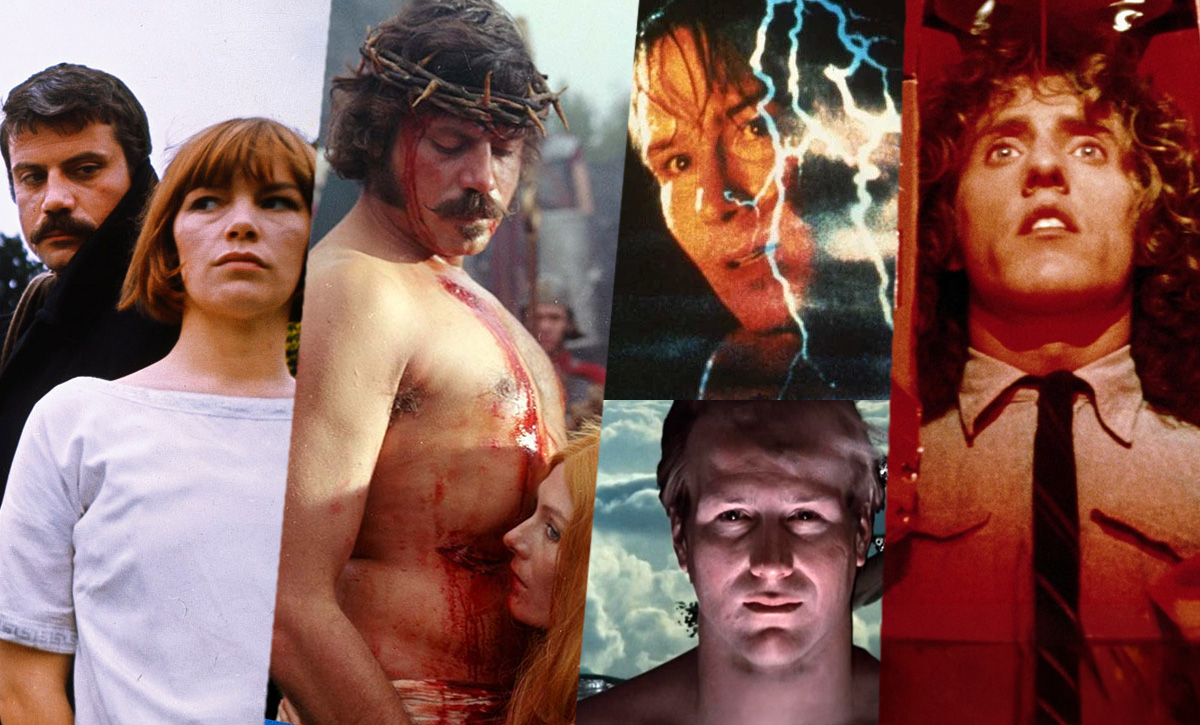
It’s a common misconception to equate British cinema with kitchen sink realism. After all, it’s impossible to discuss its legacy without acknowledging the socially conscious classics of Mike Leigh, Ken Loach, and other filmmakers who attacked authority, questioned the social ills of their time, and rooted their work in everyday life. Not so for Ken Russell.
A rare British filmmaker who matched the flamboyance and excess of the great European masters, Russell could look at Fellini’s illicit carnival of sin and rhapsody and say, “Hold my beer, sir.” Over a remarkable career, he adapted renowned authors, directed for the BBC, worked with legendary rock bands, and made grand, personal epics about historical figures. His work was rarely anything less than perverse. For Russell, prudence was always a dirty word.
Perhaps no film better embodies that spirit than his notorious 1971 masterpiece “The Devils,” a sexually charged indictment of religious hypocrisy and political corruption that became one of cinema’s great censorship battlegrounds. Starring Oliver Reed and Vanessa Redgrave, the film scandalized religious groups, censors, and its own distributor, Warner Bros., which subjected it to extensive cuts. For decades, Russell’s intended version remained effectively locked away, its reputation growing even as audiences struggled to see it. The suppression became almost as legendary as the film itself.
Now, 55 years later, “The Devils” is finally getting the recognition it deserves. Reconstructed under Russell’s supervision in 2004 and newly restored in 4K, the definitive cut premiered at Cannes earlier this year before making the festival rounds, including the New York Film Festival. Now, beginning October 16, it’s finally receiving a proper U.S. theatrical rollout, including select 35mm screenings. For a film Warner Bros. kept locked away for decades, its resurrection is extraordinary, and one of the year’s major cinematic events.
What better occasion to revisit a filmmaker who made a virtue of excess, provocation, and spectacularly bad taste? From the psychedelic terror of “Altered States” to the rock-opera madness of “Tommy,” here are Russell’s essential films, from masterpieces to misfires and everything gloriously unhinged in between.
“The Devils” (1971)
Blasphemy, thy name is “The Devils”! More than half a century after its release, Russell’s towering anti-authoritarian provocation—a spitball in the face of religious and political hypocrisy—remains his most controversial and definitive picture, a major work whose reputation has occasionally threatened to eclipse its actual content. Starring Oliver Reed as the charismatic clergyman Urbain Grandier and Vanessa Redgrave as Sister Jeanne, consumed by carnal obsession, “The Devils” explodes off the screen with sexual frenzy and sacrilegious mania. Depressingly, its indictment of political opportunism and religious hypocrisy feels as urgent as ever. America in 2026 is full of charlatans looking for someone, anyone, to pin blame on. Lensed by David Watkin (“Chariots of Fire,” “Catch-22”) with extraordinary sets by Derek Jarman (a brilliant filmmaker in his own right), “The Devils” returns to North American theaters in a 4K restoration on October 16. Given the film’s notoriously troubled release history and scarcity on physical media, its resurrection is a cause for celebration: an unholy homecoming for one of cinema’s most uncompromising masterpieces. [A]
“Altered States” (1980)
Apart from “Women in Love,” the seminal sci-fi allegory “Altered States” feels like Russell’s closest brush with mainstream Hollywood. With greater resources and prestige than ever, he turned Paddy Chayefsky’s source material into a deeply unnerving exploration of ego, consciousness, and cosmic terror. Fueled by post-Watergate paranoia, the film features William Hurt, Bob Balaban, and a briefly glimpsed Drew Barrymore in her screen debut, predating “E.T.” Despite a starker, more austere style than Russell’s earlier extravaganzas, nobody could mistake “Altered States” for another director’s work. Its hallucinatory tableaux, neurological experimentation, and good old-fashioned sensory deprivation push the human psyche toward terrifying extremes. Watching it feels like staring into the abyss, only to discover something in there staring back. [A-]
“Women in Love” (1969)
A woman’s arms glide across a sun-dappled wheat field. A dandy explains the “proper” way to eat a fig. Two men who may never share their true feelings strip naked and wrestle beside a fireplace. Even before “The Devils” and “Crimes of Passion,” Russell was testing the limits of what audiences would tolerate. His 1969 breakthrough, “Women in Love,” explores love, lust, and emotional power plays against the opulent backdrop of the 1910s Midlands. Russell’s first masterpiece arrived just as the sexual repression of American cinema was boiling over, producing erotically charged landmarks like “Midnight Cowboy,” Arthur Penn’s “Bonnie and Clyde,” and the softcore provocations of Russ Meyer. Seen through that lens, “Women in Love” is a companion to these films: less a literal-minded adaptation of D.H. Lawrence’s novel than an intensely subjective riff on its themes. Its closest contemporary equivalent might be Luca Guadagnino’s queer cinema, right down to the sexualization of fruit. Russell’s hypnotic breakthrough remains one of his essential studies of unbridled passion. [A-]
“Crimes of Passion” (1984)
The ’80s were the decade of the erotic thriller, from Brian De Palma’s scandalous horndog masterpiece “Body Double” to mainstream provocations like “Fatal Attraction” and Bob Rafelson’s “The Postman Always Rings Twice.” But even by those standards, Russell’s “Crimes of Passion” makes its contemporaries look downright sensible. Joyously unsavory and gloriously vulgar, the film features Anthony Perkins as a repressed street preacher who quite literally wields a sex toy as a weapon. Yet beyond its outrageous shocks, “Crimes of Passion” is an indictment of the puritanical fear of sex that gripped Reagan-era America. Kathleen Turner delivers a barn-burning performance as a fashion designer whose nighttime alter ego, China Blue, reveals a double life of uninhibited sexuality. Beneath the lurid exploitation, the film offers a provocative examination of the masks we wear and the absurd social rules that govern desire. In other words, it’s a Ken Russell picture. [A-]
“Tommy” (1975)
What flannel and shaggy hair were to grunge, rock operas were to the classic-rock boom of the ’60s and ’70s. The Who gave the genre two seismic landmarks, “Quadrophenia” and “Tommy,” the latter following an abused boy who grows up to “play a mean pinball” before becoming a sideways messiah figure. If anyone was equipped to adapt such outlandish material, surely it was Ken Russell. Rife with wartime disenchantment, sexual violence, spiritual reinvention, and fringe thinking, “Tommy” seems tailor-made for the director’s extravagance. Yet the resulting film is among his most ambitious, flawed gambits. Part of the album’s magic is its ability to conjure a vivid world through sound alone, leaving listeners to imagine the peaks and valleys of its hero’s journey. Russell’s literal-minded spectacle, by contrast, gets lost in translation. Overstuffed yet strangely undernourished, the film assembles a parade of famous faces—Ann-Margret, Jack Nicholson, and Tina Turner join lead Roger Daltrey—and plenty of thorny Oedipal subtext. It’s undeniably arresting, but curiously lacking in staying power. [B-]