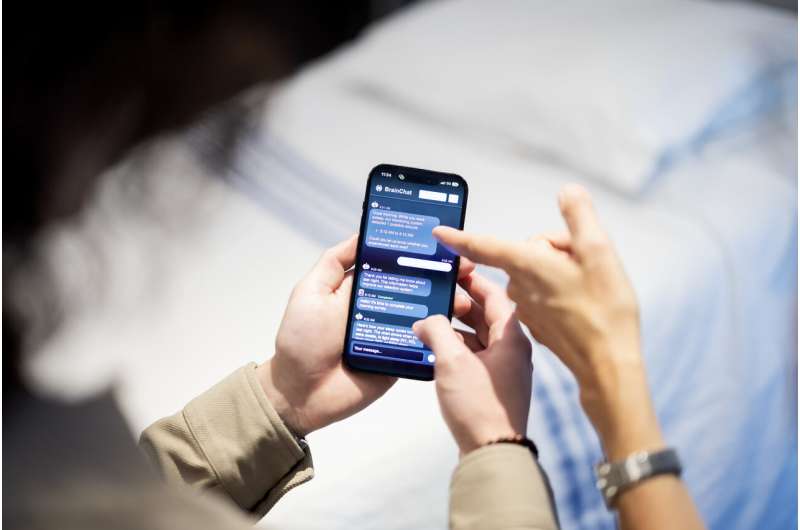
A new AI-driven platform could allow people to interact with their medical devices by sending messages using a smartphone application and receiving feedback in real time. Participants in a proof-of-concept study undergoing monitoring for seizures could ask questions about their brain activity, receive personalized alerts, report symptoms and behaviors and help train the system to better recognize seizure-related patterns.
The platform represents a fundamental shift from today’s medical devices, which largely collect data that is reviewed periodically by clinicians, to systems that actively collaborate with patients to manage their health, according to findings published in Nature Medicine by researchers at the Perelman School of Medicine and the Center for Neuroengineering and Therapeutics (CNT) at the University of Pennsylvania.
“The idea is that instead of waiting for a specialist to analyze the data collected by your device, the device could detect changes and alert you immediately, like your own personal Jiminy Cricket on your shoulder,” said senior author Brian Litt, M.D., a professor of neurology, neurosurgery and bioengineering. “More importantly, both the patient and the device can learn together over time. The device learns what matters to the patient, and the patient learns how their behavior affects their health.”
Turning data into conversations
To test the new model for patient-device communication, researchers enrolled 13 adults undergoing continuous brain monitoring using electroencephalogram (EEG) in Penn’s Epilepsy Monitoring Unit (EMU). These individuals were admitted for monitoring for a number of reasons, including determining the source of their seizures or as part of presurgical evaluation.
The participants tested a platform, constructed by a team of Penn Bioengineering Ph.D. students led by Zack Goldblum, Haoer Shi and Zhongchuan Xu, which consisted of three components:
- Software that continuously captured EEG data from electrodes in the participant’s brain;
- A secure, HIPAA-compliant cloud environment that analyzed incoming information in near real time;
- A smartphone application featuring a Penn-developed, AI-powered conversational agent, similar to the technology used for ChatGPT.
Through an app on their phone, patients could ask questions about their brain activity, request visualizations of trends in their data, report symptoms and receive alerts or surveys throughout the day. Patients could receive information such as text, charts and other visual formats. Similarly, the device could contact the patient when it saw changes that might be of interest to the patient and learn “on the fly” based upon patient responses.
Researchers analyzed 1,307 messages exchanged between patients and the system during the study period. Most interactions involved discussions about seizure events, sleep, mood, energy levels and other factors that can influence seizure activity.
Patients were also surveyed three times daily about sleep, anxiety, mood, well-being and other symptoms. Several participants said the platform helped explain patterns they had previously observed but struggled to understand.
One participant reported that the system helped “solidify what I felt to be true between some of my episodes and emotions.” Others said they valued access to sleep information and the possibility of receiving warnings before major seizures.
Beyond this communication, patients could also teach the system about their condition, noting which seizures the program correctly identified and which were false alarms. This allowed the system to improve its ability to accurately identify seizures. Clinicians could also converse with the system to review the program’s assessments and add their own notations of true seizures and false alarms, further improving its accuracy. This was done via a smart “expert in the loop” algorithm that reduced the need for expert input to high-value annotations.
As systems become more personalized, researchers believe they will require rare clinical supervision, making them practical for long-term outpatient use.
A platform for the next generation of medical devices
Although the study focused on epilepsy, the team believes the platform could have broad applications for conditions that use cardiac devices, insulin pumps and emerging treatments for neuropsychiatric disorders such as Parkinson’s disease, depression, obsessive-compulsive disorder, addiction and cognitive disorders.
In the future, researchers envision systems that can automatically adjust treatment while communicating directly with patients about symptoms and treatment goals. The team is already preparing studies with Lauren Hammer, M.D., Ph.D., an assistant professor of neurology and bioengineering, that will apply the platform to automatically tune deep brain stimulation devices used to treat Parkinson’s disease. Further work is incorporating wearables into applications for insomnia, epilepsy, brain and vital signs monitoring.
“Patients often understand aspects of their disease that sensors cannot measure directly,” Litt said. “Imagine an insulin pump that can answer questions about how a meal will affect blood sugar, or a Parkinson’s device that adjusts treatment based on how a patient feels during a walk or writing a letter. We envision medical devices becoming partners in care that learn alongside patients and help them make better decisions every day.”
Researchers believe this type of two-way communication could fundamentally change the relationship between patients and medical devices. Rather than serving as passive monitoring tools, future devices could continuously combine physiologic signals, patient feedback and AI-driven analysis to deliver more personalized and responsive care.
The work builds on Litt’s broader effort to develop a new generation of brain-computer interfaces capable of sensing physiologic signals, communicating with patients, learning from their responses and adapting treatment in real time.
Ongoing research will evaluate whether the platform can reduce seizure frequency and severity, improve quality of life, decrease emergency department visits and lower health care utilization. Researchers also plan to expand testing into outpatient settings using newer minimally invasive EEG and wearable technologies designed for continuous monitoring during daily life.
Publication details
Human-AI Collaboration for Co-Managing Epilepsy in Real Time, Nature Medicine (2026). DOI: 10.1038/s41591-026-04680-4
Journal information:
Nature Medicine
Clinical categories


Citation:
AI platform allows real-time conversation between patients and their medical devices (2026, October 18)
retrieved 18 October 2026
from https://medicalxpress.com/news/2026-10-ai-platform-real-conversation-patients.html
This document is subject to copyright. Apart from any fair dealing for the purpose of private study or research, no
part may be reproduced without the written permission. The content is provided for information purposes only.