While Tesla is struggling to get FSD approved across Europe, Mercedes-Benz is confident it will be the first to offer point-to-point driving in Germany later this year. This claim is strange unless the German carmaker is certain that Tesla won’t get FSD approved this year as it hoped. Earlier this month, Tesla changed FSD name to Tesla Assisted Driving specifically to appease German authorities.
Tesla has been waging a battle with European regulators to get its Full Self-Driving system approved. However, results have been mixed. The automated driving software did receive approval in the Netherlands earlier this year. Other countries followed, with certification based on RDW’s (the Dutch regulator) tests.
However, a vote for Europe-wide approval for Tesla FSD was postponed several times, with the next relevant meeting scheduled for December. It appears that other country regulators showed little appetite for approving Elon Musk’s driver assistance system. Among key concerns were FSD’s misleading name and the software’s disregard for speed limits.
Tesla engaged in discussions with Germany’s Ministry of Transport (BMV) and agreed to address these issues. It immediately changed the FSD name in Europe to the more benign Tesla Assisted Driving (TAD), and placed a cap on the software’s speed offset at 10% above the posted speed limit. In light of the changes, Federal Transport Minister Steffen Bilger said that he would advocate for TAD approval across Europe “as quickly as possible.”
I would’ve expected that Germany would’ve quickly approved TAD nationwide based on RDW’s certification. After all, Lithuania, Estonia, Denmark, Belgium, Slovenia, Czech Republic, Croatia, and Slovakia did just that. It turns out that Germany, which is the home country of heavyweights like Volkswagen, BMW, and Mercedes-Benz, has no intention of letting Tesla steal the show at home.

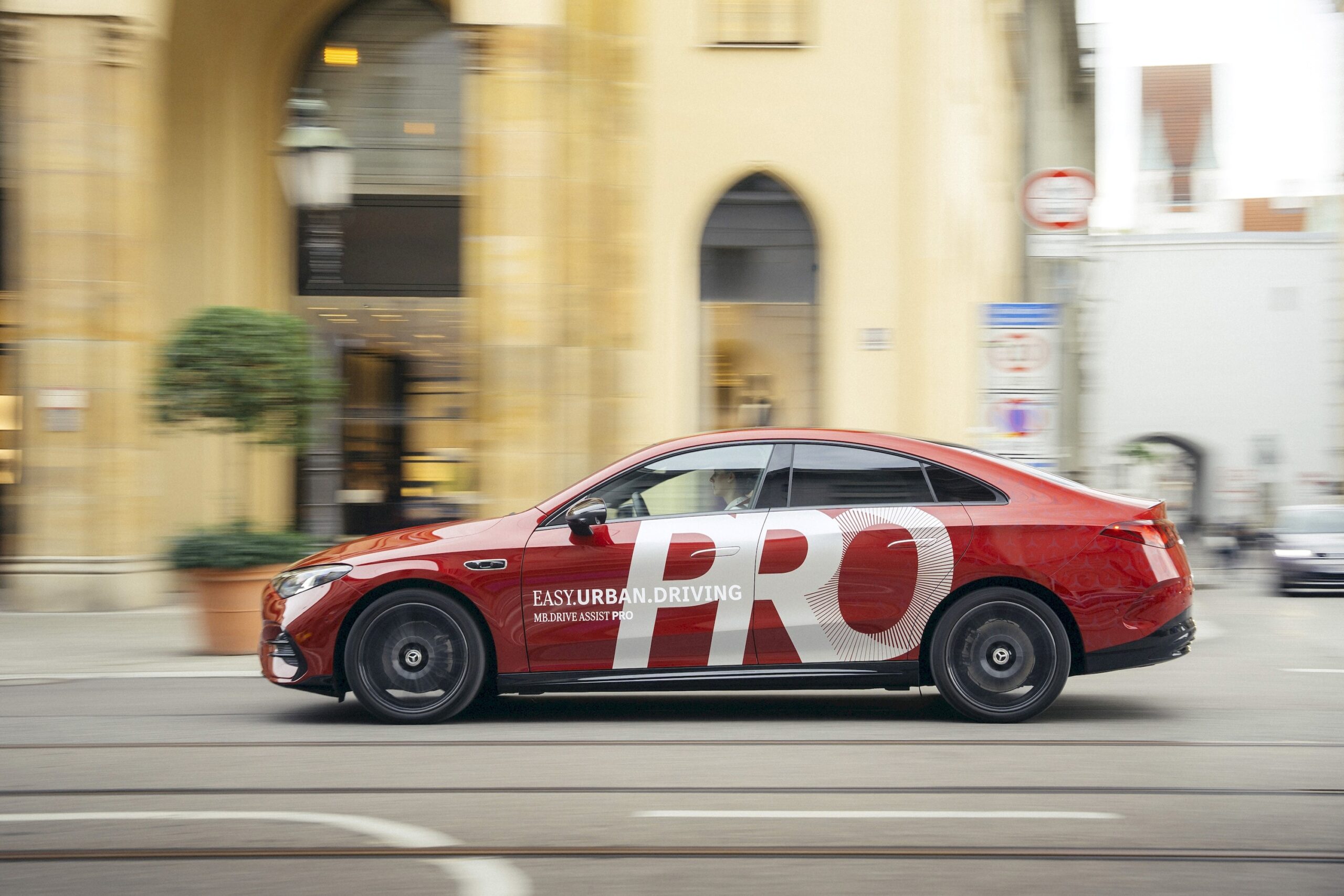
Photo: Mercedes-Benz
This is now crystal clear, as Mercedes-Benz announced that it would be the first to offer point-to-point assisted driving in Germany. The carmaker will start an early access program later this year in Stuttgart and Munich. Regular customers will be able to join from early 2027. Mercedes-Benz says that its MB.Drive Assist Pro has been developed according to the latest UNECE regulations and doesn’t need further regulatory approval.
MB.Drive Assist Pro combines the MB.OS operating system with the Nvidia Hyperion computers and sensors and Alpamayo Stack software to enable automated driving features. Although this should be capable of driving without human intervention, Mercedes-Benz still markets it as an advanced SAE Level-2 system, which requires continuous driver supervision.
MB.Drive Assist Pro was introduced last year on the 2026 Mercedes-Benz CLA EV and quickly expanded to the 2027 GLB, GLC EV, C-Class EV, and other MY2027 models. Developed in partnership with Nvidia, the system is set to power a wide range of Mercedes-Benz’s car and van models. MB.Drive Assist Pro can navigate heavy city traffic, including traffic lights and lane changes under the driver’s supervision.