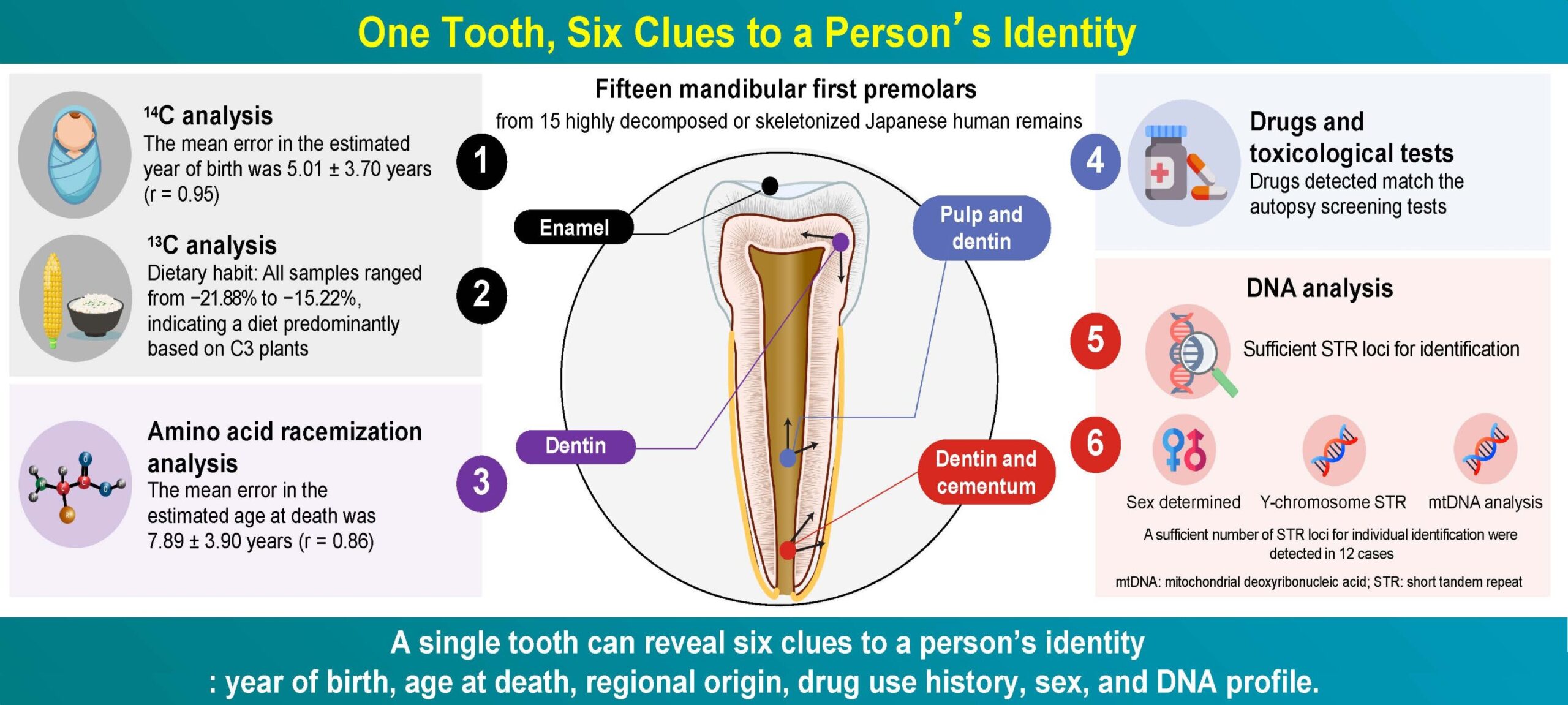
A single tooth can contain valuable clues to a person’s identity, even when remains are severely decomposed or reduced to bones, according to a study by researchers at the Institute of Science Tokyo. By applying multiple forensic methods to different tissues within a single tooth, the researchers obtained six types of information about the deceased. This integrated approach could provide complementary evidence to help identify unknown human remains when conventional methods are difficult to apply.
Identifying human remains can be challenging when a body is severely decomposed or reduced to just a skeleton, as evidence used in conventional identification may no longer be available. In such cases, bones and teeth have been the samples of choice for identification of the deceased. Although bones can provide valuable forensic information, certain analyses may be affected by environmental exposure and postmortem changes. In contrast, teeth contain enamel, the hardest tissue in the human body, which is highly resistant to decomposition and can preserve biological and chemical information over long periods.
Previous research by a Dutch forensic research group demonstrated that multiple types of forensic information could be obtained through a multidisciplinary analysis of teeth and toenails. Building on this approach, the present study investigated whether six types of forensic information could be obtained from a single tooth, even in cases involving severely decomposed or skeletonized human remains.
Six clues from a single tooth
Extending previous research to challenging forensic cases involving advanced postmortem changes, a study led by associate professor Hisako Saitoh and doctoral student Sayaka Yamada of the Department of Forensic Dentistry at the Graduate School of Medical and Dental Sciences, Institute of Science Tokyo (Science Tokyo), Japan, along with professor Fuyuki Tokanai of the Center for Accelerator Mass Spectrometry at Yamagata University, explored the range of information that a single tooth could provide.
Using mandibular first premolars from 15 deceased individuals, including severely decomposed and skeletonized remains, the researchers demonstrated that six types of complementary forensic information could be obtained from a single tooth: birth year, age at death, dietary patterns and potential geographic origin, drug exposure, biological sex, and DNA profile. Their findings were published in the journal Scientific Reports on Aug. 19, 2026.
“Different tissues within a tooth preserve different forensic information. By combining multiple analytical methods, we sought to obtain as many clues as possible from a single tooth,” explains Saitoh.
Enamel and dentin reveal age and diet
Each single tooth was sliced into several sections, and each section was used for a different analysis. The researchers analyzed enamel, the hard outer layer of the tooth, to estimate birth year using radiocarbon analysis. Radiocarbon analysis of tooth enamel yielded estimated birth years that included the actual birth year in 14 of the 15 cases.
They also analyzed stable carbon isotopes, different forms of carbon that leave characteristic signatures in the body, to provide clues about dietary patterns and possible geographic background. The results were consistent with diets predominantly based on C3 plants, such as rice and wheat, and did not contradict the individuals’ known background information.
To estimate age at the time of death, the team examined dentin, the tissue beneath the enamel, using amino acid racemization. This technique measures gradual changes in amino acids over time. The estimated age at death showed a mean error of −5.82 ± 6.87 years (mean absolute error (MAE) = 7.93, r = 0.86), with a strong correlation with the actual age.
By combining estimates from this method with radiocarbon-based birth-year estimates, the researchers were able to narrow down possible birth years. Consequently, the mean error of birth-year estimates showed 0.57 ± 6.36 years (MAE = 5.01, r = 0.95).
Drug traces and DNA profiles
The team also conducted toxicological analyses to detect drugs and other substances in dental tissues. Drugs and other substances were detected in all 15 tooth samples, with some findings consistent with conventional postmortem toxicological screening results and known medication histories. However, not all substances detected through conventional methods were identified in the dental samples. Nevertheless, these findings demonstrate the potential of teeth as a source for toxicological analysis, which has traditionally been challenging to perform using hard tissues.
For DNA analysis, the researchers used dentin and cementum. They analyzed autosomal short tandem repeats (STRs), DNA regions that vary between individuals and help distinguish one person from another. They also examined mitochondrial DNA, which provided information about the maternal line, and Y-chromosome STRs, which provided information about the paternal line. DNA analysis successfully determined biological sex in all 15 cases, while 12 of the 15 teeth yielded sufficient autosomal STR profiles for individual identification.
Toward routine forensic use
The findings highlight the potential of combining multiple forensic analyses of a single tooth to obtain complementary clues about an unidentified person. This approach could be particularly useful in cases involving severely decomposed bodies or skeletal remains, such as those encountered in disaster victim identification and criminal investigations, where biological samples may be limited or difficult to analyze. The ability to obtain multiple types of forensic information from a single tooth may help preserve limited biological evidence while providing investigators with additional clues for identifying unknown individuals.
“Moving forward, we aim to further improve the accuracy and reproducibility of each biochemical analytical method demonstrated in this study and establish standardized methods that can be widely applied in routine forensic medical and dental practice,” notes Saitoh.
Publication details
Sayaka Yamada et al., Multiple forensic insights for human identification using single teeth with applicability to advanced postmortem remains, Scientific Reports (2026). DOI: 10.1038/s41598-026-62088-z
Journal information:
Scientific Reports
Key medical concepts
Clinical categories


Citation:
One tooth, six clues: How a single tooth can help in identifying deceased persons (2026, October 21)
retrieved 22 October 2026
from https://medicalxpress.com/news/2026-10-tooth-clues-deceased-persons.html
This document is subject to copyright. Apart from any fair dealing for the purpose of private study or research, no
part may be reproduced without the written permission. The content is provided for information purposes only.