Two people infected with the same strain of COVID-19 can have vastly different experiences. One might never even sniffle, and the other might end up on a ventilator. But why?
Since the start of the COVID-19 pandemic, researchers have been trying to figure out why someone develops a mild or severe case. One way to do that is by looking at T cells, which are white blood cells that mount an immune response—and specifically CD8+ T cells, “killer” T cells that have been shown to effectively fight back against COVID-19 infections.
But most studies examining what leads to different COVID-19 immune responses have not taken differences between individual immune systems into consideration.
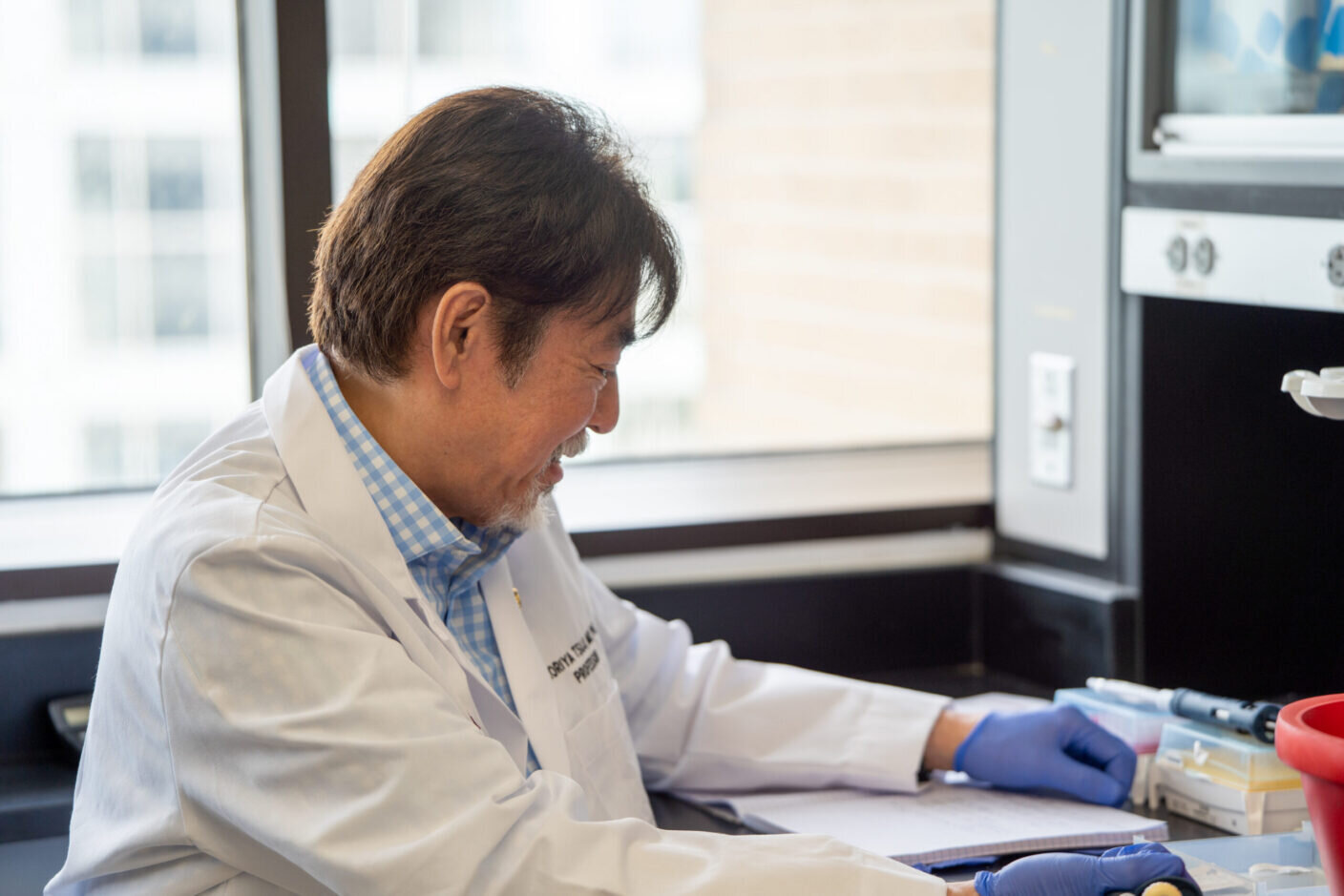
Moriya Tsuji, a professor at the Texas A&M University School of Engineering Medicine, said one important factor is a group of genes called human leukocyte antigens (HLAs). These genes help determine how the immune system recognizes pieces of a virus and activates T cells, and different people carry different HLA types.
Understanding what causes differences in immune responses can guide treatment for people with COVID infections and lead to vaccines that spur long-lasting, durable responses.
Comparing apples to apples
Tsuji wanted to make direct comparisons of SARS-CoV-2 cellular responses in patients with the same HLA restrictions.
“It’s like comparing oranges and apples. I wanted to compare a green apple to a red apple,” he said.
To do that, he and researchers from the Columbia University Vagelos College of Physicians and Surgeons and the Federal University of Minas Gerais in Brazil looked at blood samples from 42 patients who were all HLA-A2-positive. These samples were taken in 2020, before any COVID-19 vaccines were available.
They then analyzed 8,402 SARS-CoV-2-reactive T cells produced by those patients’ immune systems and found that people with mild disease had more CD8+ T cells. These cells mounted a strong, multipronged response to attack COVID-19, and this response lasted for up to four months.
In patients with severe disease, however, researchers found dysfunctional T-cell types, almost as if the patients’ immune systems had raised a white flag.
It is also important to note that many of the parts of the virus recognized by CD8+ T cells stay largely unchanged across different SARS-CoV-2 variants. Many of these targets are found inside the virus rather than on its surface, so they tend to face less pressure to mutate and change than the parts targeted by antibodies.
Tsuji said that doing this kind of study, which was published in iScience, is “laborious,” and that previous researchers studying COVID-19 either looked at antibody protection or, if they looked at T cells, “rushed to study CD8+ T cells from all kinds of patients, having different HLAs. But we really wanted to compare CD8+ T cells from mild versus severe patients and compare them on the same plane,” using a more controlled approach that allowed for a direct comparison.
Opening new lines of vaccine inquiry
Tsuji, who joined the school this year, came to study the SARS-CoV-2 immune response through his lab’s work on developing immune-based strategies to defend against a wide spectrum of diseases, such as malaria, HIV and cancer. Rather than targeting individual viruses or bacteria, his research explores how to activate and enhance key immune cells to build a more resilient and adaptive defense mechanism.
T-cell vaccines, which trigger the body to create protective T cells that can recognize and fight a specific target, could do that. In SARS-CoV-2, for example, people who would normally develop severe COVID because of a naturally poor T-cell response could have that response strengthened by such a vaccine.
T-cell vaccines aren’t new—they are being studied in cancer to boost a T-cell response that either slows or eliminates cancer—but their possible uses are expanding.
The next step in this research is to establish causality rather than simply an association, Tsuji said.
“Demonstrating that these T-cell responses directly contribute to protection will be critical for guiding the development of a next-generation, T-cell-based COVID-19 vaccine,” he said, adding that eliciting a potent CD8+ T-cell response would provide durable protection “no matter how much the virus mutates.”
Publication details
Kazuya Masuda et al, Distinct CD8+ T cell types associated with COVID-19 severity in unvaccinated HLA-A2+ patients, iScience (2026). DOI: 10.1016/j.isci.2026.115880
Journal information:
iScience
Key medical concepts


Citation:
T-cell research reveals paths to better vaccines for COVID-19 and beyond (2026, October 9)
retrieved 9 October 2026
from https://medicalxpress.com/news/2026-10-cell-reveals-paths-vaccines-covid.html
This document is subject to copyright. Apart from any fair dealing for the purpose of private study or research, no
part may be reproduced without the written permission. The content is provided for information purposes only.