Play often rewards us emotionally, with a thrill or a feeling of wonder. A roller coaster ride or a peek through a telescope trained on the cratered moon, so different, both captivating and edgy, yet easily understood as occasions for play. The body responds. The mind travels.
But consider two real or hypothetical events that lurk uncomfortably nearby in memory or imagination—a near car crash in our lingering felt-experiences, or terrifying thoughts of extinction-level planetary invasions that Hollywood loads us up with. You know the stories: a soulless hive-mind eyes our green and pleasant lands; an extra-terrestrial vanguard seeds Earth with pods that germinate with malicious, lookalike non-human infiltrators; or an emissary from a galactic police force arrives to put the planet on notice that its hungry warlike nature, its appetite for conquest, will not long be tolerated in this neighborhood of a peaceful galaxy.
We surely have enough real potential catastrophes to worry about in this Halloween season—orbiting nukes that could detonate and fry our power grid, for example, or glacial collapse that would flood coastal cities and stifle the Gulf Stream, or election subversion from power-hungry office-holders.
Yet in this spooky season, we celebrate the macabre as play and laugh in its face. Play is therapy.
Conquering Fear With Play
In the movies, a hero or a heroic coalition or natural defenses or a fundamental change of heart routinely defeat the threats. A grounded pilot steals a fighter jet and explodes a bomb in the intake valves of the mothership; the invading force succumbs to terrestrial microbes; a sobered world puts aside its squabbles to unite against extraplanetary menace. Our homeland may not live happily ever after, but it will live wiser, if sadder and more resolute.
In this season in our neighborhoods, in school classrooms, and at the office, we fight fear with play. We welcome costumed trick-or-treaters on our doorstep—all those Pokémon characters, one-eyed pirates, and haughty princesses appeasable with chocolate. Our kids dress up as heroes or spooks or superheroes or sports-heroes in classroom parties. (Plenty of Supergirls and Josh Allens this year…)
And this year too, so says BuzzFeed, among the witches and ghosts, office parties will welcome improvised Miss Trunchbulls, Taylor Swifts, Ted Lassos, bushy-headed Bob Ross-es with a brush and a palette in hand, or Flo-s from the insurance commercial. Some of these, like a nun in spider-web stockings or an orange-fright-wigged clown in a bulging blue suit and a dragging red tie, may not be quite safe for work.
But Halloween comfortably flirts with the edge of disorder and dismay, as a way of both satirizing everyday obedient humdrum and combatting haunting feelings. At Halloween again, we laugh our fears away.
Looking Backward to a Demon Haunted Era
Our modern, ironic, jokey, playful, immunizing approach to Halloween contrasts sharply with the spiritual view and deep psychological underpinnings of our Puritan founders.
For the theologians among them and for their faithful congregants, the Devil was not a remote occult figure out of medieval pagan (that is to say Catholic) hocus pocus, but a literal present force, a swindler that roamed their “errand” into the wilderness and undermined their City Upon a Hill. I have read enough closely argued 17th-century Puritan sermons that contained paragraphs starting with “fifthly” and “sixthly” to suss how their view was not irrational, not as such, but rather based meticulously in rational argument, however strange and ill-founded their premises.
The Puritan Wilderness
Peering outward, Puritan divines saw that the dark woods at the perimeter of New England settlement was inhabited by Native Americans whose spiritual, animist assumptions were literally devilish. Satan ruled “savage” land as his dominion, literally. Indigenous people were his decoys and instruments of his malice, literally. Among Puritan authorities we may remember Cotton Mather best, because he had a hand in justifying the Salem Witch Trials. “We know not when or how these Indians first became inhabitants of this mighty continent,” he wrote, “yet we may guess that probably the Devil decoyed these miserable savages hither.”
There were no coincidences in the fearful worldview of people who lived on the edge. Who could be trusted? Every deviation, each sin, gave the Devil a foothold and an entryway. Signs of imminent invasion lay everywhere in plain sight; manifest in a destructive storm, for example, in the failure of crops, or in the outbreak of sickness. And infamously, also in the hysterical conversion neurosis (as we moderns would understand it) that teenage girls suffered in the villages around Salem, Massachusetts, in 1792.
The Devil had possessed them, literally. They had been easily tempted and recruited. Their demonic possession posed a contagious risk. Failure to prosecute these crimes zealously invited divine disfavor and punishment of the whole society. And so, in the careful court proceedings that followed, judges marshaled “spectral evidence” and convicted 30. Twenty-five died by hanging, under torture, or from disease in filthy prison cells.
Placing a Foot Inside the Uncanny Valley
Those of us who have taken a ride on a smoothly plunging roller coaster will recall a sense of pleasing vertigo; in these experiences, weightlessness alternates with strong g-forces in wacky, swooping succession. Riders, feeling victorious and bolstered, will typically giggle or guffaw as the cars pull in. But designers of some modern amusements calculate them to scare the pants off us. I have in mind a clattering old ride at Ohio’s Cedar Point called “The Mean Streak” that left passengers so tossed about and battered that none were left smiling.
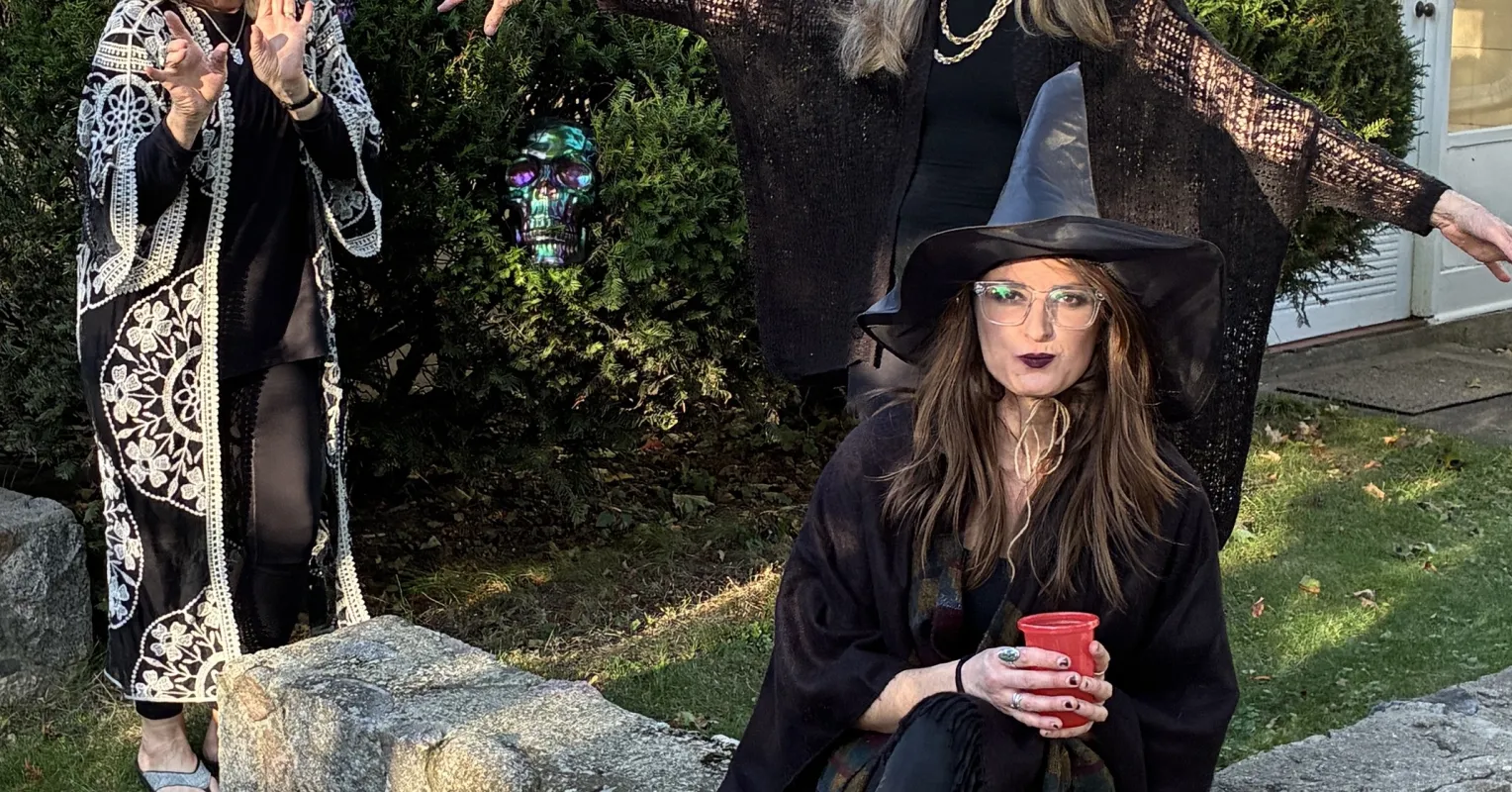
In a similar way most Halloween costumes are scary-cute or silly-scary: witches in pointed hats, their faces powdered green, for instance, a striped Beetlejuice with a goofy painted-on smile, or a vampire nurse-phlebotomist who aspires to comedy. Once at a hip Halloween party I met a woman whose face was framed in a spray of spiky white pillows airbrushed in yellows, oranges, and reds. I wanted to know what she was. “I’m a flaming as*hole,” she said. “Don’t be so hard on yourself, dear,” I replied, helpfully.
Other outfits without a trace of humor strike an opposite note: lurching vacant zombies, soulless mummies, merciless zipper-faced robots, or most unsettling but simpler, translucent but altered plastic masks that blur reality into an expressionless pod-person stare.
These apparitions seem uncanny, standing close to reality but not close enough for comfort. They seem hollow, and therefore deeply unsettling.
On Halloween the border between fun and fright, humor and horror, and teasing and terror becomes porous and occasionally leaky, reverberating with a distant echo of Puritan elemental dread.