
Evernorth’s newly effective public-warrant registration creates a potential $132 million funding route for the XRP treasury company. Whether that money increases XRP per share depends on how much additional XRP accompanies each new economic share. Issuing shares expands the ownership base, so XRP holdings must grow faster than that base for the ratio to improve.
A conditional model using its disclosed closing capitalization and 473 million-token treasury puts the break-even allocation at roughly 70% of gross exercise cash at the October 22 XRP price snapshot of $1.32. That is an illustration of the financing economics, rather than Evernorth’s verified current per-share figure: the actual threshold requires a current reconciliation of ownership, holdings and share changes.
The SEC notice records October 19 effectiveness. Actual exercise receipts and XRP purchases will determine the per-share outcome.
The funding route and its economic owners
The October 19 prospectus covers up to 11,499,992 Class A shares issuable through public warrants with an exercise price of $11.5. Full exercise for cash would generate $132,249,908 before costs. Evernorth receives no additional money when investors subsequently sell those shares.
The warrants’ contractual exercise period began at the October 9 business-combination closing, following an October 5 amendment. Cash exercise also requires an effective, current registration statement and a current prospectus. October 19 effectiveness is therefore distinct from the start of the contractual exercise period.
Management expects any net proceeds to support general corporate purposes and has broad discretion over their use. The filing specifies no mandatory XRP allocation. Exercises are unassured, and a cashless exercise where permitted would not deliver the $11.5 exercise price in cash.
CryptoSlate’s earlier coverage examined the conditions on Evernorth’s closing cash. The warrant route creates another funding possibility, but the same distinction between financing capacity and executed token purchases still matters.
Evernorth defines its primary performance measure as XRP attributable to the public parent, or Pubco, divided by outstanding Class A and Class C shares. Its structure also includes outside ownership in subsidiary Pathfinder Digital Assets. The token count must therefore match the economic ownership represented by the share count.
The prospectus gives a closing basis of 23,638,882 Class A shares and 31,392,746 Class C shares, totaling 55,031,628. It separately identifies 22,953,128 Company Units held outside Pubco that can be exchanged into Class A shares. Those outside units already carry economic interests in the subsidiary.
Simply dividing all consolidated XRP by the publicly traded Class A count would overlook both Class C shares and outside ownership. Adding Pubco-held subsidiary units again would create a different problem by counting the same economic interest twice.
The executed subsidiary agreement describes post-closing asset contributions and generally provides a corresponding unit for either an A or C share, subject to exceptions. Its publicly rendered member schedule does not establish the current unit count. A Class C-to-A conversion also does not create another economic share.
The denominator needs a consistent date. Evernorth corrected its delayed-funding share issuance on October 12 after a clerical error in its closing Form 8-K. The closing filing and later prospectus also give different A/C totals. Those differences cannot simply be added to the later total as new dilution.
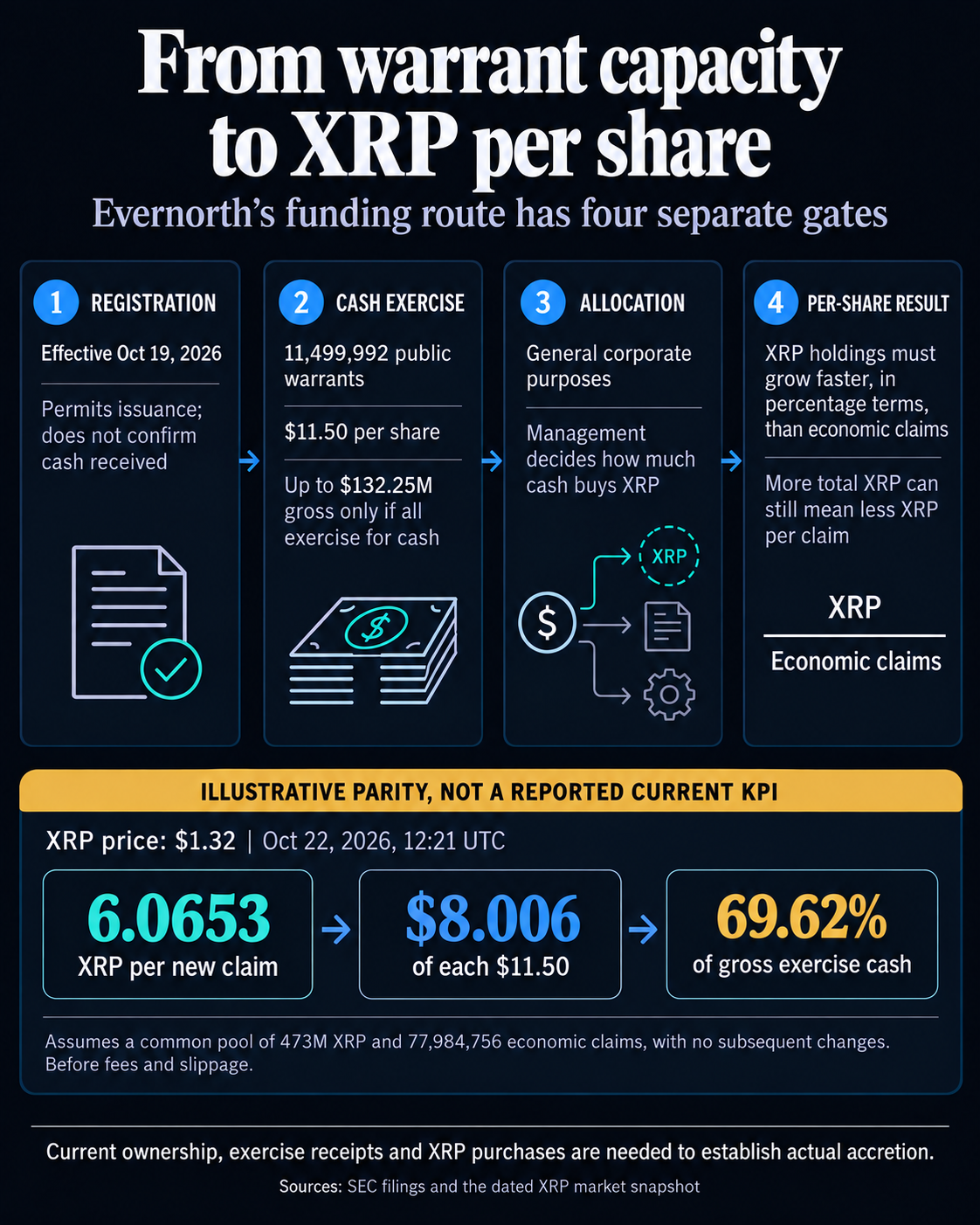
The allocation hurdle at $1.32
Assume the stated 473 million XRP sits in one common economic pool, one subsidiary unit backs each A/C share, the 22,953,128 outside units participate on the same basis, and no later token or capital changes have occurred.
On that basis, 55,031,628 Pubco shares plus 22,953,128 outside units give 77,984,756 economic claims. Dividing 473 million XRP by that total produces approximately 6.07 XRP per claim. An ownership-adjusted Pubco numerator would produce the same ratio under those assumptions; assigning Pubco all the tokens while omitting outside claims would not.
Each additional cash-exercised warrant share needs about 6.07 additional XRP to preserve the modeled ratio, and more to increase it.
XRP market data displayed $1.32 at 12:21 UTC on October 22, alongside a 13.8% decline over 30 days. At that frozen execution price, 6.07 XRP costs about $8.01. That is 69.62% of the $11.5 gross cash received for a new warrant share, before fees and slippage.
At full covered cash exercise, approximately 70 million additional XRP would preserve the model’s starting ratio. The cost would be about $92 million at $1.32; increasing the ratio requires more tokens.
| Full cash-exercise scenario | XRP bought at $1.32, before costs | Result against modeled parity |
|---|---|---|
| 50% of gross proceeds buys XRP | 50 million | Below parity |
| 69.62% buys XRP, approximately | 70 million | Preserves the ratio, approximately |
| 100% buys XRP | 100 million | Above parity |
Every row assumes full covered cash exercise and purchases at the October 22 snapshot price, before costs.
Allocating half the proceeds to XRP would increase the absolute token treasury yet reduce XRP per economic claim in this model. Cash retained for expenses or other uses may still have business value, but it does not count as additional XRP in the token measure.
Spending choices determine the outcome
Evernorth has already described a broader treasury strategy. Its October 14 announcement named Ripple, Kraken, Coinbase and BitGo as partners for intended fourth-quarter strategies involving its stated 473 million XRP treasury. The agreements remained subject to conditions and approvals.
Deploying existing tokens, acquiring additional tokens and generating future yield are different activities. CryptoSlate’s earlier analysis of the per-share strategy identified that measure as central; the warrant route now supplies a specific allocation decision to assess.
The October 19 prospectus and October 14 strategy announcement provide no post-effectiveness public-warrant cash-receipt figure or resulting XRP-purchase total.
A higher token ratio measures accumulation per economic share. Dollar net asset value and the equity price are separate outcomes. Cash, liabilities and the price of XRP also matter to dollar value. A falling XRP price makes a fixed cash sum buy more tokens, but does not by itself increase the number already held per share.
The next decisive disclosure is a matched set of figures: shares and outside units outstanding, XRP attributable to Pubco, cash exercises and net receipts, and additional XRP acquired. Until then, the $132 million headline describes capacity. The allocation and ownership figures determine how much of that capacity can improve the per-share result.