When you think of swashbuckling high adventure, let’s get real—the hero that you think of isn’t Tommy Lee Jones. Rather, you think of his The Fugitive nemesis, Harrison Ford, right? Well, ten years before that movie, Hollywood, aiming to capitalize on the success of Raiders of the Lost Ark, aimed to make a slew of high-adventure movies, and Tommy Lee Jones, who was best known for Coal Miner’s Daughter, got his chance to play a swashbuckling hero in a pirate movie called Nate and Hayes. And—it was written by none other than John Hughes. That’s right—John Hughes of Sixteen Candles and The Breakfast Club wrote a pirate movie. So why haven’t you ever heard of it? Let’s dig into the complicated history of 1983’s Nate and Hayes.
The Era of Raiders of the Lost Ark Clones
In the golden age of Hollywood, swashbucklers were one of the most popular genres, particularly pirate movies, with Errol Flynn, Tyrone Power and others the kings of the genre. Yet, it tapped out sometime in the fifties, but Hollywood tried to make some new ones a few times in the seventies, eighties and nineties. Without exception, they were all major flops, with one of them, Cutthroat Island, even bankrupting a studio. When Disney made Pirates of the Caribbean in 2003, everyone thought they had lost their minds—only for the film to turn into one of the biggest hits of the decade. Nate and Hayes was one of the movies that was considered a textbook example of why pirate movies didn’t work for contemporary audiences, although unlike other contemporary pirate flicks, like the Robert Shaw-led Swashbuckler or the Roman Polanski flop, Pirates, Nate and Hayes was less influenced by Errol Flynn and owed a lot more to Harrison Ford and Steven Spielberg.
You see, in 1981, Raiders of the Lost Ark came out and was such a resounding success that it reverberated through the industry. Every studio wanted their own Raiders of the Lost Ark, and as Spielberg and producer George Lucas had been openly inspired by thirties and forties Saturday matinees, as well as pulp action heroes and old-time stories of high adventure, everyone started to riff on the formula. It started with two TV rip-offs, Tales of the Gold Monkey and Bring ’Em Back Alive, but as it takes longer to make a movie than a TV series, it was only in 1983 that the first Raiders clones hit theaters. There was Tom Selleck—the one-time pick to play Indiana Jones—in High Road to China, while Roger Moore found himself running through jungles in the James Bond movie Octopussy, which was heavily indebted to the film.
Turning the Real Bully Hayes into a Swashbuckling Hero
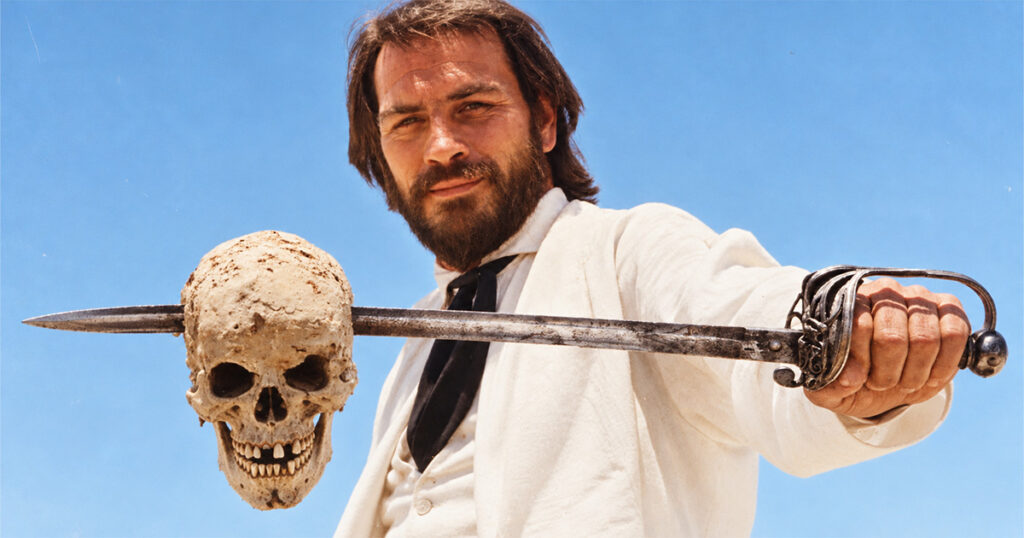
Nate and Hayes came out later in the year. It actually hailed from Paramount Pictures, the studio that produced Raiders, but ironically, that aspect might be what spelt its inevitable doom. It was actually a New Zealand production, with their nascent film industry looking to exploit how exotic the terrain was. To do so, the New Zealand producers looked to history and made an infamous American-born pirate named Bully Hayes the hero. The real-life Bully Hayes was a notorious South Seas pirate, infamous for raping, pillaging, and most notoriously of all, engaging in the practice of “blackbirding,” which was the trade of indentured labourers and—despite it being outlawed—slaves.
Not much of a hero to hang your movie on, right? As such, writers David Odell and John Hughes—yes, THE John Hughes—dropped pretty much all the facts about Bully’s life, other than the fact that he was an American and a pirate. In the movie, he’s a swashbuckling hero who, in the opening moments, states explicitly that he’s never raped or pillaged, and he’s shown to despise blackbirding. This rumor about him is chalked up to the fact that his former partner, Ben Pease, also a pirate, is the actual slave trader, and the one to do all the raping and pillaging—only to leave evidence behind that it was Bully and not him. In the movie, he is an Indiana Jones-like hero. Sure, he’s a bit of a scoundrel, but he has a moral code and is the film’s hero. In the movie, which was directed by British TV journeyman Ferdinand Fairfax, Bully has just delivered a missionary, Nathaniel Williamson (the Nate of the title), and his betrothed, Sophie, to a South Seas island where they are to be missionaries. Sophie, who doesn’t want to be a missionary, secretly loves Hayes, who is too honour-bound to return her affection. Nathaniel is a pious wet blanket, but no sooner are they deposited at their island home than it’s attacked by Pease and his men, who take Sophie as a prisoner they want to sell as a slave, leaving Nathaniel for dead. Yet, he survives and, thinking Hayes is responsible, looks for revenge. Soon, he realizes Bully is innocent, and the two team up to try and save Sophie, whom they both love, from Pease.
Tommy Lee Jones as an Unlikely Action Hero
While atypical casting, Tommy Lee Jones is actually great as Hayes. Wearing his hair long and sporting a beard, those who only know him as an older character actor might be surprised at his youthful, vigorous appearance here. He delivers an energetic performance as the swashbuckling Hayes, with him having plenty of sword fights and hand-to-hand scraps. He’s also funny, delivering a ton of one-liners that seem to have largely been written by Hughes. Jones wasn’t the star he would later become, but was relatively well known, having acted in the seventies hits The Eyes of Laura Mars and The Betsy in heartthrob parts, before co-starring in Coal Miner’s Daughter. It wouldn’t be the only time in the eighties that he nearly became an action star, with him also appearing in the cult action hit Black Moon Rising. Ironically, it was only when he lost his youthful good looks and became more rugged and wan-looking that Hollywood and audiences took notice, with him hitting superstar status in middle age.
His co-star was another actor whom Hollywood was molding as a leading man, Michael O’Keefe, who’d had a major success in Caddyshack. Like Jones, stardom didn’t happen for him, but he became a noted character actor and has worked steadily over a long career. He’s actually quite good as Nate, with him starting off as a total wimp, but then, over the course of the film, becoming tougher and more rugged, with the pirate life seemingly agreeing with him, to the point that when he and Bully finally rescue Sophie, who is played by the lovely Jenny Seagrove, he’s no longer the jerk he once was, and is now a swashbuckling hero who is willing to let her take up with Bully if that’s what makes her happy, only for her to be won over by this new version of Nate, meaning he actually gets the girl in the end. Seagrove is similarly good as the initially naive Sophie, who views Bully as the man who will whisk her away from a dull life, only to take a lot more agency as the film goes on. By the time Nate comes to her rescue, they are equals and seem like they might actually get a well-deserved happily ever after.
The film also has a strong villain in the sordid Ben Pease, as played by Australian Max Phipps, who wanted revenge because, in a duel, Bully accidentally blew his balls off. Oops. The movie also had a good score by Trevor Jones, which is very much in the high-adventure tone of the movie, as well as nice set design, even if the low budget sometimes makes it look a little too much like slightly elevated TV. Nevertheless, though, it’s a pretty solid early-eighties adventure movie, with a TERRIFIC ending where the imprisoned Hayes is rescued by the now-outlaw Sophie and Nate duo, who are like a pirate version of Bonnie and Clyde following their adventures with Bully.
Did Similarities to Indiana Jones Doom Nate and Hayes?
So why, then, did it flop so resoundingly? Here’s where it gets interesting. When the movie was delivered to Paramount, it contained two sequences that were VERY similar to set pieces that featured in their then-upcoming Indiana Jones and the Temple of Doom. This wasn’t a case of one film copying the other; it just worked out that way. Nate and Hayes opens with a scene where Hayes escapes by cutting a rope bridge, which is exactly like one of the classic moments in Temple of Doom, and a stunt they were going to use in all the marketing they had planned out. It also has a scene where the heroine is slowly lowered into a fiery pit and has to be saved by the heroes, which also happens to Willie Scott in Temple of Doom. Perhaps not wanting to upset Spielberg and Lucas by giving too much of a buildup to a movie with such strong similarities to their own, Nate and Hayes was only given a cursory release, where it made $1.9 million. It was such a non-event that it was actually retitled overseas as Savage Islands. It did, however, pick up a bit of a cult following once it hit video and cable, and it aired regularly throughout the decade. It would eventually get a DVD and Blu-ray release thanks to Tommy Lee Jones’ later notoriety. While not a great movie by any means, it’s a fun eighties flick and well worth checking out if—like me—you’ve exhausted your supply of prime eighties action and need to dip into the deeper catalogue.
The post Nate and Hayes: Tommy Lee Jones is an Indiana Jones-style hero in this lost 80s gem appeared first on JoBlo.