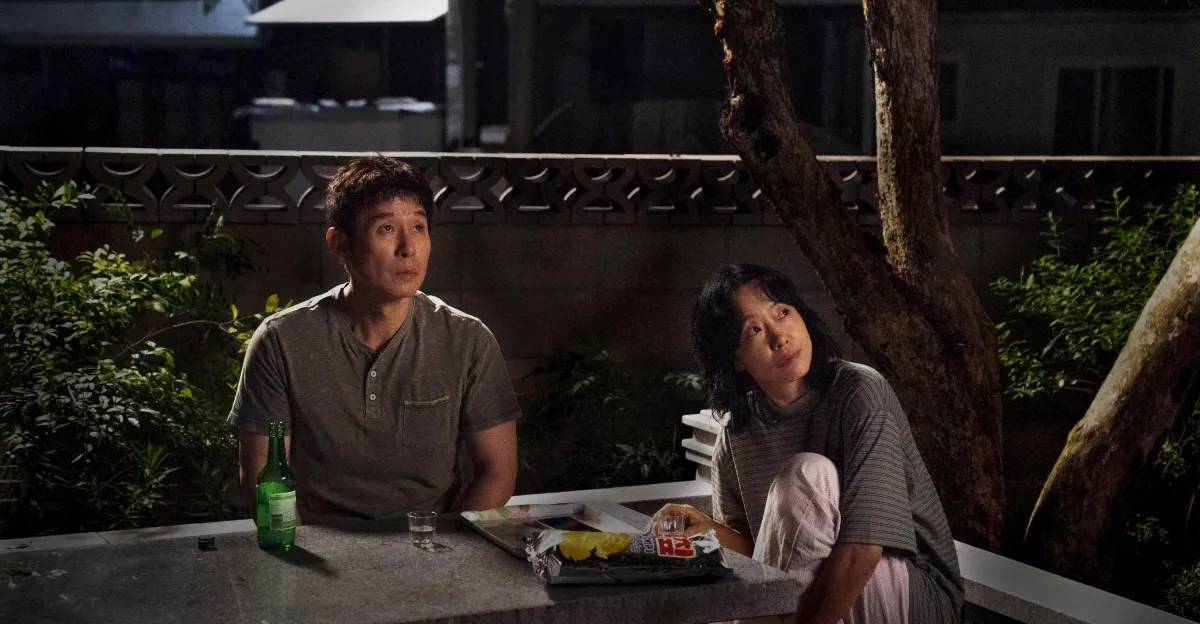
Lee Chang Dong’s seventh feature film, Possible Love, is inspired by true events from 2009, when a Korean conglomerate fired a third of its staff – 2,600 employees – after which many died by suicide. Possible Love is the latest in a long line of Lee movies that engage with themes of class or labor or religion or compressed modernity, that uniquely Korean affliction, without feeling didactic.
A different kind of movie would have captured the heat of that labor struggle. Possible Love picks up with the characters in the aftermath, a murkier time that defies easy understanding. The film opens with an epigraph: “Thou shall not covet.” What follows is a movie about characters who covet. They covet each other’s job, designer clothes, spouses, and positionality. Mi-ok (Jeon Do-Yeon) is the long-suffering wife of Ho-seok (Sul Kyung-gu), her laid-off husband. At a funeral of a colleague who died by suicide, Mi-ok and Ho-seok meet another couple, documentary filmmaker Ye-ji (Cho Yeo-jeong) and her rich husband, Sang-woo (Zo In-sung). And off we go.
The Verge spoke with Lee during his trip to New York about how he arrived at his politics, porousness between people, the properties of the camera, and what it is like to work with Netflix. The interview was conducted in Korean and translated into English.
I am also from Daegu. I wonder how this fact shaped you? And more broadly, to whom or what do you owe your political education?
As you know well, Daegu is referred to as the heartland of conservatism in Korea. I went to school there, all the way through university, so I grew up steeped in that conservative disposition and was influenced by it. But until I graduated from college, in the spring of 1980, I didn’t realize how politically conservative Daegu citizens were.
That spring, in May of 1980, I participated in protests against the Chun Doo-hwan regime as a university student. It was on the streets that I met them, the citizens, and experienced their hardline sentiments in a visceral way. It was shocking to me. Afterwards, I thought a lot about how come the people in Daegu were so politically conservative. In light of all that, the thoughts of a person I perceive as myself, that person’s attitude towards the world, could only be bound with a certain kind of tension.
I was interested in how different directors respond to similar social forces in different ways – like Bong Joon Ho’s Parasite and Park Chan Wook’s No Other Choice. I imagine you know them both personally. What is the conversation between you all when working on your various projects?
We do know each other personally, but we seldom talk about our work. It might be the result of coincidence. Though of course, there might be a certain inevitability hidden within them. We lived through the same modern Korean history, and you cannot call that coincidence.
One thing does come to mind. A long time ago, I think before he made Mother, Bong Joon Ho told me over drinks that he had almost finished writing a script and wanted to show it to me. It was a story about a mother, and he was wrestling with how he could portray that person’s pain, whether he even had the right to. He said he wanted to show me the script. But once he sobered up, maybe he forgot, because he never showed it to me. Later, when I saw the film, I felt I might understand what he had been talking about.
Possible Love is concerned with similar questions: How can I portray another person’s story, another person’s pain? What position am I in? How much distance should I keep from them? You could say that these questions around the ethics of the camera are connected to the worry Bong Joon Ho had back then.
Like Ye-ji, I come from the so-called margins, and now report on that terrain, which is perhaps why watching her character pursue a near-vampiric level of access, I felt something close to repulsion. How were you able to represent the filmmaker–participant dynamic so accurately?
I can’t say how accurate it is. I don’t think Ye-ji’s attitude can be generalized. Not every documentary filmmaker has a rich husband. Nevertheless you can say Ye-Ji captures something universal about filmmakers, or those who deal in other people’s stories, directors such as myself, or reporters, in that they aren’t exactly the people they portray. Even if they came from a lower class, they are no longer of it. Their position in life has changed. And yet, in order to do their work, what do they do? When someone else’s suffering unfolds dramatically in front of them, are they to capture the moment on tape, or should they step away from the camera? Or maybe it isn’t unfolding dramatically in front of them, in which case, do they create a certain effect by producing the moment, by staging it?

I think those are basically properties of the camera. The moment you hold a camera you have power, and the camera operates according to that power.
It’s not so much that I portrayed it so precisely, but these properties of the camera are something worth thinking through together.
For us filmmakers, we don’t belong to the world of our subjects, nor are we on the side of capital either. We are in the middle where we are, it can be said, in a neutral, or perhaps cowardly position. Despite that, those who make movies, those who tell stories of others, in the end, can, through their efforts, bring about some small change.
In this film, Ho-seok ends up pouring out what’s inside of him in front of the camera, which functions as a kind of treatment, even if that isn’t what Ye-ji intended.
Possible Love is a collaboration between you and screenwriter Oh Jung-mi. How did you two come to work together, and what does that collaboration look like?
She is a student I met at Korea National University of Arts. You could say it’s a school that draws the most talented and ambitious students, and she was special even among them. By special I mean she was creative and wrote well, of course, but she also has a perspective, and the ability to take a step back and regard something, and find meaning in things.
As I get older, I grow duller and numb, and set in my ways, and she is a friend who reliably jolts me out of it, which is very precious to me.
I think I’m lucky. Not just with Oh Jung-mi but everyone around me that I work with is very precious to me, and I feel lucky to have met them.
The problem with Oh Jung-mi, though, is that while working together, I kept scrapping projects. So she suffered. But she never left. She stayed beside me, and even though she herself is someone who makes and develops films, she has given me a lot of help up to now.
Ye-ji documents in service of higher purpose. Mi-ok’s character snaps photos of the table spread for no purpose at all. The footage from the helicopter captures a moment of police brutality. How does the function of cinema compare to all the other instances in which we hit record?
Ye-ji has a desire to capture in her camera vanishing laborers [and] the value of their labor — not unlike her dry cleaner father. And yet, it is undeniable that she also regards their lives as source material for her own movie. As narrative filmmakers, stories of others in pain often is nothing but material for a commercial movie.
As for Mi-ok, she knows about the properties of the camera, but she, too, has a desire: to broadcast her pain, and her problems. She has a secondary desire, which is that she wonders if her husband’s traumas may not be healed through the camera, because she believes that his biggest issue is keeping all his problems, his despair and his anger, hidden.
So each has their own desires regarding the camera.
As a filmmaker, firstly, I had the goal of conveying the contents of the documentary Ye-ji was making, of capturing the sufferings of the laid-off laborers. I believed what Ye-ji tried to show, I had to show through my own film.
The group therapy session scene, for example, could be very long and tedious, and for some viewers it might be something that they cannot emotionally relate to, because they came to see a narrative film, not documentary. Despite that, I felt I had to convey it.
Regarding the crackdown scene, some of it appears through archival footage shot from a distance. But as someone making a fiction film, I also have a responsibility to convey Ho-seok’s subjective memory cinematically. So you could say within the narrative structure of Ye-ji’s documentary, multiple layers of roles and goals co-exist.
What are some notes you received from your American movie executives that felt unique to working in the American system versus Korean?
I didn’t feel that at all. From pre-production through post-production, Netflix, as the investor, never once interfered or offered unsolicited notes. Of course, I can’t generalize from that. I haven’t asked everyone else. But I had none of that. In that sense they absolutely guaranteed my independence and freedom as a director.
Now the film is finished and we are promoting it, and in particular part of what we call the Oscar campaign. I probably wouldn’t have gotten this kind of help without Netflix, that’s clear.
Possible Love was released in select US theaters October 23rd and will be available on Netflix globally on November 6th.