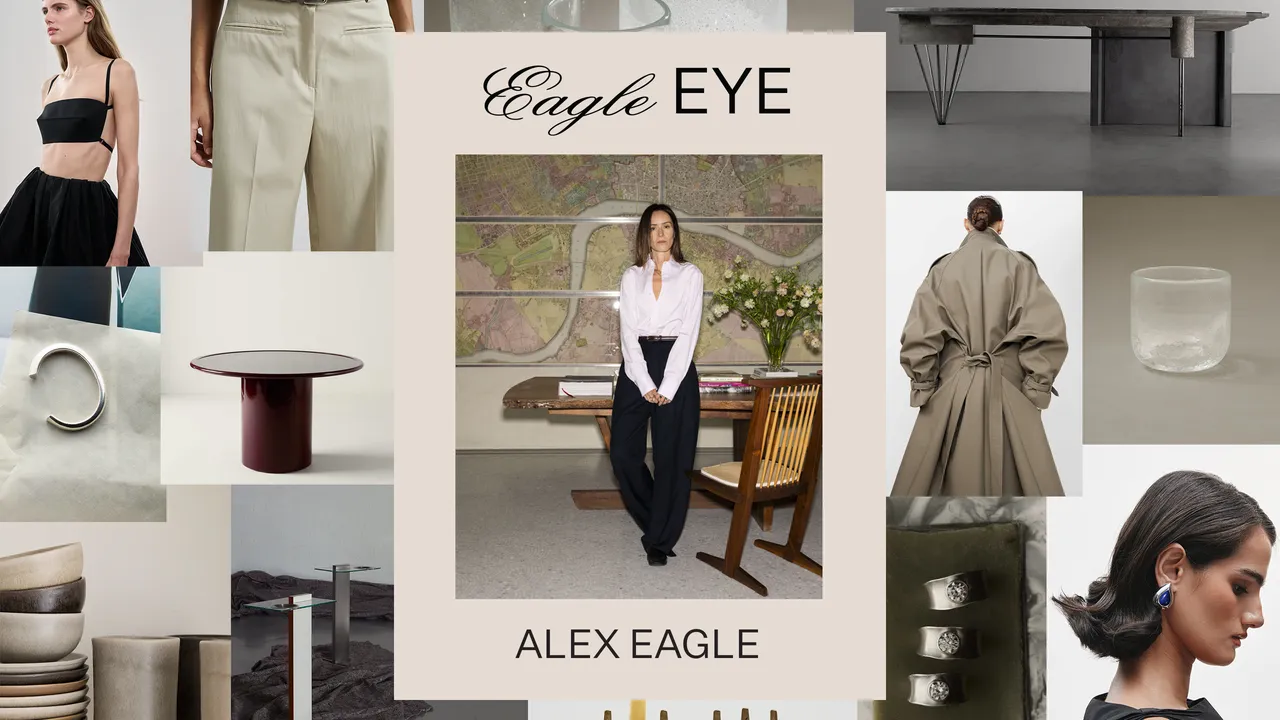
Eagle Eye exists to explain the gaps—between how we dress and how we live; between the spaces you’re drawn to and the coat you keep reaching for. Each month, London-based designer and creative director Alex Eagle will tap her roster of friends and experts to explore the “why” behind a certain theme—why we’re drawn to certain things, and how those instincts quietly form over years without us really noticing. It’s a column rooted in interior design, with many branches (and, of course, a curated edit of shoppable products to boot).
For more fashion-meets-home inspiration and Alex’s favorite finds of the moment, head to her digital storefront, powered by VETTE.
Taking its name from “béton brut” (French for “raw concrete”), brutalism evolved from the broader modernist philosophy, rising in influence with postwar cities built for a new world. Originally, it was an architectural ethos focused on functionality and honest materials. Today, it’s often read as severe—but this overlooks how much brightness and space these buildings typically hold. Take the Barbican in London, for example. It was built as a utopian dream, and that’s what I love about it—it’s full of light and softness; the exterior coldness is only temporary.
There’s a rawness to the style, but also an integrity and a confidence. Gallerist Max Radford thinks it feels particularly relevant right now because it’s a return to simplicity in a time of uncertainty: “I think the optimism of a new world that the original movement was imbued in ties into this—it’s about looking forward in a positive way through an aesthetic.” Andrew Taylor-Parr, the image director for Comme des Garçons (who actually lives in the Barbican), notices the appeal of raw materials and strong form against the modern backdrop of visual noise and commercial polish. “I think people appreciate it more now, across interiors, furniture, and fashion,” he adds. Furniture designer and writer Amelia Stevens sees it as a response to increased sustainability efforts, too: “As we become more conscious of accumulating only that which will stand the test of time, brutalism offers an answer without compromising chicness.”
The subject sits close to home. The original 180 The Strand, Sir Frederick Gibberd’s 1970s brutalist landmark, stands next door to our studio here in London and shapes my work with Eagle + Hodges: We try to focus on material shown as-is, with nothing disguised. I spoke with Radford, Taylor-Parr, and Stevens to dig deeper into the style and its key tenets—fully embodied, the ethics of brutalism can go beyond architecture to apply to the way you live, the things you choose to have around you, and the way you put things together. There’s something very strong about that sense of simplicity and purpose.
Concrete, Reinterpreted
Concrete is one of the first things I think of when I hear the word brutalism. It’s best when it is imperfect, and although people think of it as this very industrial material, there’s depth to it. I’m taking an abstract interpretation here, looking closer at the individual components of concrete to translate it into fashion: a surface that shows how it was made, texture left unfinished, some weight. Try a cashmere jumper, with a knitted slub texture that gives it an unfinished feel, or a stripped-back trench coat, whose rigid structure contrasts with a soft cotton fabric.
“I think the appeal of concrete is the way it takes on the material qualities of whatever it is cast against. Often, you can see the imprint of the material in which it was cast—it can resemble marble or stone, or the rough knots and seams of wooden planks,” explains Stevens. She points to Martin Laforet’s works as examples of concrete’s versatility. For a smaller touch, Serax’s round stool is an understated way to bring a bit of the material home.