Finding a premium muscle cruiser that genuinely delivers on performance without sacrificing everyday comfort is harder than it sounds. American manufacturers have largely retreated to familiar territory — proven engines, proven frames, proven price points — leaving riders who want something more with fewer options than ever. Harley-Davidson’s Softail lineup continues to cycle through familiar nameplates, with the brand focused on cost management rather than chasing new performance benchmarks. Even the most potent Softail, the Low Rider S, barely clears the 120-horsepower threshold. Indian tells a similar story. So if you’re shopping for a proper muscle cruiser in 2026 — one that pairs genuine firepower with long-haul comfort — you’ll want to look across the Atlantic.
Why Europe Leads The Way In Performance Cruisers

As we said, American bikemakers follow a well-worn recipe for cruisers — one they’ve refined over a century in business. It typically calls for an air-cooled V-twin engine in a steel chassis with simple suspension. Those choices come with inherent limitations, most of which cap performance. Air-cooled V-twin engines can only be pushed so far before reliability suffers, and steel frames carry a meaningful weight penalty compared to aluminum alternatives.
American Cruisers Barely Breach The 100-Horsepower Mark
American cruisers rarely promise impressive horsepower and torque together. Harley’s most powerful offering is the Sportster S, with its liquid-cooled Revolution Max engine. While you do get 121 horsepower, it doesn’t come anywhere near the 100 pound-feet mark. On the flipside, most of its traditional cruisers with large-capacity air-cooled V-twins hover below the 100-horsepower mark while promising 120 pound-feet of torque. Only the Low Rider S has well over 100 horsepower and 120 pound-feet in H-D’s lineup, and that is after the brand’s recent overhaul of its Milwaukee-Eight 117 engine.
The Average Performance For Premium European Cruisers Is Way Higher

This is where European cruisers come in. Not only do they feature different engine layouts, but they also borrow sports bike-derived hardware to keep curb weight in check. Engine tolerances and technology are more advanced as well, yet service intervals remain generous. The Ducati Diavel lineup — Diavel V4, XDiavel V4, Diavel V4 RS — is a prime example of this. They produce over 165 horsepower and close to 95 pound-feet of torque. But when you factor in torque, stability, and comfort together, one cruiser rises above the Ducatis.
The Triumph Rocket 3 GT Has Torque, Stability, And Comfort In Heaps

We’re talking about the Triumph Rocket 3 GT. The GT designation brings a suite of touring-ready features for added comfort, including a backrest, forward-set footpegs, swept-back handlebars, and a windscreen. Stability is handled by high-quality Showa underpinnings, anchored by beefy USD forks working in concert with a distinctive aluminum chassis.
Then there’s the engine — a near-2,500cc inline-triple that produces 166 pound-feet of torque, the highest figure in the cruiser segment by a considerable margin. That’s a whopping 77 pound-feet more than the Diavel V4 RS, and roughly 40 pound-feet more than a typical Harley-Davidson Softail. That combination of torque, chassis refinement, and touring comfort is exactly why the Rocket 3 GT is the obvious choice here.
The World’s Largest Production Motorcycle Engine Brings The Firepower
Diving deeper into the Rocket 3, its engine is easily the standout feature. The mill is remarkable for several reasons, chief among them being its sheer displacement. With 2,458cc on tap — courtesy of a 110.2 mm bore and 85.9 mm stroke — this is the world’s largest production motorcycle engine. It has held that title for some time, and no rival has come close to unseating it (even the over-$100,000 CVO Road Glide RR displaced roughly 300cc less).
Over 175 Horsepower And 160 Pound-Feet At Your Disposal
All that displacement, combined with a compression ratio of 10.8:1, yields 179.5 horsepower and 166 pound-feet of torque. The power output ranks among the highest ever seen in a production cruiser, while the torque figure is the highest of any production motorcycle — eclipsing even some compact cars like the Honda HR-V.
|
Engine |
Power |
Torque |
Transmission |
Claimed efficiency |
|
2,458cc, triple-cylinder |
180 horsepower at 7,000 RPM |
166 pound-feet at 4,000 RPM |
Six-speed |
~35 miles per gallon |
The Rocket 3 Will Take You To Over 140 Miles Per Hour
Power reaches the rear wheel through a shaft-driven six-speed transmission — a low-maintenance setup that has a clear advantage over chain or belt final drives. The service interval sits at 10,000 miles, twice that of Harley-Davidson Softails. Pin the throttle and the six-speed gearbox will carry you past 140 miles per hour without breaking a sweat.
A Unique Chassis To House The Unique Engine
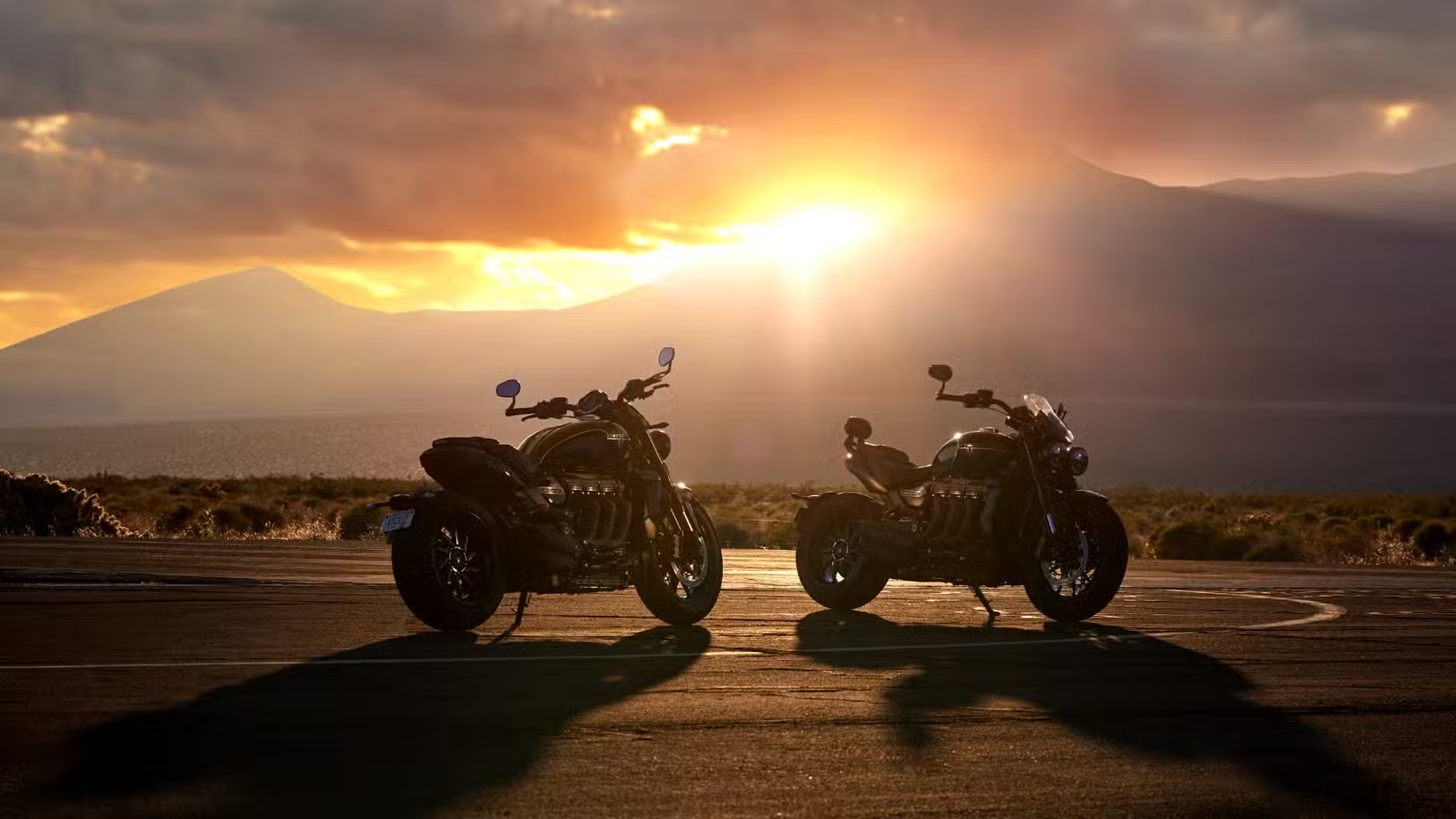
The steel double-cradle chassis is the norm in the cruiser segment, but with such an unconventional engine, Triumph engineered a purpose-built frame. It’s an aluminum unit that uses the engine as a stressed member, paired with Showa suspension comprising 47 mm USD forks and an RSU monoshock.
Compression and rebound damping adjustment is available up front, while the rear offers hydraulic preload adjustment. The bike rolls on 17/16-inch aluminum wheels, with two 320 mm front discs gripped by Brembo Stylema calipers, and a single 300 mm rear disc with an M4.32 caliper.
Heavy Usage Of Aluminum Ensures A Sub-700-Pound Curb Weight

Aluminum appears throughout the rest of the bike as well. The single-sided swingarm, subframe, and wheels are all machined from the same material, contributing to a wet curb weight of just under 700 pounds. That may sound substantial, but it’s comparable to the heavyweights from Harley and Indian — meaning the Rocket 3 GT offers a significantly better power-to-weight ratio.
Laidback Ergonomics Ensure Comfort
On the comfort front, the Rocket 3 Storm GT puts you in a relaxed, natural riding position. The seat is thick and set low at 29.5 inches, while the handlebars sweep rearward toward the rider. Compared to the Rocket 3 Storm R, you also gain forward-set footpegs, a pillion backrest, and a windscreen. Additional seat options are available through Triumph’s accessories catalog for riders who want even more cushioning on long hauls.
Superbike-Level Electronics Help Handle The Performance

With nearly 180 horsepower on tap, a sophisticated electronics package is essential. A six-axis IMU enables cornering ABS, cornering traction control, and dedicated wheelie control, all complemented by selectable throttle maps and ride modes. Convenience features include cruise control, all-LED lighting, hill hold control, and a USB charging port. Heated grips and a quickshifter are available as accessories — items that, at this price point, arguably should come standard.
The Rocket 3 Storm GT Costs Over $27,000
On the subject of price, the Rocket 3 Storm GT carries an MSRP that starts above $27,000, with the figure climbing further if you opt for special editions such as the Evel Knievel collection. That is undeniably steep by cruiser standards — higher than every Harley-Davidson Softail at base pricing. However, Harley’s own prices escalate quickly once you factor in color choices and trim levels. The Low Rider ST, for example, can exceed $26,000 in certain configurations. Given the Rocket 3 GT’s performance credentials and equipment level, the asking price looks increasingly reasonable. The value proposition strengthens further when you compare it against the Ducati Diavel V4 — which offers less performance and comfort for more money — or the Buell Super Cruiser, which has yet to reach dealers in meaningful numbers.
Source: Triumph Motorcycles