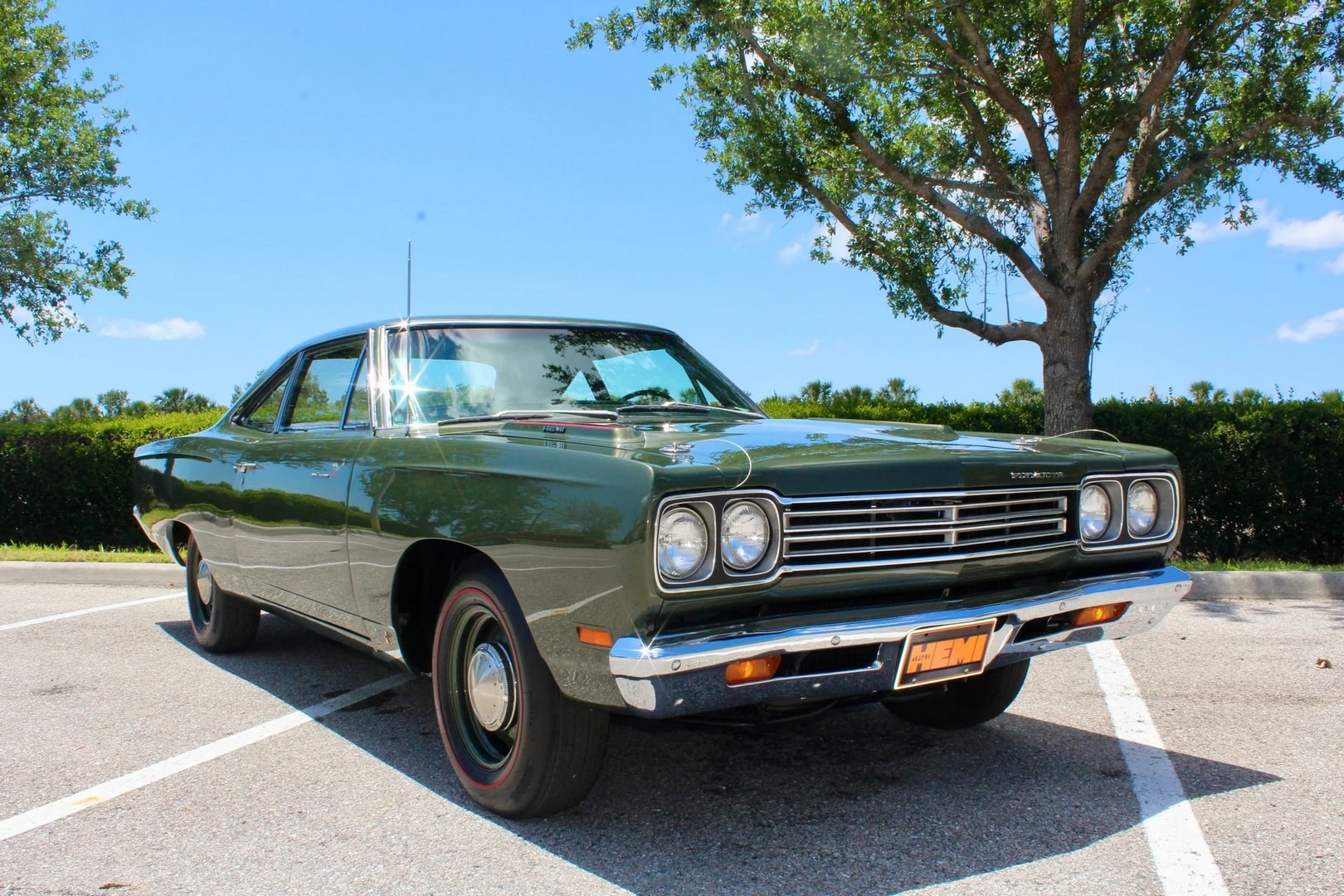
How much is too much for a museum-grade Hemi Mopar, specifically a 1969 Plymouth Road Runner 4-speed post coupe? Asking $250,000—or $249,500 on the showroom floor—seems to sit on the side of the fence where the grass is not so green, despite the car’s own factory F8 Ivy Green Metallic livery. Featured on the Classic Cars of Sarasota list of current offers, this 1-of-1 specimen is testing the market’s upper ceiling.
Let’s cut to the chase: this car is for sale, for a cool quarter-million bucks. Not unheard of – particularly not in the rarefied realms of 426 Hemi cars. After all, the recent Mecum Dallas/Fort Worth auction saw a couple of spectacular Plymouths go for over 300k – and none were powered by the Elephant V8 legend. Ask my colleague Ciprian Florea about them – he’s covered each sale in detail.
Granted, all those cars were holy grail rarities in their own right, but this ’69 coupe is no dime-a-dozener, either. And it’s got some history – one that lead me to believe someone is flipping the iconic muscle car big time. Think $70K big.
This exact Mopar has crossed the block several times since January 2018, when it stalled at a high bid of $130,000 at Mecum Kissimmee. Four months later, in May 2018 at Mecum Indy, it hammered for that same $130,000 bid, or $143,000 with fees, before bringing $180,000 on Bring a Trailer in January 2024. Listed for $250,000 since April 2025, it has sat unsold for eighteen months – so far , not a single soul thought it would be a good idea to pay up.

Photo: Classic Cars of Sarasota
Between January 2024 and October 2026, this car moved precisely 27 miles, from the 84,700 read recorded nearly three years ago to the 84,727 shown on the odometer now. It doesn’t take a rocket sciences degree to figure out this is a trailer queen, a garage jewel, a piece of showroom art, a car show bauble – you get the idea. And, frankly, I don’t think anyone with a quarter-million bucks in hand would consider buying an old car for the fun of driving the nostalgia off.
Peaking of history and memories: Plymouth introduced the Road Runner for the 1968 model year as a back-to-basics, budget-friendly B-body muscle car aimed at young enthusiasts priced out by luxurious grand tourers like the 440-cubic-inch GTX. Management paid $50,000 to Warner Bros. for the rights to the cartoon bird’s name and likeness, plus $10,000 to engineer the signature “beep-beep” horn, targeting 14-second quarter-mile capability for less than $3,000.
The recipe was too simple: pillared coupe body style, 383 big-block, four-on-the-floor. That was about it. unless, of course, someone moneyed up and went for the optional 426 Hemi engine and the also optional 3-speed Torqueflite automatic. That was the short version of how one could configure their Road Runner back in 1968. There were no other engines, no other body styles.

Photo: Classic Cars of Sarasota
Plymouth had a change of heart and added the hardtop coupe mid-year in ’68, then introduced the 440 Six-Barrel in 1969, and the convertible.
After moving 44,599 units in its inaugural year, the 1969 Plymouth Road Runner captured the coveted Motor Trend Car of the Year award and set an all-time nameplate production record of 84,420 vehicles. That global tally comprised 33,743 pillared two-door coupes, 48,549 pillarless two-door hardtops, and 2,128 first-year convertibles. Within that grand total, 81,105 cars were built to United States specifications, alongside 3,315 Canadian and export deliveries.
Breaking down those 81,105 domestic units reveals 32,368 coupes, 46,847 hardtops, and 1,890 convertibles. The standard 335-hp, 425-lb-ft 383-cubic-inch V8 powered 78,906 cars, split into 31,397 coupes (18,191 4-speeds and 13,206 3-speed TorqueFlite automatics), 45,629 hardtops (21,278 4-speeds and 24,351 automatics), and 1,880 convertibles (769 4-speeds and 1,111 automatics).
The mid-year 390-hp A12 440-cubic-inch Six-Barrel accounted for 1,412 units, comprising 615 coupes (388 4-speeds, 227 automatics) and 797 hardtops (422 4-speeds, 375 automatics).

Photo: Classic Cars of Sarasota
At the top of the hierarchy sat the 426-cubic-inch Hemi V8. Unleashed in 1964 as a race-only engine that dominated NASCAR and NHRA competition, the monstruous powerplant became the 425-hp, 490-lb-ft Street Hemi in 1966 with dual Carter AFB 4-barrel carburetors and 10.25:1 compression. In 1969, only 787 US-spec Road Runners received the E74 Hemi option.
421 hardtops (234 manuals, 187 automatics), 10 convertibles (four 4-speeds, six automatics), and 356 coupes (194 4-speeds and 162 automatics, plus 22 Canadian units).
VIN RM21J9G172560 was scheduled for production on November 21, 1968, at the St. Louis, Missouri plant and delivered on March 17, 1969, by Mark Motors Inc. in Arlington Heights, Illinois. Decoded by Galen Govier on June 11, 2007, it is number 17 of 48 St. Louis-built US-spec Hemi coupes in his Registry, 1 of 24 with the D21 4-speed, 1 of 10 with the A34 Super Track Pak, 1 of 3 in F8 paint, and 1-of-1 with all those combined.

Photo: Classic Cars of Sarasota
The original window sticker show a $2,928.00 base price for the RM21 two-door coupe. Factory options added $1,362.35, led by the E74 426-cubic-inch 2×4-barrel Hemi V8 at $813.45 and the A34 Super Track Pak—bundling a 4.10:1 Dana 60 9.75-inch rear axle, 7-blade viscous fan, and 26-inch radiator—at $256.45.
Extras included the A87 Road Runner Decor Group ($81.50), R11 AM radio ($61.55), B41 front disc brakes ($48.70), B51 power brakes ($42.95), D91 Sure-Grip differential ($42.35), and S78 full-horn-ring wheel ($15.40), plus $40.00 destination for a $4,330.35 total. That was downright Hemi GTX territory, or Pontiac GTO Judge Ram Air IV, and inched perilously close to Yenko Super Camaros and Boss 429 Mustangs.
Long before achieving collector status, this Hemi muscle car lived a gritty life on the street and drag strip, with documented history tracing back to 1976. Registered with the National Hemi Owners Association in 1986 and 1990, one of its three early owners included club president Jack Sharkey. During the January 2024 Bring a Trailer auction, a former caretaker who rescued the neglected Mopar in 1983 shared how he found it.

Photo: Classic Cars of Sarasota
“I owned that RR between 1983 and 2003. I know history back to 1976. I called it my Army Staff car back then. I have videos and photos going back to car shows and drag racing it. I paid 3,00.00 dollars for it out of the local advertiser. It was mostly in primer, rod bearing loose, 4 flat tires, two frozen rear brake drums all the chrome was in the trunk. I remember the first time I lifted the hood, Boy! I couldn’t get the money out of the pocket fast enough.”
Let’s pause for a second and consider that number: three HUNDRED dollars – legal money of the United States, in other words – for a Hemi Mopar. One that’s gunning for a quarter million today. The $300 from 1983 would equal in purchasing power to about $1,015 today. Again, no rocket scientist is required to do the math.
“I am so happy to see it has lived on and in a good shape. Good luck to the new owner!!” I should say, he looks like luck is not so eager to knock on his door – not in the form of a buyer, anyway. Then again, when someone has $180k to bury invest in a car they move nine miles a year, I don’t think luck is absent from their life.

Photo: Classic Cars of Sarasota
Following that 20-year tenure, Mike Paremsky of Michael’s Auto Restoration in Winter Haven, Florida, performed a comprehensive rotisserie restoration. The body shell was stripped and acid-dipped—preserving the factory stampings on the radiator core support and trunk lip—before receiving F8 Ivy Green Metallic basecoat/clearcoat paint over an H2X black deluxe vinyl bench-seat interior.
The numbers-matching 426-cubic-inch Hemi, A833 New Process 4-speed manual transmission, N96 Coyote Duster Air Grabber hood, and redline F70x15 tires with Plymouth Division hubcaps look so much better than when the car left the assembly line. Not a metaphor – Ma’ Mopar was famous for drivetrains and suspensions, not so much for fit and finish. (Anyone care to remember the biggest recall in the history of Detroit? Hint: the Road Runner was part of it).
Period magazine road tests demonstrated the potency of a showroom-stock 1969 Hemi Road Runner even when hampered by narrow bias-ply street tires. In 1969, Motor Trend recorded a 0-to-60 mph sprint of 5.1 seconds and a quarter-mile time of 13.56 seconds at 105.38 mph, while Car and Driver achieved 13.54 seconds at 105.14 mph and Super Stock & Drag Illustrated posted 13.32 seconds at 106.5 mph.

Photo: Classic Cars of Sarasota
Prepared for the strip with sticky tires and 4.10:1 gears, however, a 4-speed B-body Hemi delivered a far more violent 11-second rush, as a fellow enthusiast recounted on bringatrailer.com back in ’24, when the car sold last.
“First time I dropped the hammer at 5,800RPM on a B-body Hemi car and rowed through the 4-speed, shifting at 7,200RPM in each gear, tripping through the quarter mile in 11 seconds….I got back to the pits, got out of the car and my legs were shaking from the experience. I feel lucky to have had raced these cars. I think several others in this group have had the experience. That’s why there is so much love for the “ugly” Mopars!”
Yeah, about that “ugly:” the man who won the online bid back then wrapped up his experience with this gem: “Amazing, ugly car, big price.” I guess “ugly” is a new word for “great”?
Showing 84,727 miles on the odometer and backed by its original broadcast sheet, window sticker, National Hemi Owners Association records, and Galen Govier registry certificates, RM21J9G172560 possesses ironclad provenance. Even so, watching its price climb from a $130,000 sale in 2018 to $180,000 in January 2024 and a $250,000 asking figure since April 2025 explains why this 1-of-1 Ivy Green Metallic bruiser is still waiting for a buyer.