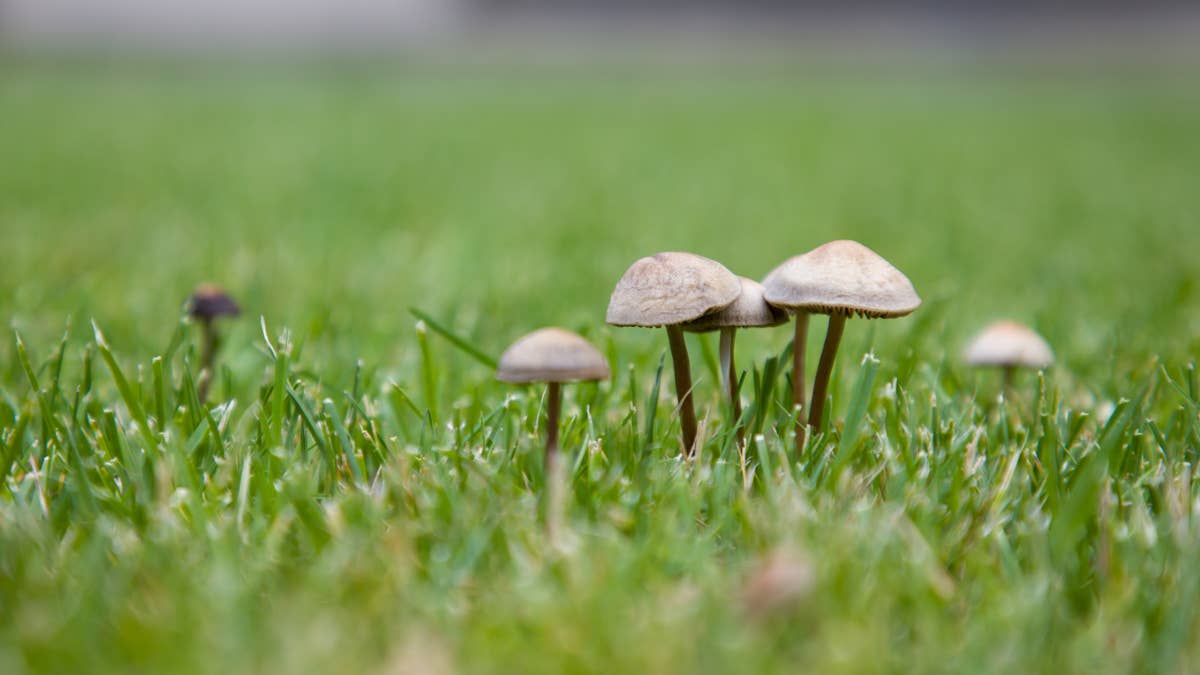
If you see mushrooms popping up across your yard, your first thought is probably that something is seriously wrong with your turf. The good news is that most lawn mushrooms are completely harmless, and their sudden arrival is often just a sign of nutrient-rich soil and a healthy lawn ecosystem breaking down organic matter.
Still, if you’re worried about curious pets and young kids, or you simply can’t stand how they ruin a clean cut, you don’t have to leave them there. With a few targeted adjustments, you can safely remove them and keep them from taking over again.
Why Are Mushrooms Growing in My Lawn?
Mushrooms growing in your lawn are actually a good sign, says Dr. Roger May, director of technical operations for national lawncare service, TruGreen.
“Generally speaking, the presence of mushrooms in your grass isn’t a bad thing,” he says. “In fact, it’s often a sign that your lawn is healthy, gets plenty of water, and contains beneficial organic matter.”
Mushrooms actually help to decompose organic matter and release nutrients into your lawn. However, May says that in some cases, they can be a sign of overwatering, drainage issues, or even lawn disease:
- Too much irrigation: Watering your lawn too often can leave it constantly wet, creating the ideal environment for mushroom growth.
- Excessive rainfall: A period of excessive rain will saturate your lawn, which often leads to temporary mushroom growth.
- Poor drainage: If your lawn has areas where water pools or simply doesn’t drain well, it will stay wet for long periods, creating an ideal place for mushrooms to sprout.
- Too Much Shade: The sun is key to removing excess moisture from the soil. Shady parts of the lawn can stay wetter for longer, resulting in mushroom growth.
- Excessive thatch: A layer of thatch, that dead layer of organic material that sits between the grass and the soil, traps moisture while also supplying fungi with a food source.
- Dead wood: Mushrooms don’t just need moisture but also a food source to grow. Mushrooms in your lawn could be a sign of decaying roots, branches, or logs buried in the soil.
Related: How Bad Does a Lawn Have to Look Before You Should Replace It? Lawn Pros Weigh In
The Safest Way to Remove Lawn Mushrooms Without Spreading Spores
Physically removing mushrooms is the best option, but it won’t eliminate the problem. It’s important to note that while you may take out the visible mushroom, the mycelium in the soil will remain. “Removing the fruiting body won’t remove the fungus itself since the mycelium (which we’ll liken to the root of a leafy plant) is both entirely underground and invisible to the naked eye,” May says.
Removing the part of mushrooms you can see is a simple process:
- Step 1: Proceed with caution – Some mushrooms are toxic, and it’s very difficult to identify which mushrooms are toxic and which are harmless. While ingesting mushrooms can hurt you, touching harmful mushrooms won’t.
- Step 2: Mow, rake, cut, or pick – The best way to get rid of visible mushrooms is to physically remove them. You can accomplish this by mowing or raking, but these methods will scatter pieces of mushrooms throughout the yard, creating hazards if you have pets or children. Picking is the best way to remove mushrooms without leaving any pieces behind.
- Step 3: Collect the pieces – Regardless of which method you choose, make sure to pick up the pieces of the mushrooms, seal them in a bag, and dispose of them, as mushrooms can be potentially toxic.
- Step 4: Repeat – While removing the mushroom caps may improve the aesthetics of your lawn, it won’t eliminate the underground network. If conditions are right, new mushrooms will emerge to take the old ones’ place.
Related: Lawn Care Pros Reveal How Often You Should Actually Mow Your Grass
5 Simple Adjustments to Keep Lawn Mushrooms From Coming Back
You can’t eliminate the mycelium in the soil that causes mushrooms to grow (nor would you want to give up its beneficial impact on soil health), but you can take measures to prevent mushroom caps from returning.
Adjust Watering Schedule
One of the easiest ways to prevent mushrooms from growing in your lawn is to dial back the watering schedule. Mushrooms are a sign that the soil is overly saturated. By watering less frequently, you give soil time to dry out. Rather than frequent daily watering, water deeply one to two times per week. This provides enough moisture for the grass roots while allowing the soil surface to dry out, preventing mushroom growth.
Improve Drainage
If water isn’t draining properly from your lawn, it will leave soil saturated for long periods, creating the ideal environment for mushroom growth. “To minimize fungal growth in your lawn and garden, make sure that the soil is draining properly,” May says. You can improve drainage by relieving soil compaction through aeration. If this doesn’t work, you may need to regrade the area to prevent water from pooling.
Manage Excessive Thatch
Measure the thatch layer in your lawn by cutting a small wedge out of it using a trowel or spade. If the thatch layer exceeds one-half inch, dethatch the lawn to thin out that layer. Doing so will allow that top layer of soil to dry out while reducing the amount of dead material fungus can feed on.
Remove Decaying Debris
Decaying stumps, dead roots, buried construction lumber, and other organic material that’s decaying beneath the surface of the yard serve as food for mushrooms. Eliminate this food source by removing lumber and logs that you can access easily. Digging up old roots is also an option, but that amount of excavation can also do major damage to your yard. Removing mushrooms when they appear may make more sense.
Increase Sunlight and Airflow
If the mushrooms are in damp, heavily shaded areas, then improving sunlight and airflow by pruning back trees is an option. “Soaking the area in sunlight (when possible) can also help to limit fungal growth,” May says. While light to moderate pruning is a good option, don’t remove healthy trees simply because mushrooms are growing in your yard.
When Lawn Mushrooms Are a Sign of Damaging Fairy Ring Disease
While most mushrooms are harmless, there are some that are a sign of a turf problem. Mushrooms that grow in an arc or circle with a ring of dark green grass on the outside and yellowing or dying grass in the middle may be a fairy ring. This type of fungus releases a water-repellent residue in the soil that blocks water from reaching grass roots, causing it to wilt, turn brown, and die. The fungus also releases a large dose of nitrogen in the lawn, creating the dark green ring around the dying grass.
Related: Look for This Winter Damage To Your Lawn
Why Store-Bought Lawn Fungicides Will Not Kill Yard Mushrooms
Fungicides you’d find in your home improvement store generally aren’t effective for killing ordinary mushrooms that are feeding on decaying material in your yard or fairy ring. If you’re dealing with a fairy ring, you can treat it by removing the mushrooms, then using a core aerator or spading fork to break up the soil to allow water to pass through. After aerating, water the area deeply so that it soaks past the dry zone in the soil and reaches grass roots.
FAQs
Will Dawn dish soap kill mushrooms in your yard?
Dawn dish soap may shrivel and damage the visible part of mushrooms, but it won’t kill the extensive network of fungus that’s underground. Mushrooms will likely reemerge in the same place unless you address any issues with excessive moisture and the presence of decaying organic matter.
Will vinegar kill lawn mushrooms?
Using vinegar to kill mushrooms isn’t a good idea. As with dish soap, vinegar may shrivel the visible mushroom cap, but it will do nothing to eliminate the fungus growing beneath the line. Vinegar is also non-selective, so it will kill the healthy surrounding grass.
Related: The Winter Watering Mistake That Can Wreck Your Grass