- Achilles tendinopathy is commonly treated with injections containing saline, local anesthetics, and/or corticosteroids, but like many orthopedic procedures, this treatment became popular without rigorous evidence.
- This three-arm trial randomized patients to receive saline injections with bupivacaine with or without hydrocortisone, or to a sham treatment with saline and bupivacaine delivered to a site not expected to affect tendon pain or swelling.
- Improvement relative to sham was seen in the arm receiving hydrocortisone plus bupivacaine after 6 weeks, but this advantage disappeared by week 12; no significant difference between arms was seen at 12 months.
High-volume injections to relieve pain and disability for patients with Achilles tendinopathy failed to demonstrate significant benefit versus sham injections in a randomized trial.
With 192 patients assigned to three arms (all including saline) — bupivacaine plus hydrocortisone, bupivacaine alone, or bupivacaine delivered to a site not expected to yield any benefit — levels of improvement were similar across all three after 12 months, according to Peter Malliaras, PhD, of Monash University in Melbourne, Australia, and colleagues.
The bupivacaine-steroid combination did provide significantly greater relief at 6 weeks compared with the other two arms, but this advantage vanished by week 12, and pain and disability actually appeared worse with the combination at week 26, the group reported in The BMJ. Including the steroid did, however, reduce overall healthcare costs.
Meanwhile, no differences between sham and bupivacaine alone were noted at any time.
“Although high-volume injections with corticosteroid showed short-term clinical benefit and potential reduction in healthcare costs over a year, they were associated with worse longer-term clinical outcomes,” Malliaras and colleagues concluded. “The clinical data do not support routine use for midportion Achilles tendinopathy.”
In an accompanying editorial, a sports medicine expert at the University of Sydney commented that the short-term benefit with hydrocortisone may be real, but patients need to know that it’s only temporary and comes with a significant cost.
“Corticosteroids for tendinopathy appear to be borrowing from the future to finance the present,” wrote John W. Orchard, MBBS, MD, PhD, who also serves as chief medical officer for Australian cricket associations. “Individual circumstances should dictate how important the present and near future are compared with the medium to long term.”
“The short-term improvement is impressive, but the benefits are a loan not a gift,” he continued. “All clinicians recommending or performing corticosteroid injections for tendinopathy need to understand this trade-off and make every effort to explain the broader overview to the patient as part of the informed consent process.”
As with many orthopedic procedures, injections of saline, analgesics, and/or steroids grew popular for treating tendon injuries without rigorous supporting evidence. Inclusion of steroids, though, has become more controversial with accumulating reports of longer-term adverse effects when used for tennis elbow. Orchard explained that a “workaround” developed for Achilles tendinopathy is to use a lot of saline, like 50 mL per treatment. But trials conducted in recent years yielded mixed results and no clear evidence of efficacy relative to placebo.
For their trial, Malliaras and colleagues enrolled adults with gradual-onset, midportion Achilles tendinopathy from activities such as running, confirmed with ultrasound and with pain lasting at least 3 months. Severity was assessed with the Victorian Institute of Sport Assessment-Achilles (VISA-A) instrument, which evaluates pain and disability on a 100-point scale (lower values = worse severity). At baseline, patients averaged about 50 on this scale in all three arms:
- Bupivacaine alone: 10 mL 0.5% bupivacaine and 40 mL saline
- Bupivacaine plus steroid: the same plus 25-mg hydrocortisone
- Sham: 2-3 mL 0.5% bupivacaine
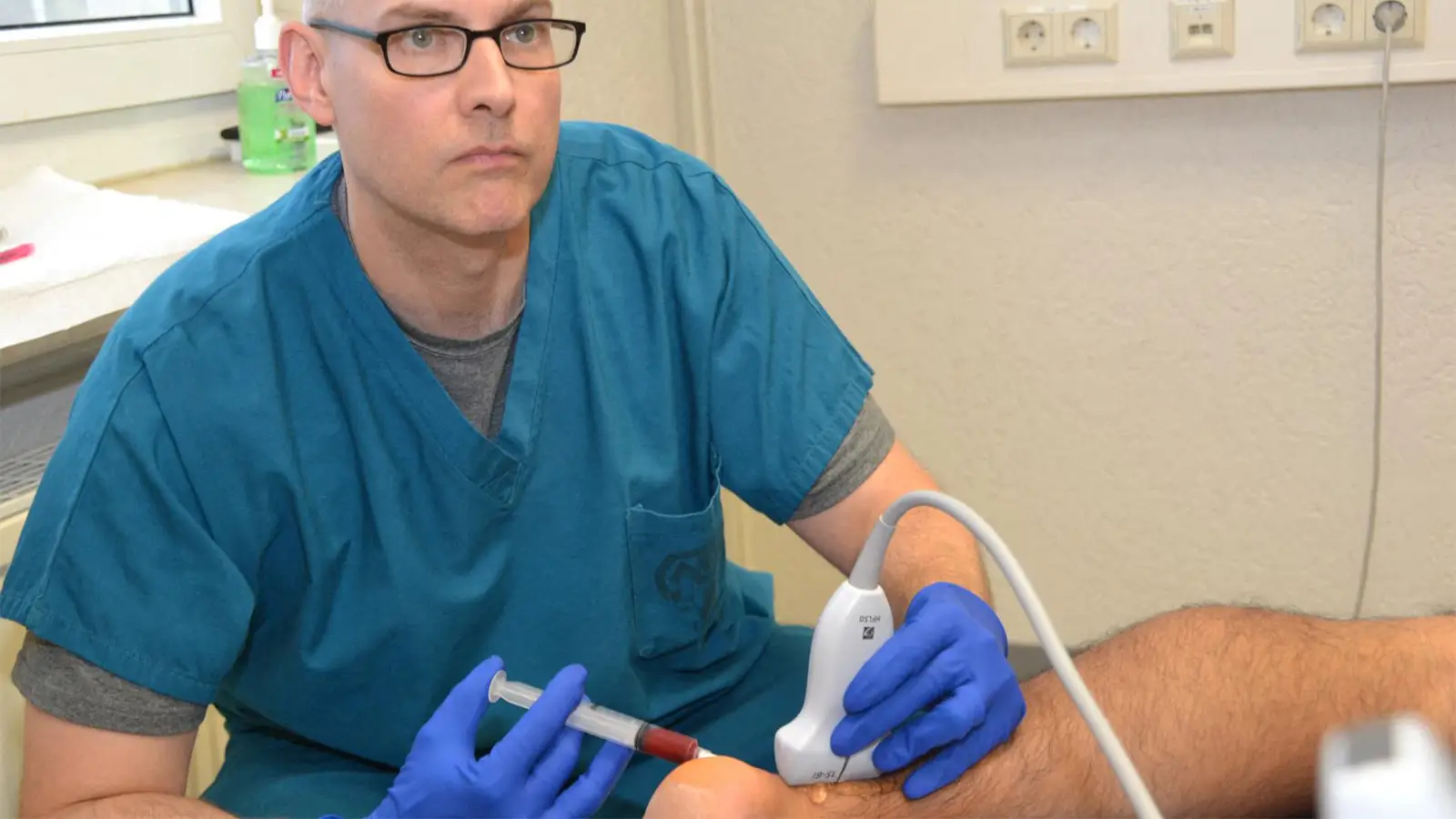
Active injections were placed at the junction of the Achilles tendon and Kager’s fat pad. Sham injections, meanwhile, were delivered at least 10 mm anterior to the junction, where no therapeutic effect is expected; it still produces “a numbing effect,” the researchers explained, so as to maintain patients’ blinding. For the same reason, a sleeve was placed over the Achilles region so that participants getting the high-volume injections couldn’t see the temporary resulting bulge.
Mean patient age was about 50, and just under half were women. Roughly one-third had obesity, but other metabolic comorbidities were much less frequent.
Changes in VISA-A scores at week 52, on an intention-to-treat basis, were the primary outcome measure. These averaged about 25-30 points in all three arms, and the differences at week 52 did not reach statistical significance. Scores at week 52 were not collected for eleven participants, but per-protocol analyses yielded similar results.
The one point in the study where significant differences were seen was at week 6, when patients in the steroid-included arm showed more VISA-A improvement than in the other arms, by roughly 10 points. But by week 26, the difference turned negative — numerically with respect to sham and significantly compared with active bupivacaine alone. This latter gap shrank slightly through the final 6 months and became statistically insignificant.
Malliaras and colleagues also looked at healthcare costs during the year-long study period. This analysis did favor the bupivacaine-steroid treatment over sham, with more than 90% certainty that the active regimen was cost-effective at willingness-to-pay thresholds of AUS$50,000 to $100,000 (approx. US$35,000 to $70,000).
Other secondary outcomes showed minimal differences, at most, among the three treatments. Adverse effects were generally mild, infrequent, and didn’t differ substantially between arms. The most common was aggravated Achilles pain, which occurred in 28% of the sham arm, 16% of those receiving bupivacaine alone, and 25% of those given bupivacaine and hydrocortisone. Six serious adverse events were recorded, but all seemed unrelated to Achilles tendinopathy (five surgeries for other conditions and one transient ischemic attack).
Some limitations to the trial applied. Participants were recruited on social media and therefore may not be representative of the ordinary clinical population. The trial took place in part during the COVID-19 pandemic, which required some adjustments to the protocol that limited in-person attendance. Also, efforts to maintain blinding may not have fully succeeded.