Support CleanTechnica’s work through a Substack subscription, on Patreon, or on Stripe. Help us produce all of the high-quality, original content we publish week after week despite the challenges of content-scraping AI, antisocial media, inflation, and other hurdles.
Last week, I attended Greenbuild International Conference + Expo 2026 in the North Hall of the Javits Center here in NYC.
After being overwhelmed by shows like CES and InterSolar Europe, the smaller scale of Greenbuild was a welcome break. At the show, there were a few heat pumps and Copper brought their battery-backed induction range, but less emphasis was placed on renewable energy storage and energy efficiency than other events. Many of the people I talked to had not heard the emissions reduction requirements of New York City’s LL97, which was a major motivator of Build Expo in the Spring. I also did not see much media presence at the show.
However, what stood out at Greenbuild was an emphasis on green materials. Although some of these companies had appeared at other shows, I had more opportunity to discuss and really get into the details at Greenbuild. A few exhibitors stood out.
Building Better With Straw
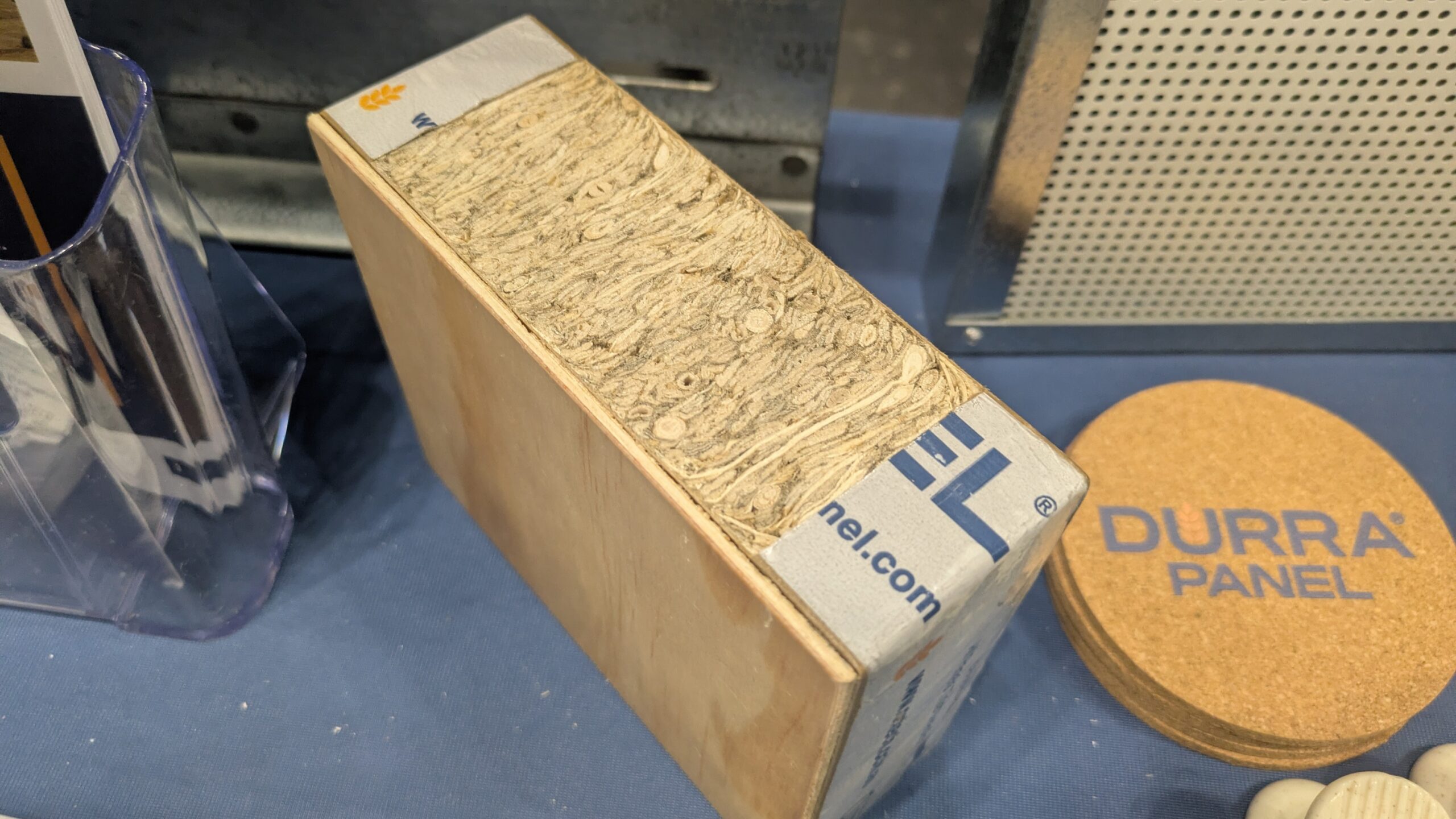
Durra Panel was the first product to really attract my attention. Throughout history, straw has gotten a bad rap in parables. In contrast to the “Three Little Pigs” folktale, Durra Panel is using straw to create a building material that is not only more sustainable but, in many ways, better than traditional materials.
The standard boards are 96% compressed straw and 4% recycled craft paper. The process uses heat and pressure to bond the straw together with naturally occurring lignin, with no added binders needed. In the process, the straw panel gains a 1-hour (60-minute) Fire Resistance Level (FRL). The panels are 99.9% VOC-free, but the resulting panel, which incorporates biochar, actually absorb VOCs from the environment where they are installed. Standard panels are 50 or 58 mm thick (~2”).
Due to the mechanical strength of the panel, it can replace a partition wall or form a walkable roof without additional reinforcement or studs. Compared to a stud wall, the embodied energy drops from 153 MJ/m2 to 12.6 MJ/m2. It simply needs a header and footer to be mounted as a wall. According to Durra Panel, these walls provide an 84% time savings and 21% cost savings versus traditional building materials.
In a place like NYC, where rented commercial real estate and offices frequently have partition walls added and removed with high labor costs, those savings could add up quickly. In addition, the walls can be dismantled and re-used, further reducing cost and environmental impact.
The technology was developed in Australia decades ago, but it is expanding globally. Due to the acoustic performance, it is often used to build recording studios. Durra Panel recently selected Brocton, Massachusetts for their first US manufacturing facility.
Roughly 40% of global CO2 emissions come from the built environment, more than all transportation combined. In addition, a large portion of agricultural straw is burned as waste, putting more CO2 back into the atmosphere than all commercial air travel, according to Durra Panel. As much as 3.7 Gt of CO2 could be sequestered if agricultural straw could be used in construction. Carbon is locked away for the life of the building. At the end of life, the panels can be recycled or shredded and composted.
There were also several companies touting timber-related products. However, even if forestry is managed properly, utilizing waste is still preferable to felling trees. Using agricultural waste for construction makes you wonder what other waste streams could potentially be put to use.
Cleaning Up Concrete
Up to 8% of global emissions come from concrete manufacturing. That is more than air travel and global shipping combined. However, concrete has clear mechanical advantages as a durable, long lasting building material.
ZeroTwelve is incorporating biochar as a replacement for a portion of cement. In the process, the company claims more carbon can be sequestered than emitted, making the concrete carbon negative. At the same time, the concrete can become stronger and more resilient, depending on the mix. In addition, the biochar gives the concrete a slate-like dark gray appearance, making it well suited for decorative applications like floors or poured concrete countertops.
Nearby Pozzotive showed another solution, replacing a portion of cement with powdered glass, or pozzolan, from post-consumer recycled glass in what they call “urban mining.” Currently, much of the glass that gets put in recycling bins ends up in landfills. By eliminating the need to sort by color and size, more glass can be recycled. And it can be manufactured locally with low energy requirements, close to where the waste glass is generated. In the process, 94% of CO2 emissions are eliminated vs. the cement being replaced. The resulting pozzolan powdered glass can replace up to 50% of cement. The resulting concrete is stronger and more chemical resistant. In addition, the powdered glass makes the concrete more reflective, potentially reducing heat island effect.
Beyond the cement itself, Glavel showed off their foamed glass aggregate. Made from recycled glass using renewable energy, the aggregate both replaces crushed stone in the concrete and provides a level of insulation to replace separate foam insulation. It also makes the concrete structure lighter while maintaining high compressive strength.
Part Of A Larger System
There were many more options for building materials at the show. Something like a composite may have lower initial carbon footprint and durability but create challenges at end of life. Some natural materials may have degradability benefits but durability challenges. Each has its tradeoffs, and what works for one application may not be ideal in another. However, there is clear potential for the different materials to fit different applications and priorities..
While at the show, I briefly met with “legend” David Gottfried, co-founder of the US Green Building Council and founder of the World Green Building Council. He was promoting his new book, Regen360, which is positioned as “An Operating System For A Regenerative Earth.” While I have just started the book, it poses frameworks used to ask the right questions and align what we do with what we value.
I will not say that any material that I saw at the show is the answer. But if we change the way we think about building and start asking the right questions, green materials have the potential to contribute to a net positive impact.
Sign up for CleanTechnica’s Weekly Substack for Zach and Scott’s in-depth analyses and high level summaries, sign up for our daily newsletter, and follow us on Google News!
Have a tip for CleanTechnica? Want to advertise? Want to suggest a guest for our CleanTech Talk podcast? Contact us here.
Sign up for our daily newsletter for 10–15 new cleantech stories a day. Or sign up for our weekly one on top stories of the week if daily is too frequent.

CleanTechnica uses affiliate links. See our policy here.
CleanTechnica’s Comment Policy