
A new study has found that almost one in three Israeli adults surveyed who use generative artificial intelligence (AI) tools reported seeking emotional support, coping advice or mental health assistance from platforms such as ChatGPT and Gemini. Among users experiencing severe psychological distress, that figure rose to nearly one in two, according to researchers from Tel-Hai University of Kiryat Shmona in the Galilee and collaborating institutions.
The study, published in Cyberpsychology, Behavior, and Social Networking, examined how attachment styles and psychological distress relate to the use of general-purpose generative AI for mental health support.
Led by Dr. Dorit Hadar Shoval of the School of Psychology at Tel-Hai University of Kiryat Shmona in the Galilee, together with Elad Refoua of Bar-Ilan University, the researchers surveyed 584 Israeli adults, aged 18 to 70, who had used a general-purpose generative AI tool such as ChatGPT at least once within the previous year.
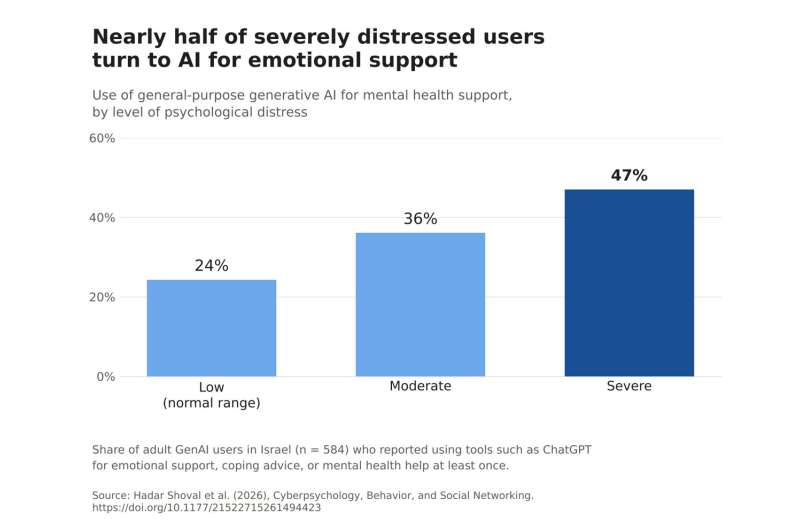
Participants were recruited in November 2025 through an online panel, and the figures describe this sample rather than the general population. Overall, 29.3% reported using AI at least once for emotional support, coping advice or mental health-related assistance. Among participants with severe levels of psychological distress, 47% reported such use.
A need to better understand the risks
The findings suggest that psychological distress is the psychological variable most strongly associated with turning to AI for support. Younger participants and women were also significantly more likely to report using AI for mental health-related purposes.
“Our findings show that many people, particularly those experiencing significant distress, are turning to generative AI systems for emotional support and guidance,” Hadar Shoval said.
“These tools offer immediate, accessible and nonjudgmental interactions, but they were not designed to function as mental health providers. The high level of use among distressed individuals highlights the urgent need to better understand both the possible benefits and the potential risks of relying on AI during periods of emotional vulnerability.”
Hadar Shoval noted that people with higher levels of attachment anxiety were more likely to seek mental health support from AI. However, once psychological distress was taken into account, attachment anxiety was no longer a significant predictor. The two are closely related, and the study cannot determine which comes first.
No clinical mandate or safety protocols
The authors note that generative AI is increasingly functioning as a form of informal, AI-mediated help-seeking. Unlike mental health professionals or dedicated digital therapeutics, consumer AI systems carry no clinical mandate and have no established safeguards for managing psychological crises.
The study does not evaluate whether AI interactions were helpful or harmful, nor does it determine whether users substituted AI for professional care. However, the researchers argue that the widespread use of these tools by distressed individuals warrants closer attention from clinicians, researchers and policymakers.
“Understanding patients’ digital help-seeking behaviors is becoming an important part of modern mental health care,” Hadar Shoval said. “Future research should focus on safety, crisis-response quality and whether AI serves as a complement to professional support or, in some cases, replaces it.”
The authors emphasize that the data reflect any self-reported use for mental health support, ranging from a single interaction to more sustained engagement, and that additional research is needed to understand how people use AI in real-world emotional contexts.
Publication details
Dorit Hadar Shoval et al., AI-Mediated Mental Health Support: The Role of Attachment Orientation and Psychological Distress, Cyberpsychology, Behavior, and Social Networking (2026). DOI: 10.1177/21522715261494423
Journal information:
Cyberpsychology, Behavior, and Social Networking
Key medical concepts
Clinical categories
Provided by
Tel-Hai University of Kiryat Shmona in the Galilee


Citation:
Nearly half of severely distressed generative AI users turn to chatbots for emotional support, study finds (2026, October 29)
retrieved 29 October 2026
from https://medicalxpress.com/news/2026-10-severely-distressed-generative-ai-users.html
This document is subject to copyright. Apart from any fair dealing for the purpose of private study or research, no
part may be reproduced without the written permission. The content is provided for information purposes only.