Billionaire Mukesh Ambani-owned Reliance Industries Ltd (RIL) on Friday posted a 32 per cent jump in profit after tax (PAT) to Rs 29,250 crore for the second quarter ended September 2026, against Rs 22,146 crore recorded in the corresponding quarter of the previous financial year (2025-26).
The company’s gross revenue also rose 27.8 per cent to Rs 3,62,268 crore during the September 2026 quarter from Rs 2,83,548 crore posted in the same quarter of the previous financial year.
The higher profit was driven mainly by a sharp increase in crude and product prices, which boosted the performance of the oil-to-chemicals (O2C) portfolio, the company’s largest business segment by revenue. O2C revenue increased 44 per cent year-on-year (YoY) to Rs 2,31,601 crore during the quarter.
Crude prices for the quarter increased 40 per cent on the back of the West Asia crisis, whereas transportation fuel prices were up 50-78 per cent YoY. Prices of most downstream chemical products were up 25-35 per cent YoY, driven by strong feedstock prices.
The company said the O2C segment’s earnings before interest, tax, depreciation and amortisation (Ebitda) during the quarter increased sharply by 68 per cent YoY to Rs 25,203 crore, with a surge in transportation fuel cracks and improved downstream chemical margins.
“Fuel cracks were up 3-3.7 times Y-o-Y and reached historic highs during the quarter. Polyester chain margins also recovered sharply, reaching a 3-year high, led by Paraxylene and Purified Terephthalic Acid deltas. Earnings growth was constrained by continued Special Additional Excise Duty (SAED)-related costs and under-recoveries in Jio-bp business,” RIL said.
Despite disruptions in the Strait of Hormuz, the company achieved high crude runs by sourcing from the strait and other regions, including Latin America, North America and the Mediterranean region. This helped limit the impact of a wider Arab Gulf crude differential and a 15-20-fold surge in freight rates. “Exports were redirected to the highest-netback markets: light distillates to East and South Africa, and middle distillates to Europe, Latin America and West Africa,” RIL said.
It added that combined petrol and diesel volumes at Jio-bp, the fuel retail venture, grew 4.2 per cent YoY in the second quarter to 1.83 million kilolitres, driven by continued high demand and better retailing.
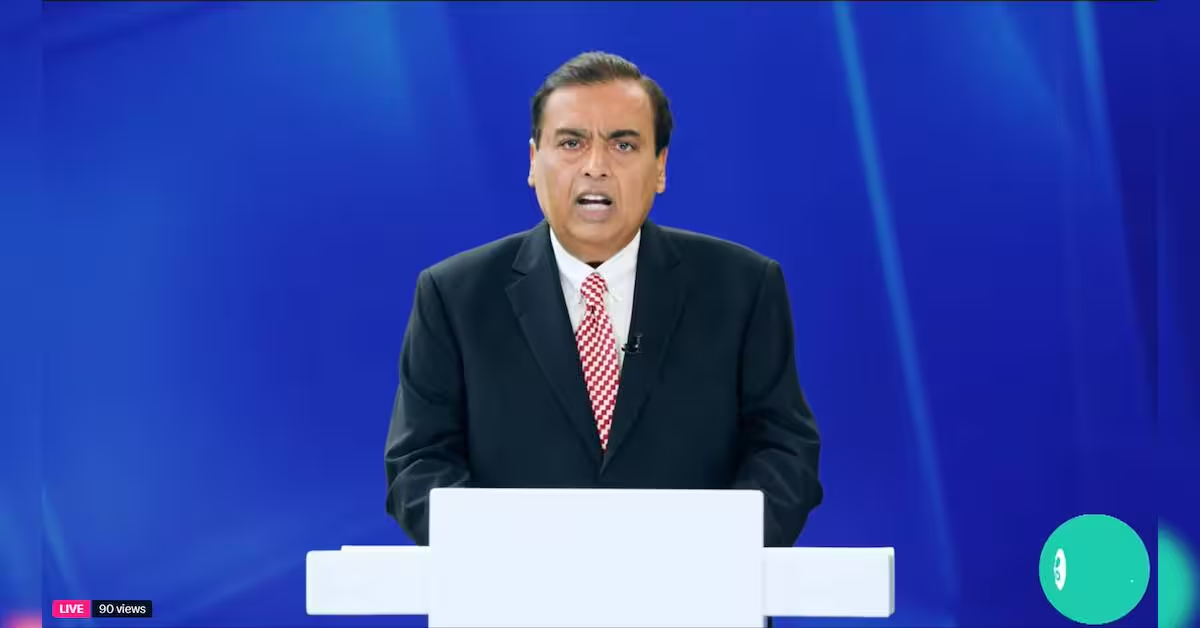
“Our O2C business delivered a particularly strong performance this quarter, led by tight fuel markets, improved downstream petrochemical deltas and firm domestic demand. Our ability to optimise feedstock sourcing and product placement along with operations across the value chain enabled us to improve margin capture,” Ambani said.
However, revenue from the oil and gas (exploration and production) segment declined 0.6 per cent to Rs 6,020 crore. This was mainly on account of lower production and gas price realisation from the KG-D6 block. The impact was offset by higher condensate prices and improved coal bed methane (CBM) prices and volumes.
Production from the flagship KG-D6 field dropped 9 per cent to 57.8 billion cubic feet equivalent (BCFe), while CBM production grew 21.4 per cent to 3.4 BCFe.
The company reported a 2 per cent drop in Ebitda for this segment to Rs 4,901 crore during the quarter due to lower revenue and higher levies by the central government, even as favourable exchange rate movements supported earnings.
The company said its capital expenditure for the September 2026 quarter stood at Rs 38,153 crore and was largely driven by investments in O2C and new energy projects under implementation, and by building and expanding the infrastructure and distribution reach of its consumer businesses.