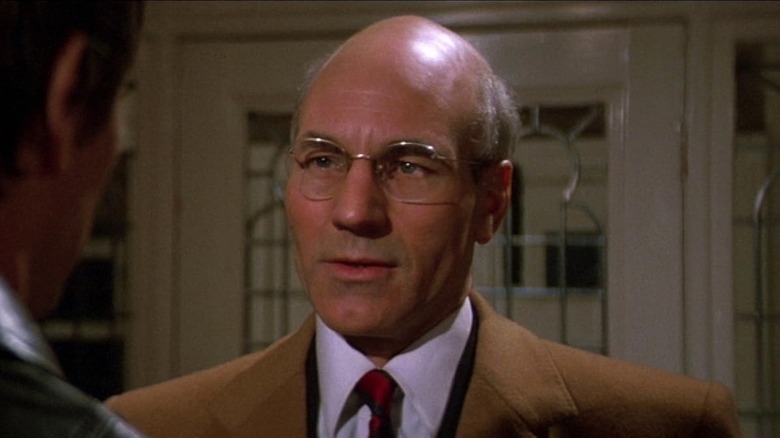
Throughout his lengthy acting career, Sir Patrick Stewart (who sadly passed away this week) amassed an impressively varied collection of projects and roles. While his Shakespearean training and English pedigree allowed him to appear in all manner of prestigious roles, the man was also no stranger to genre. Nor was he scared of it; unlike the stereotype of a stuffy British thespian who turns up his nose at sci-fi or horror (as epitomized by Alan Rickman’s Alexander Dane in “Galaxy Quest”), Stewart seemed to relish his work in genre films and television. Among his most famous works in the genre like “Star Trek: The Next Generation” and “X-Men,” Stewart appeared in the likes of David Lynch’s surrealist sci-fi “Dune,” Freddie Francis’ gothic horror “The Doctor and the Devils,” and later, Jeremy Saulnier’s grimy “Green Room.”
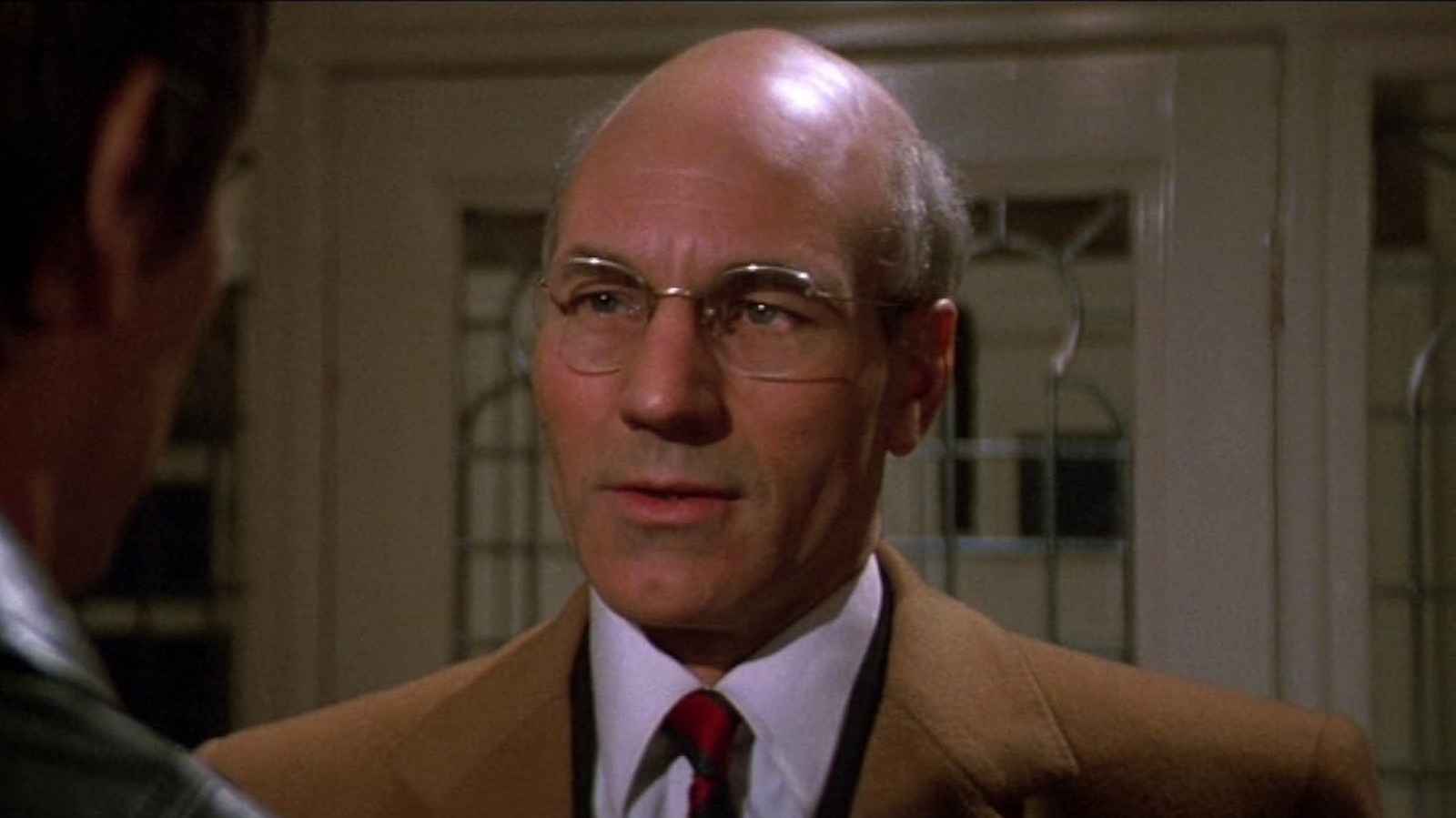
Yet Patrick Stewart’s most unusual performance in a genre movie has got to be as Doctor Armstrong in 1985’s kooky sci-fi/horror opus, “Lifeforce.” The film is a totally bizarre mixture of highbrow and lowbrow elements that will probably never be quite matched again. Adapted from Colin Wilson’s 1976 novel “The Space Vampires” by co-writer Dan O’Bannon (of “Alien” fame), “Lifeforce” was directed by Tobe Hooper (of “The Texas Chain Saw Massacre” and “Poltergeist”), features an original score by Henry Mancini, and, being set in England, includes an ensemble of other such classically trained British actors like Peter Firth, Frank Finlay, and Michael Gothard.
It was also produced by notorious schlockmeisters Yoram Globus and Menahem Golan under their Cannon Films banner, meaning that there are copious amounts of gory practical effects and gratuitous nudity in the film. Given all this, Stewart’s performance feels like the apex of the movie’s charms: it’s all at once gloriously gonzo while being respectably committed.
Patrick Stewart makes a small supporting role memorable in Lifeforce
The basic plot of “Lifeforce” is similar to most classical vampire tales, only the big twist is that the vampires don’t come from some far-off Eastern European land, but from outer space. The commander of a joint British-American space shuttle, Tom Carlsen (Steve Railsback), is the sole survivor of the shuttle’s reentry to Earth after their mysterious discovery of humanoid beings in pods on a spaceship within Halley’s Comet. It turns out that those humanoids are, in fact, space vampires, and the escaped creatures begin feeding on the life force of humans in and around London while evading capture. The lead vampire (Mathilda May) has established some manner of psychic link with Carlsen, essentially making their relationship a gender-swapped version of Dracula and Mina Harker from Bram Stoker’s novel.
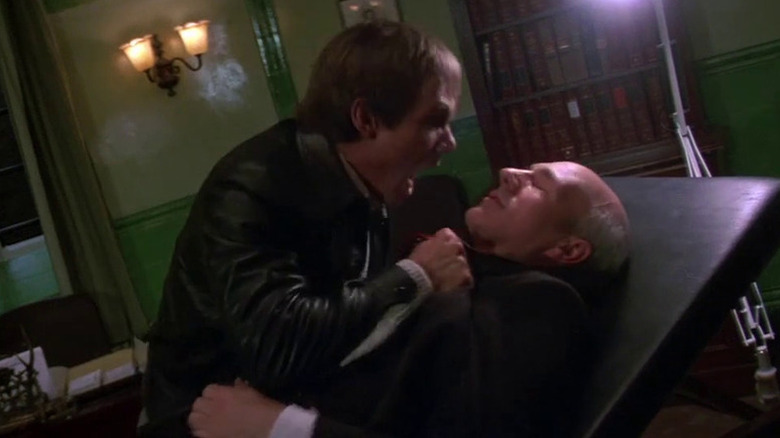
This vampiress can shapeshift her body into that of one of her victims, and midway through the movie, Carlsen and the authorities believe they’ve tracked her down to Doctor Armstrong, the manager of a psychiatric hospital in Yorkshire. Carlsen uses his psychic link to the vampiress as a way of getting her to reveal her existence within Armstrong’s body, in a scene which feels like a combination of regressive hypnosis (showing shades of a similar moment from “The Exorcist”), desperate confrontation, and seduction.
For this scene, Tobe Hooper has Patrick Stewart speak dialogue in his own voice that’s then blended with May’s, making the moment even stranger. Yet the uncanny quality of the scene is all thanks to Stewart and Railsback, who unabashedly tear into the layers and subtext of the encounter with all the gusto they can muster. It truly must be seen to be believed.
Lifeforce is a movie which benefits from the credibility and gravitas of Patrick Stewart
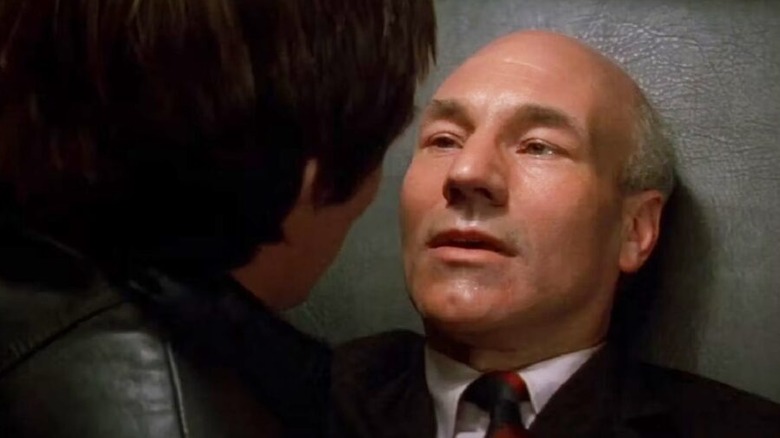
Although “Lifeforce” has endured an uneven reputation both upon its initial release and in the decades that have followed, those who adore it (like me) do so thanks in large part due to the commitment to the material of everyone involved, especially Patrick Stewart. A lesser version of the material would’ve been fully schlocky, and likely embarrassing. Yet Tobe Hooper and Cannon seemed convinced that “Lifeforce” could be their shot at “Star Wars”-level success, and that conviction is only bolstered by Stewart and the other actors.
As a result, Stewart pulls no punches with his performance, fully giving in to the concept that he’s playing a female alien vampire in a middle aged male doctor’s body. Even taken out of the film’s context, the scene is still jaw-droppingly off-kilter, eschewing the potential camp factor in favor of histrionic psychodrama. There aren’t many actors, then and now, who could credibly pull off a scene that is simultaneously homoerotic and heteroerotic, and it’s for this reason why Hooper plays a majority of the scene with Stewart in the shot rather than Mathilda May.
Thanks to all the groundwork laid by Stewart, the subsequent moment in which the vampiress escapes from Armstrong’s body via all the blood in him draining out feels phantasmagorically fantastic rather than off-puttingly goofy. The animatronic head of the actor is decent enough, but being shot in slow motion to allow the blood to emerge slowly doesn’t do it much favor. The selling of this effect is part of what Patrick Stewart brought to “Lifeforce” that makes it so special. It literally wouldn’t be as good without him, which is something one can easily say about nearly everything Patrick Stewart starred in.