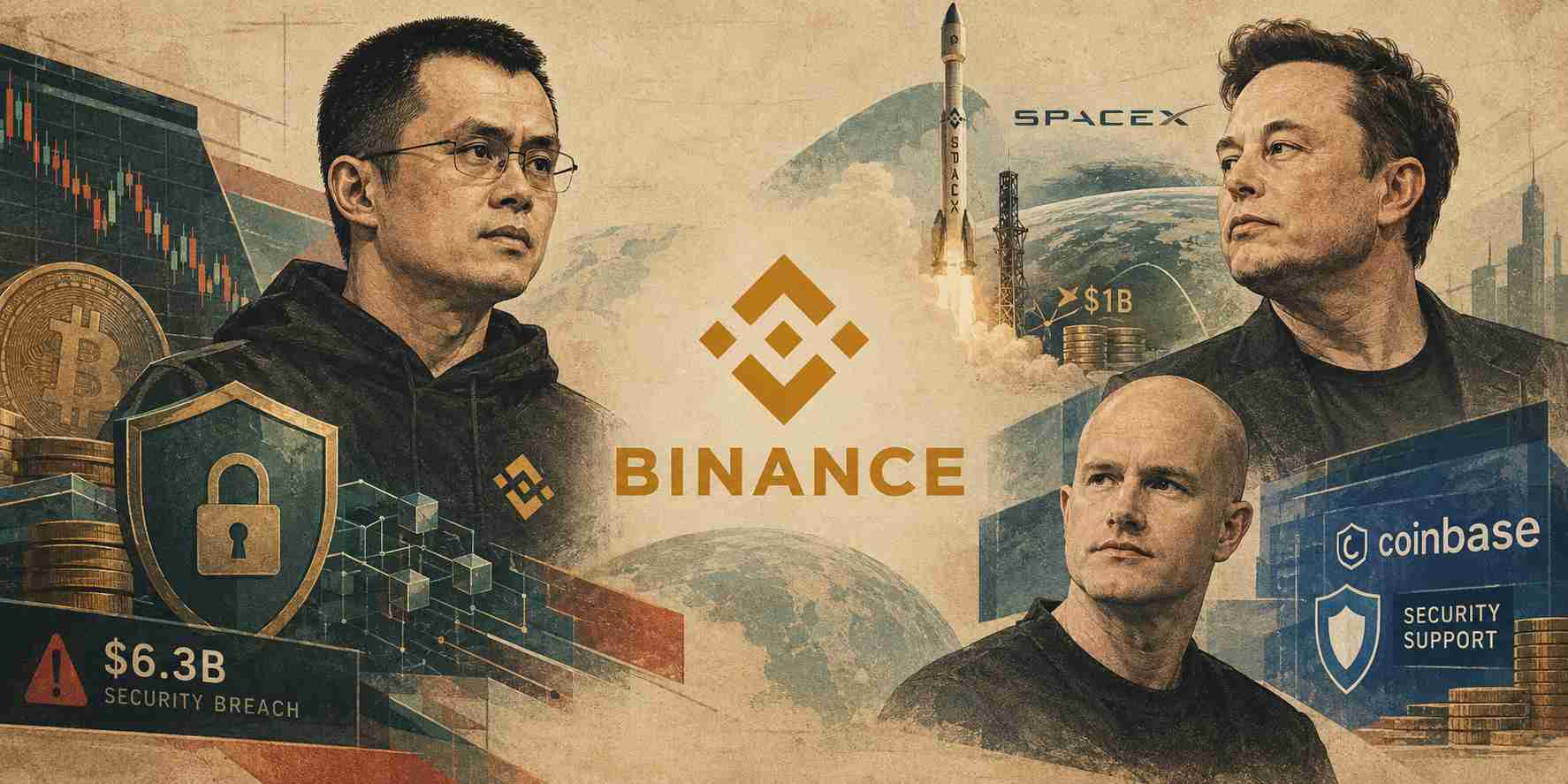
The dispute unfolded as Binance worked to contain the October 29 attack, freeze affected assets, and reassure customers that their funds would remain protected. Zhao, widely known as CZ, referred to Binance’s investment in SpaceX while defending the exchange’s financial position. Meanwhile, Coinbase CEO Brian Armstrong said his team was helping block transactions involving compromised wallets and had contacted Binance directly.
Summary
- Binance founder CZ asked Elon Musk to stop making jokes about the exchange’s $6.3 billion security breach, calling the timing inappropriate.
- Zhao cited Binance’s SpaceX shares, valued at more than $1 billion, following its $500 million investment in Elon Musk’s Twitter takeover.
- Binance co-CEO Yi He said the company’s annual revenue was sufficient to cover the losses without selling its SpaceX holdings.
- Coinbase CEO Brian Armstrong offered assistance by blocking transfers to compromised wallets and contacting Binance.
- Binance reported that approximately $3 billion in affected assets had been frozen and committed to covering all losses through its SAFU fund and company resources.
CZ asks Elon Musk to stop mocking Binance
The disagreement started after Musk reacted to Zhao’s cybersecurity warning and subsequent reports of the attack on Binance.
On October 28, Zhao published a warning on X, advising users against opening suspicious email links or downloading attachments, even when messages appeared to come from trusted contacts. Musk responded with fire and laughing emojis.
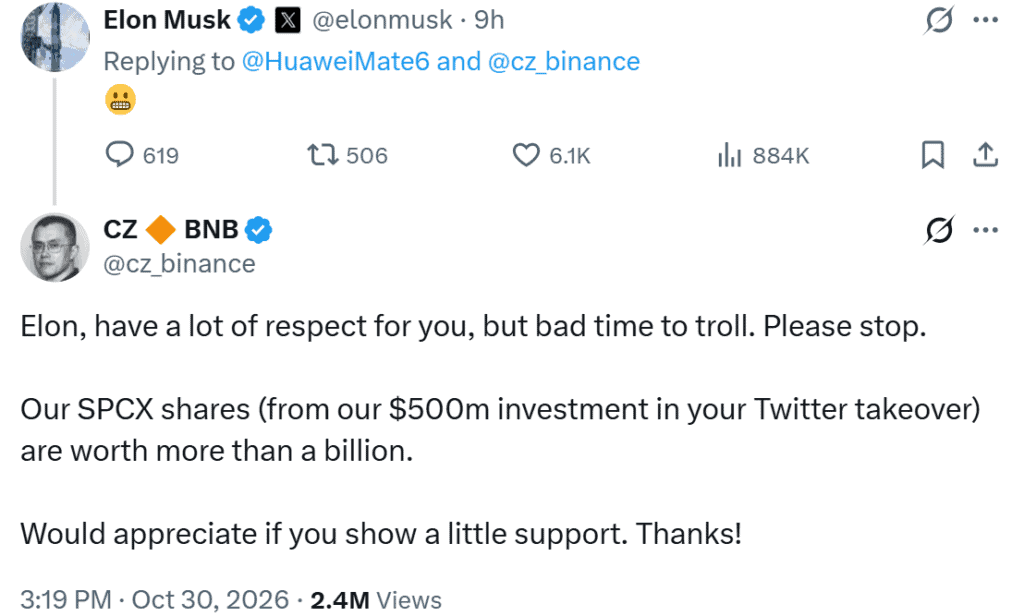
CZ urges Elon Musk to stop mocking Binance’s record $6.3 billion hack, citing the crisis’s seriousness while expressing respect for him. Source: X
Following reports of the Binance incident, Musk commented, “Everyday is Zeroday,” referring to zero-day vulnerabilities. These are previously unknown security weaknesses that attackers can exploit before developers have an opportunity to address them.
The exchange continued as details of the security breach emerged. When Zhao’s earlier warning resurfaced, he said he wished more people had followed the advice. He also acknowledged that the attack appeared more complex, adding that compromised devices or algorithms frequently play a role in security incidents.
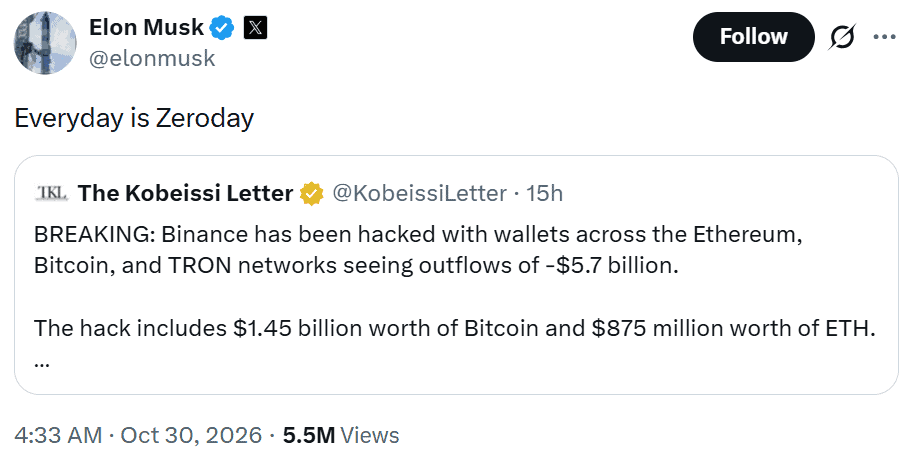
Musk’s “Everyday is Zeroday” remark underscores the constant threat of zero-day exploits, particularly for high-value crypto platforms. Source: Elon Musk via X
Zhao eventually addressed Musk directly, asking him to stop making jokes while Binance dealt with the financial and operational consequences.
“Elon, have a lot of respect for you, but bad time to troll. Please stop,” Zhao wrote on X.
He also reminded Musk of Binance’s financial connection to his businesses, pointing to the exchange’s investment in the Twitter acquisition and asking for support during the incident.
Binance’s SpaceX holdings enter the dispute
Zhao’s response brought Binance’s investment in SpaceX into the public discussion. He said the exchange’s stake originated from its $500 million contribution toward Musk’s acquisition of Twitter in 2022.
“Our SPCX shares (from our $500m investment in your Twitter takeover) are worth more than a billion,” Zhao wrote.
The statement attracted questions from X users about how an investment in SpaceX related to Binance’s security problems. Zhao subsequently explained that he was referring to the company’s financial resources when assessing its ability to cover the incident’s impact.
His preliminary calculation considered the estimated $6.3 billion impact, approximately $3 billion in frozen assets, and more than $1 billion available through Binance’s Secure Asset Fund for Users (SAFU).
Based on those figures, Zhao estimated a potential funding gap of around $2 billion. He described the remaining amount as manageable, although financially painful.
However, the calculation was not a final assessment of Binance’s net losses or the amount of assets that could ultimately be recovered. Zhao also did not announce any plans to sell the company’s SpaceX holdings.
The distinction is important because frozen assets, insurance-style reserves, and company investments represent different sources of financial support. Their availability and eventual use depend on recovery progress and the exchange’s financial decisions.
Yi He says Binance revenue can cover losses
Binance co-CEO Yi He responded to Zhao’s comments, saying the exchange had sufficient annual revenue to absorb the losses without selling its SpaceX investment.
“Reporting to the major shareholder: Our company’s revenue for the year is sufficient to cover the losses, so we do not yet need to sell the SpaceX shares you are bullish on,” she wrote.
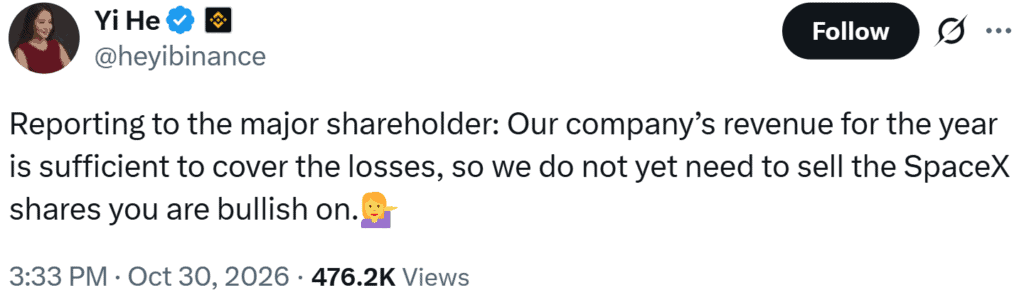
Binance’s $500M Twitter takeover investment reportedly grew its SpaceX stake to over $1B amid the security breach dispute. Source: Yi He via X
Zhao subsequently clarified that he had not suggested selling the holdings. Instead, he said he mentioned their value to demonstrate Binance’s available financial resources and potentially reassure Musk about the company’s ability to manage the incident.
The exchange has separately committed to covering all losses using its SAFU reserve and company funds. In an October 30 update, the exchange said it had reserved approximately $6.34 billion in company funds to address the incident.
The exchange also disclosed that it already held around $5 billion in the affected cryptocurrencies and was purchasing the remaining approximately $1.34 billion through market transactions and over-the-counter channels. The objective is to restore affected assets in their original tokens rather than simply compensate users with an equivalent dollar amount.
This reserve is separate from the approximately $3 billion in affected assets frozen with assistance from blockchain partners. The exchange said it would continue working with law enforcement, token issuers, blockchain intelligence firms, and other industry participants to trace and recover additional funds.
The exchange also plans to publish updated Proof of Reserves information after the recovery and remediation process is complete.
Binance’s preliminary investigation initially pointed to a compromised DevOps engineer’s laptop, which allegedly allowed an attacker to access a service container and initiate unauthorized withdrawal transactions. The exchange reported no evidence that wallet private keys had been exposed.
Subsequent reporting indicated that investigators were examining additional points of breach. Blockchain intelligence firm TRM Labs estimated that approximately $6.36 billion had moved from Binance wallets across multiple blockchains, with most of the transfers occurring within roughly 20 minutes.
TRM Labs and Chainalysis separately attributed the attack to North Korea-linked hacking group TraderTraitor. However, Binance has not publicly confirmed the identity of the attackers and said it was cooperating with law enforcement to establish who was responsible.
Musk’s Binance hack comments draw mixed reactions
Musk’s remarks attracted reactions from cryptocurrency executives, industry participants, and traders as Binance worked to contain the incident.
Coinbase CEO Brian Armstrong offered direct assistance, saying the exchange was helping prevent transfers to wallets associated with the attack. He also confirmed that Coinbase had contacted Binance to offer support.
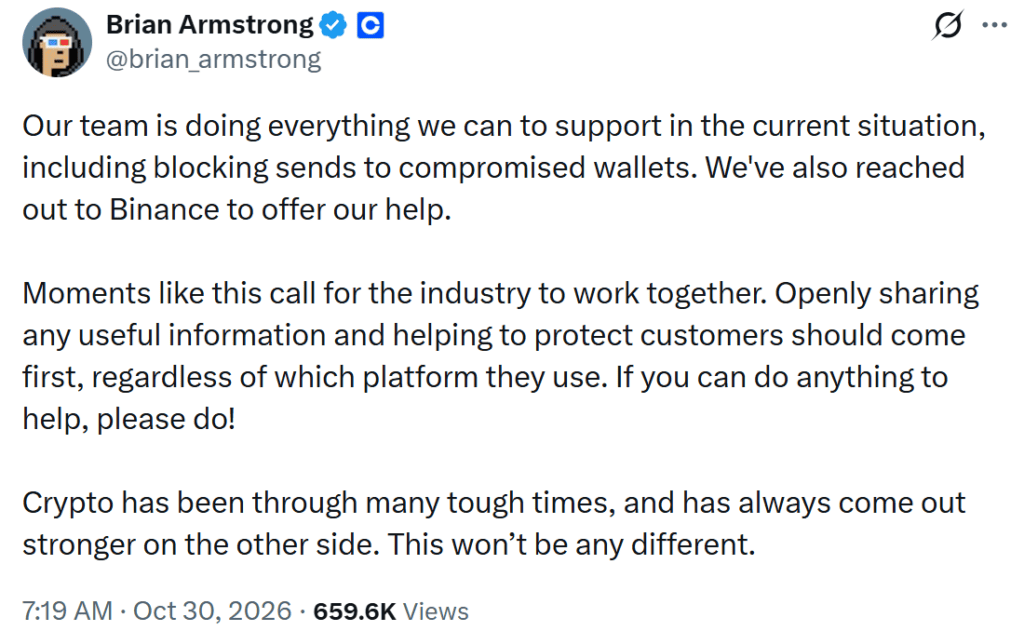
Brian Armstrong announces Coinbase’s proactive response to the record $6.3B Binance hack. Source: Brian Armstrong via X
“Our team is doing everything we can to support in the current situation, including blocking sends to compromised wallets,” Armstrong wrote.
He added, “Moments like this call for the industry to work together.”
The response highlighted the role of cooperation between cryptocurrency exchanges and blockchain service providers during security incidents. Tether and Circle also helped freeze assets linked to the attack, contributing to the comapny’s reported recovery efforts.
Meanwhile, the breach placed additional pressure on cryptocurrency markets. Bitcoin and other digital assets faced selling pressure following the incident, with Bitcoin briefly approaching six-week lows near $76,000 as concerns about exchange security affected market sentiment.
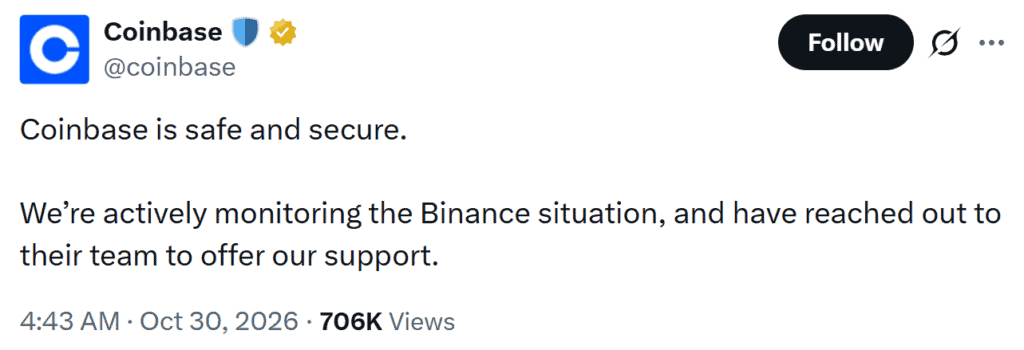
Coinbase reaffirmed its security measures, monitored Binance’s crisis, and offered support, including blocking transfers to compromised wallets. Source: Coinbase via X
Binance’s operational restrictions also became an important concern for customers. The exchange initially suspended deposits and withdrawals while reviewing its security systems and affected withdrawal addresses. In a subsequent service update, the exchange confirmed that deposits were operating normally, while withdrawals remained paused during a security revamp. It expected withdrawal services to resume within 48 hours of the October 30 update.
The exchange reiterated that user funds would remain protected and pledged to publish a detailed technical report once its investigation was complete.
The public disagreement between Zhao and Musk has added another dimension to Binance’s recovery efforts. While Zhao has pointed to the exchange’s financial resources and SpaceX investment, Yi He has said annual revenue can cover the shortfall without selling those holdings. Coinbase’s offer of assistance has also demonstrated how competing exchanges can coordinate when a security incident affects the wider cryptocurrency industry.

