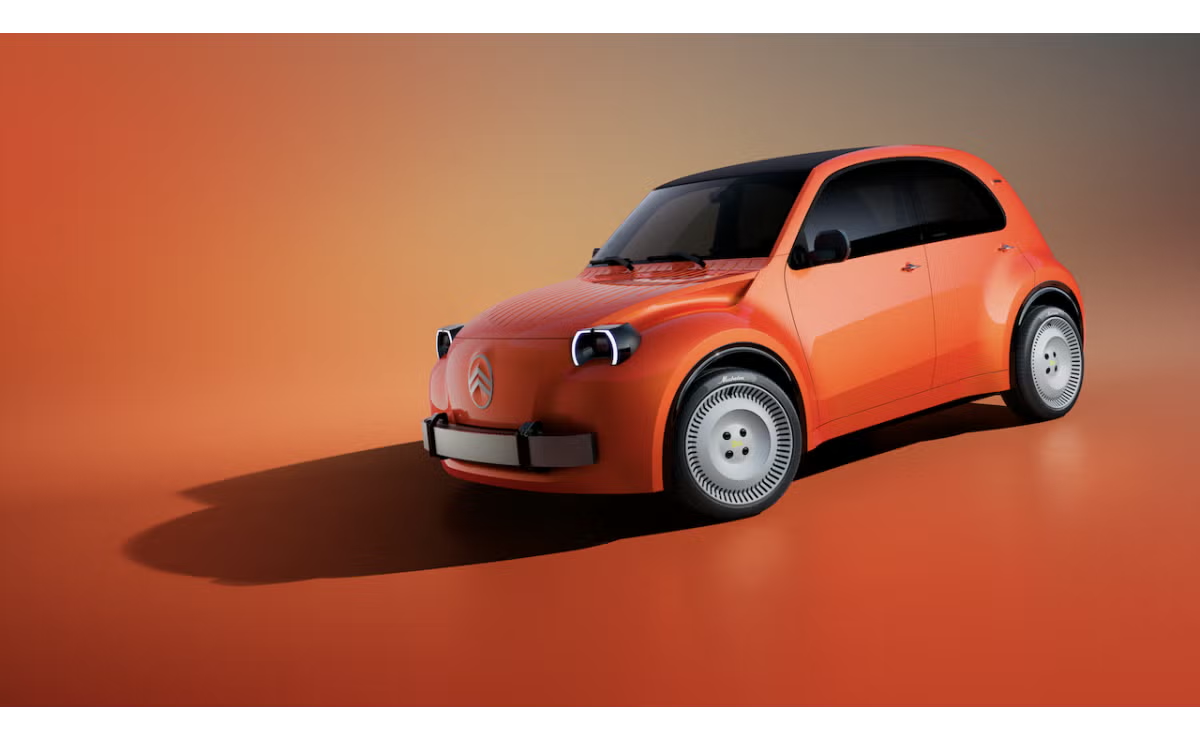
Can retro designs rescue Europe’s carmakers? The short answer is no. They are, however, well worth having in the OEM’s toolbox as they face up to unprecedented challenges from East Asia.
Retro designs are an especially interesting talking point at the moment. Some OEMs have heritage to raid, others not so much. The question many are asking is: Can they be a significant differentiator for European brands struggling to compete on price with Chinese rivals?
Chinese carmakers are coming into the European market in force with electric cars and hybrids that are at significantly lower price points than the established incumbents can achieve. Some of them are highly vertically integrated and boasting broader technological credentials than simply acting as a traditional end-of-value-chain OEM carmaker. Moreover, they are starting to develop deeper European industrial presence and going beyond retail with new manufacturing and R&D facilities. All this as Europeans weigh growing industrial overcapacity, painful restructuring plans and greater job losses.
The success of Chery’s Jaecoo 7 – top selling model in the UK in September – is a very good case study in successful Chinese entryism; right product at the right time. A new entrant brand can play it smart with long warranty periods, trusted local dealers, low price points and cars loaded with advanced tech and features. The recent wave of Chinese new entrants suggests something of a step-change to the passenger vehicle market landscape in Europe. Worryingly for the Europeans, the East Asian newcomers have flooded the market with brands and models that are gaining rapid traction in the market.
It is no accident (the strategy developing NEVs and associated supply chains long mapped out in Beijing), but they’ve also arrived in Europe at an opportune time: the energy transition in the background is loosening the old brand loyalties that have long protected the established European brands.
If a car buyer is opting for an electric car or hybrid for the first time, there may be a naturally greater propensity to consider a new brand than would have been the case with a combustion engine-powered car replacement previously. Brand reputation and attributes back then were bound up in obvious and well-established tech heritage. For example, consider rear-wheel drive BMWs and the BMW marketing campaigns long proudly built around driving dynamics and long engineering heritage. It was all at the core of the combustion engine tech proposition. They can try and keep that going with their new electrified powertrain set-ups, but it’s not quite the same messaging with what is brand new tech.
It’s now a more fluid market landscape with the rapid energy transition and all-new powertrain tech – not just the BEVs, but the hybrids, too – and the Chinese OEMs have got into the market in force with plenty of product to cover important market segments. And they have done that very, very rapidly. They have also been smart with their distribution infrastructure; quickly identifying, doing deals and working closely with local retail partners. If the long-established local dealer with the prime spot that used to sell Suzuki is now selling Jaecoo and Omoda, there’s a degree of prospective customer reassurance there, straight away.
So, the new brands’ strong market proposition comes as brand loyalties are weaking anyway. There’s reassurance in those long warranty periods (a learning from what Kia did) and seeing these new brands on the roads in significant numbers very quickly. Getting that early and very visible volume presence further reinforces the sense of brand and product credibility.
But what of retro themes in new car designs? Can they help those OEMs and brands that have a long automotive history?
For the European OEMs, tapping into heritage could count as a significant opportunity in the battle with the Chinese newcomers – who obviously don’t have the long history that the European brands have. It’s not just the physical designs themselves, there is also value in the model nameplates – for example in Ford Europe reviving the Fiesta name for an upcoming small electric car.
While brand loyalties may not be quite what they used to be, heritage still counts for something. There can be an emotional pull from a design that draws on a past icon. And that is something that can potentially also appeal to curious Gen Z’ers interested in captivating historical narratives that originally worked with their parents – a kind of ‘hipster’ factor maybe.
It has to be handled with some dexterity though. The background to, say, the Citroën 2CV’s success in post-war France is obviously very different to the market landscape of today. Leaning into the principles of utilitarian low-cost and simplicity of design is fine, but the designers of a modern vehicle with retro design cues must execute that with care. They are not just playing to the relatively small group of enthusiasts of past designs and heritage. New interpretations must still appeal to others who may be much more swayed by modern features and a sense of modern design at the right price. Mobility is part of a modern digital lifestyle (something the Chinese OEMs have certainly grasped).
Adroit designer nods to past glory days must also work as very modern products. The basics of the transport proposition must be there, alongside the cute retro design. If it’s a small electric vehicle with a low price point, delivering that comes with the challenge of avoiding too many other compromises – with battery performance, say.
Renault seems to have got it right with the electric 5. It clearly works as a modern interpretation with a contemporary shape that has plausibly continuously evolved from the 1970s original. But even so, there has been some criticism of rear cabin space – perhaps a necessary compromise to get the right retro lines and angles on the body shape in a necessarily dimension-constrained B-segment car. No car design is ever ‘perfect’ on all counts.
How do you update a retro design?
There is also another point about retro designs though – how do you update them over the model cycle and keep the interest up after the initial wave of enthusiast sales? A conventional car design can be extensively adapted. The designers have a pretty free hand to ‘correct’ and improve, but it’s perhaps more difficult to keep a heavily retro design ‘fresh’ with facelifts – the first retro version being the essential ‘visual take’. It’s not impossible, but there are perhaps more constraints for the designers to work within.
The heavily retro-styled Chrysler PT Cruiser in the US was well received when it went to market in 2000. The production run lasted a decade, but sales ran out of steam after the initial hit with enthusiasts. It started to attract negative sentiment when the car remained essentially unchanged and was eventually perceived – perhaps a little ironically – as somewhat dated.
Volkswagen’s New Beetle is another example of a retro-designed product that ultimately was withdrawn because it had exhausted its limited market appeal. Why buy that car when there is a VW Golf – on the same engineering platform – that delivers a much more practical proposition? The cool design alone couldn’t quite cut it.
It’s great when the enthusiasts buy, but how do you keep the sales rolling and how long should the product cycle be? The risk is that the niche for the retro-appeal product stays low in volume terms. That might be fine if planned for, but it might undermine the manufacuring strategy.
The key perhaps is to have a design that can have a degree of retro-appeal but also works very well with a wider audience beyond the retro enthusiasts. BMW got that spot-on with the Mini. It is of course much larger the Issigonis original, but that’s the whole point. They could make it much larger and much more suitable for modern buyers, whilst retaining, broadly, something of ‘the look’ of the original. There have been significant powertrain changes, the car has got a little bigger – to improve interior space – and finish has become more premium. The subsequent design updates have therefore been relatively subtle, maintaining the core retro look and appeal. The current ‘new Mini’ is still a clear descendent of its previous versions (and indeed, the founding original).
A reimagined Citroën 2CV should obviously give a big nod to its ancestor (and it does) – especially on price-point and design simplicity as well as visual cues – but also needs to be a credible modern electric car in terms of functionality and features, with widespread appeal. It needs to be differentiated from competitors and have its unique set of design or visual attributes – but still absolutely work as a modern car package, with the right price-point and features for its target market segment. And there is the question of how it relates to the wider Citroën brand family of cars, from a design point of view. How does the whole brand sit with the consumer and what does it say?
Don’t be fooled by Chinese ‘cookie cutter’ designs
One thing about many Chinese car designs is that they are a little bit devoid of any real differentiating design composition or constant theme that is associated with a particular brand. That cookie cutter ‘commoditisation’ has arguably been turned into a positive with the low-prices and features-stacked value packages as the focus to the market. As long as the designs hit an acceptable bar, it’s more about the other parts of the overall package.
There’s a general perception of design modernity of course – sometimes leaning in a little to what the established players already provide, but at a much lower price (the Jaecoo 7 so-called ‘Temu Range Rover’, for example). It is probably fair to say though, that the visual impact or themes of Chinese brand designs are not heavily specific across model lines within a particular brand. They don’t immediately suggest any Chinese cultural facet as the Europeans do (with their French flourish and flair or German clean-lined premium efficiency, say).
If some Chinese brands’ designs lack a clear visual character or theme, that is perhaps not a big problem so far, the market enthusiastically embracing their competently performing low-price products. They had to get to base camp.
But ‘lacking character’ in terms of visual impact may be more significant in 2-3 years’ time. By then, the Chinese brands perhaps need to be establishing serious brand identity through differentiated product offerings and that will include how they look. How their car designs have evolved by then will be interesting to see.
Does it really matter?
It can be argued though, that this is slightly missing the point. How a car looks perhaps matters less today than it used to and will matter even less in five years’ time. AI and advanced design tech have perhaps evened out the designer playing field and some say the era of the over-arching automotive designers is over, at least in terms of how things have always been done.
Perhaps the exterior visual design will continue to diminish in importance versus the technological capabilities of new cars and what is inside the cabin. This may well turn out to be where the Chinese brands can continue to successfully differentiate themselves – in areas such as battery performance, connectivity, automation and the overall capability of the car to comfortably fit into a modern digital lifestyle. The Chinese players will surely aim to capitalise on their industrial and technological strengths – scaling up their big competitive advantage to pile on the pressure for Europe.
There again, while the Chinese OEMs have shown themselves to be very adaptable, they don’t have the rich and long automotive history that some of the European brands can potentially tap into. It certainly makes sense for the Europeans to try to do that, as something of a product differentiator, where it can work.
The European carmakers can raid their heritage for inspiration and look at that for renewed product differentiation via selective designs, even as they struggle to meet the Chinese OEMs on cost – but that’s where the real challenge is going to be. Retro designs are no silver bullet.
For the Europeans, working with the Chinese OEMs may make more sense, effectively giving up part of the value chain in order to survive and co-exist. It is perhaps a more flexible business model that plays to European OEM strengths and addresses the threats in a smarter manner (for example in VW-Xpeng’s collaboration model). That way, the overall design of the end-product (all aspects of the vehicle, but with more tech features outsourced to China) stays at the forefont of the European OEM’s proposition, but underpinned by a much lower cost base. The risk there is loss of control over new tech, ‘second-best’ delivery and timelines for introduction etc.
To sum up, design and its part in establishing the brand image and attributes is obviously an essential part of the mix, but mass-market segments that are moving to electrification have become more fluid than ever. Brand loyalty and that sense of evocative continuity from a rich automotive history that matters, is perhaps not quite what it used to be. Technological drivers in the auto industry are becoming more important in the product package mix. An old truism: The price-point matters more than ever, but so does the perception of the value in the overall package.
Leaning into heritage for a brand makes sense if handled well and as part of a broader business plan. The competitive threat to European OEMs from the East though, runs a bit deeper than how a car looks and evoking past design successes.


