Support CleanTechnica’s work through a Substack membership , on Patreon , or on Red stripe Assist us create all of the premium, original material we release week after week despite the challenges of content-scraping AI, antisocial media, rising cost of living, and other difficulties.
Zero-emission bus procurement has moved beyond the phase where battery-electric and hydrogen fuel-cell buses must be treated as two parallel modern technologies waiting on the marketplace to make a decision between them. Transportation companies have actually now invested years running both, rebuilding depots, installing charging and refuelling framework, training professionals and finding which assumptions survive day-to-day solution. Both technologies can move travelers without tailpipe discharges. The more useful proof now originates from what firms are prepared to get continuously and at fleet scale.
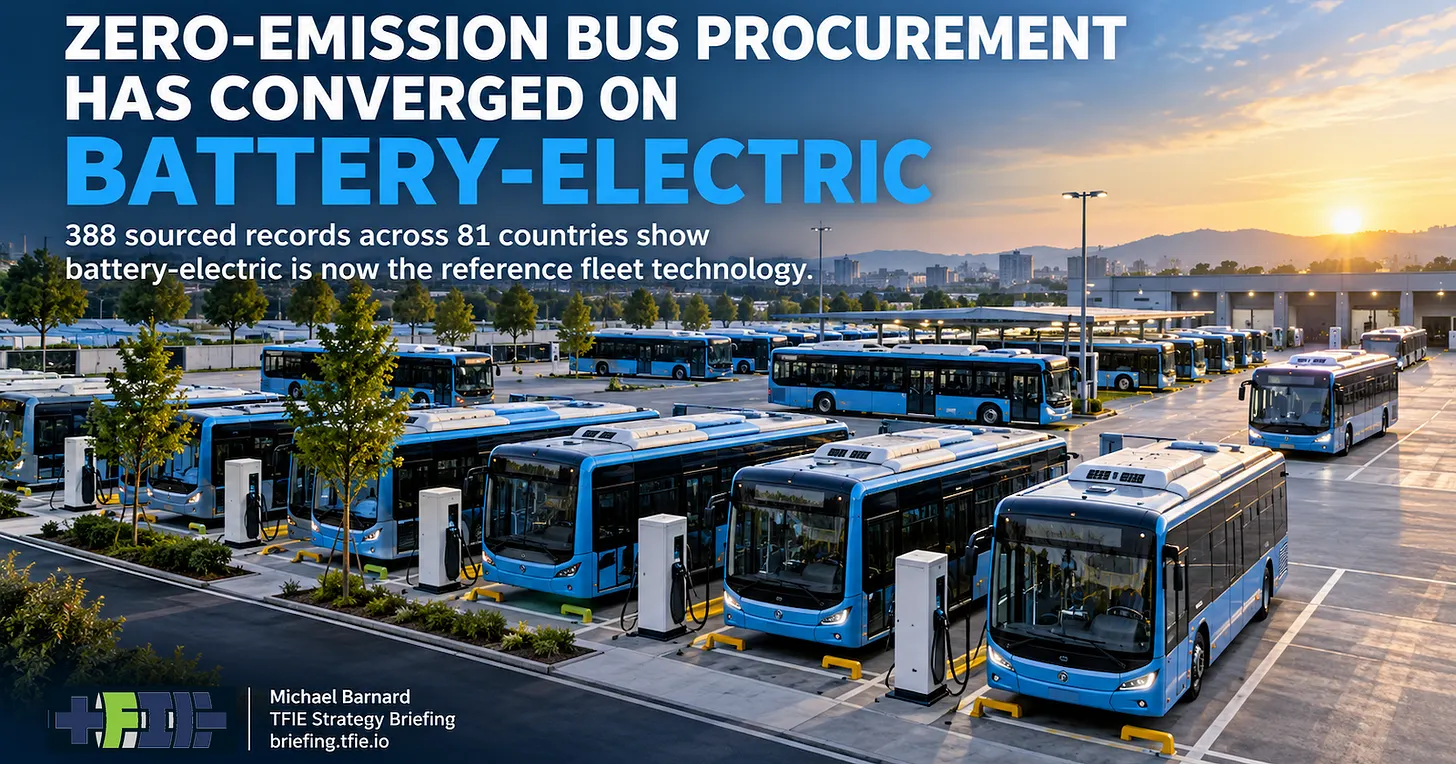
I assembled a global procurement register with 388 sourced documents throughout 81 nations, separating firm orders and honors from tenders, alternatives, framework amounts and moneying statements. On that particular conventional basis, the register includes 13, 165 company battery-electric buses and 65 hydrogen fuel-cell buses. The difference in breadth is equally as striking: battery-electric orders originated from 55 buying bodies, while all 65 hydrogen buses originate from two.
The full TFIE Approach Rundown analysis goes behind those total amounts right into both hydrogen purchases, the country-level robustness checks and the procurement register itself. The concentration of hydrogen purchasing is at the very least as exposing as the vehicle matter.
Purchase data require care due to the fact that public news consistently describe the exact same buses a number of times. A tender, an award and a shipment news can all refer to one purchase, while framework options might never be worked out and funding approvals do not always end up being agreements. That is why the firm-order complete issues. It stands for identifiable acquiring choices rather than every optimistic number that has actually appeared in a news release.
The resulting split is a little over 200 battery-electric buses for every hydrogen bus, with battery-electric representing concerning 99 5 % of the company acquisitions caught for both innovations. The forward procurement record factors in the same direction, with thousands a lot more battery-electric buses noticeable in open procedures and a much smaller hydrogen pipe. Buses delivered today can show decisions made a number of years ago; present tenders and awards reveal what agencies are selecting after soaking up much more current operating experience.
The register is not a census of every bus purchased all over. Purchase openness differs extensively, and Chinese community honors, European tenders and North American multi-year agreements do not map nicely onto one another. Some acquisitions will inevitably be missing. But removing a 13, 165 -to- 65 void would need a huge hydrogen purchase market to have actually left the general public document while battery-electric purchasing stayed noticeable throughout lots of nations. I discovered no evidence of such a market.
Both hydrogen buyers are worthy of reasonable treatment since they demonstrate that the modern technology can still make sense under specific problems. Qingyang in China is intentionally building a municipal hydrogen ecological community, working with buses, gas supply and refuelling facilities as part of a more comprehensive development program. Krefeld in Germany is the stronger commercial counterexample because the operator already has hydrogen buses in service and chose to buy more after acquiring operating experience.
What those instances do not show is replication. After years of hydrogen-bus presentations, aid programs, refuelling facilities and producer development, the firm procurement document still decreases to one Chinese metropolitan hydrogen programme and one German metropolitan driver making a repeat acquisition. Battery-electric procurement, on the other hand, is distributed throughout lots of customers operating under various environments, grids, course frameworks and policy routines.
That does not make big battery-electric fleet conversions very easy. Depot power can need new substations and multi-megawatt connections, utility interconnection can take years, and billing systems, software application and routines have to work reliably enough to put buses onto the street every morning. Those are worldly constraints. Significantly, however, they are deployment issues associated with the technology agencies are extremely selecting as opposed to evidence that the propulsion choice continues to be evenly well balanced.
For regular metropolitan and country bus procurement, battery-electric should currently be the default referral modern technology. Agencies need to start with the architecture that has by far the deepest procurement base, broadest vendor community and biggest body of operating experience, after that ask whether a details regional restriction warrants departing from it. Technology nonpartisanship implies applying the very same solution, dependability, exhausts and expense needs; it does not call for acting that modern technologies with radically different commercial recommendation courses existing equivalent danger.
Hydrogen must currently be dealt with as the exemption that has to establish its case. A proposition must recognize a material duty-cycle, depot-power or functional constraint that battery-electric buses and sensible charging can not fix financially; show that hydrogen solves it at appropriate whole-system cost; establish a qualified long-lasting gas supply; and show that the operational advantage is big sufficient to validate dedicated production, transport or on-site generation, compression, storage and giving framework.
If a hydrogen proposal clears those tests, a company has a factor to purchase hydrogen buses. What the proof no more sustains is resetting every procurement to absolutely no and acting as though battery-electric and hydrogen are 2 equally fully grown options awaiting another openly funded test.
The plan top priority ought to relocate with the marketplace evidence. For battery-electric fleets, the vital issues now include grid planning, depot links, billing reliability, workforce ability, functional software application and funding. Resolving those restraints is more probable to increase zero-emission transit than continuing to money comparative presentations whose basic modern technology inquiry has actually currently been answered repeatedly in purchase.
The full TFIE Approach Rundown checks out the two hydrogen purchases separately, tests whether existing fleet sizes clarify the result and provides the underlying 388 -record procurement workbook.
Sign up for CleanTechnica’s Weekly Substack for Zach and Scott’s thorough analyses and high level summaries , sign up for our day-to-day e-newsletter , and follow us on Google News
Have a tip for CleanTechnica? Intend to advertise? Intend to suggest a guest for our CleanTech Talk podcast? Get in touch with us here
Sign up for our daily newsletter for 10– 15 brand-new cleantech stories a day Or sign up for our weekly one on top stories of the week if day-to-day is as well regular.


CleanTechnica uses associate web links. See our policy here