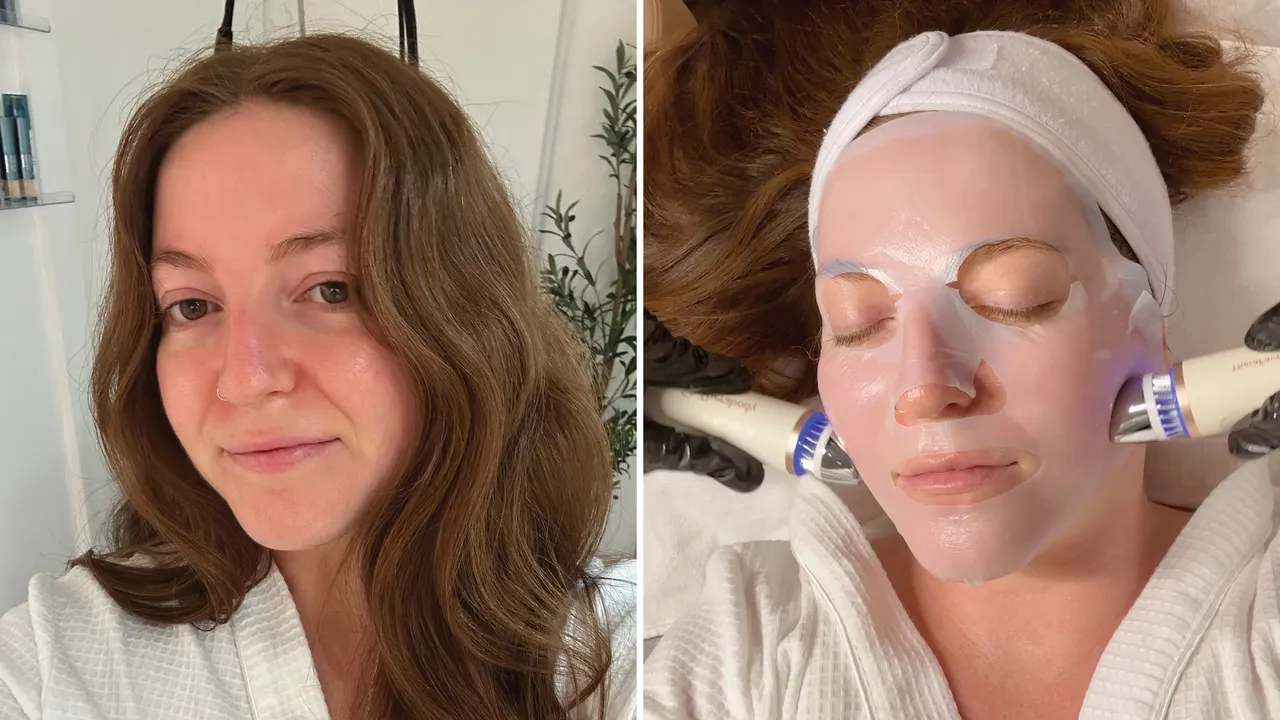
Regardless of what you call it—dewy, glass, glazed-donut, or mochi skin—it seems the vast majority of us are in pursuit of the same thing: a bouncy, luminous, ultra-hydrated complexion. I certainly was, especially after a packed summer at the beach. As the temperature dropped, I noticed my face looked dull and lifeless, and while there could be many causes for that, the main culprits for me were dehydration and a buildup of dead skin cells.
A great skin-care routine helps, but it can get you only so far. Once we seem to have reached that plateau, many of us turn to professional-grade treatments for an extra boost. Enter Glacē, Hydrafacial, and DiamondGlow, three facials that supposedly restore your glow. Each of them has zero downtime, is tolerable on most skin types, and is based on a three-part skin-resurfacing regimen: cleansing, exfoliating, and infusing the skin with serums. They’re all performed using similar devices that help vacuum gunk out of blackheads and whiteheads, and help topicals penetrate the skin more effectively.
But what makes these three options stand out in the industry? I tried them all to give you the lowdown.
Glacē
Glacē—pronounced “glassy,” because its main objective is to give you glass skin—is a fairly new treatment, launched in 2025 by Candela. It’s a non-invasive facial that combines hydrodermabrasion (a fancy word for vacuuming pores while pushing actives into your skin), LED light therapy, and lymphatic massage. This is a great facial for anyone looking to boost hydration and radiance, but also experience cooling and soothing treatment, according to Sameer Bashey, MD, a board-certified dermatologist and clinical instructor in dermatology at the University of Southern California in Los Angeles.
With that, Dr. Bashey had described me to a T, so I booked a visit with Julianny Goncalves, an aesthetician and founder of On Esthetic in lower Manhattan. We started my Glacē treatment with a double cleanse to rid my face of any debris (hello, subway air). Then, Goncalves used two TheraFace Depuffing Wands (a two-time Best of Beauty winner) on my face and let me relax under a facial steamer for a few minutes to further loosen up whatever might be clogging my pores.
She reached for a handheld device equipped with “diamond-integrated disposable tips” for the main event: hydrodermabrasion. (Both Glacē and DiamondGlow have diamond-encrusted tips in the devices used during the exfoliation step, while Hydrafacial recently introduced the feature as an add-on.) “Diamond is an exceptionally hard material, so tiny diamond particles create a durable, textured surface that buffs away dead skin cells as the wand moves across your face,” says Mona Gohara, MD, a board-certified dermatologist based in Hamden, Connecticut. “Think of a nail buffer smoothing a rough nail, only with a tool designed specifically for skin. Removing that uneven buildup makes skin feel softer and reflect light more evenly, which translates to glow.” Since the intensity is adjustable, this works for a variety of skin types—it’s just not recommended for people with irritated skin or an active eczema or rosacea flare.