With the exception of the Cypher design of the late 1980s, helicopter maker Sikorsky didn’t really step into the world of uncrewed aerial systems (UAS). That changed recently, when the company entered the Defense Advanced Research Projects Agency’s (DARPA) AdvaNced airCraft Infrastructure-Less Launch And RecoverY (ANCILLARY) program back in 2023.
The effort is meant to come up with vertical take-off and landing (VTOL) drones that can be operated without specialized tools and can fly from the most austere of environments. As per the requirements of the program, the hybrid-electric-powered designs have to weigh 300 pounds (136 kg) and be able to carry a 60-pound (27 kg) payload.
Sikorsky’s answer to DARPA’s request was something called the Nomad 50, presented in the spring of 2024. Seeing the impact it could have on military operations, but not only that, the company turned the design into a family of drones. And it’s the larger Nomad 100 that’s the focus of our story today.
The design performed its first flight in the summer of this year, so it’s not really operational yet. That isn’t stopping the helicopter maker from imagining new ways of deploying and operating the drone in the hands of the military.
Remember Ukraine’s Operation Spiderweb from the summer of 2025 against five Russian Air Force bases deep inside Russia, which involved the use of drones hidden inside civilian trucks? That’s the first thing that came to mind when stumbling upon Sikorsky’s Nomad 100 fast pack idea.

Photo: Sikorsky
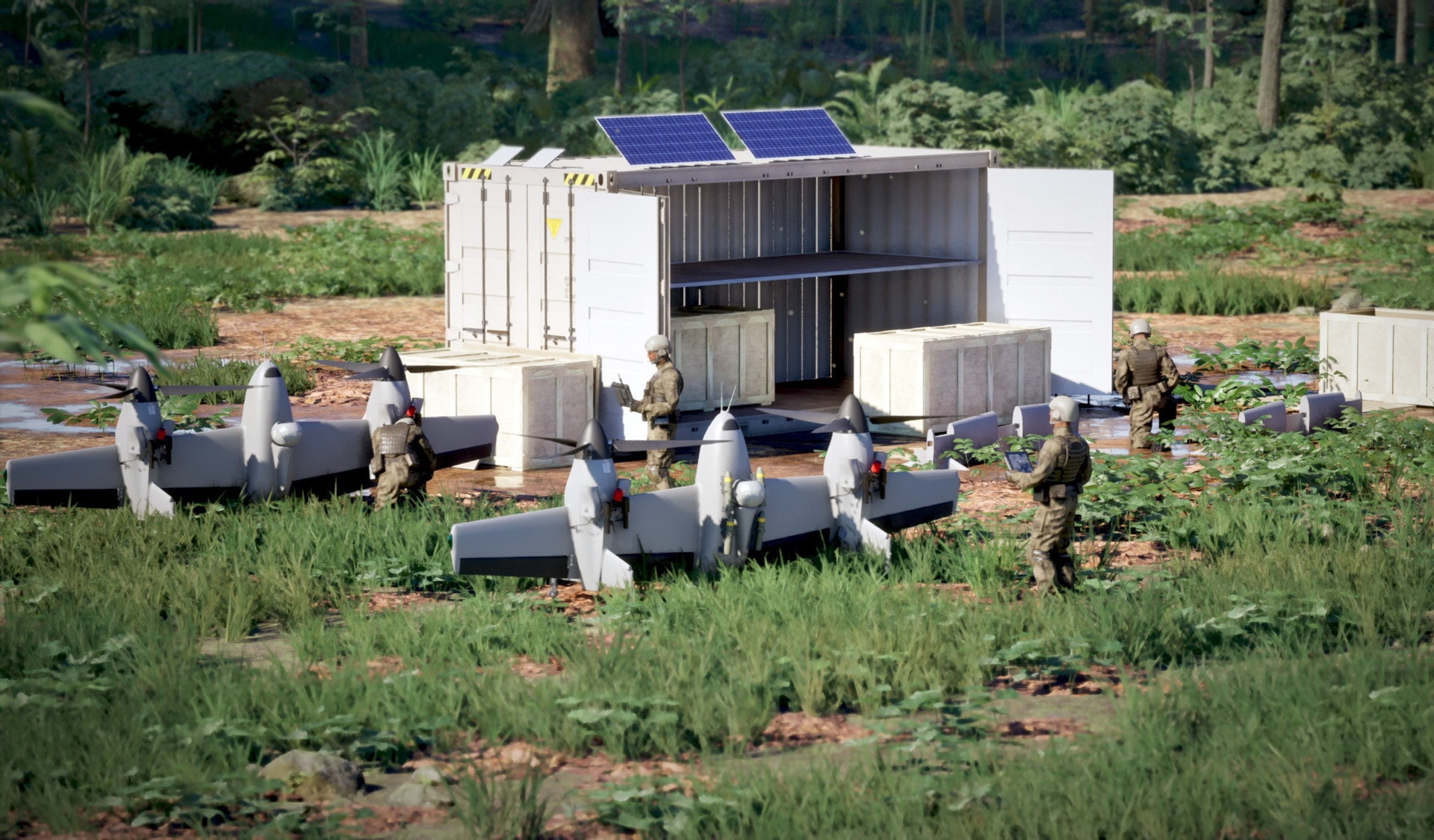
What we’re dealing with is basically a containerized launch kit for the Nomad 100, centered around a single 20‑foot (six meters) ISO container that can hold a total of four such drones, but also the required mission‑command software, power, communications, and sustainment equipment.
The idea behind this concept is that, instead of transporting individual drones or launching them from afar, operators can deploy the container in austere and infrastructure-limited locations, from where they can launch the Nomads on the heads of unsuspecting enemies.
The American defense contractor says this setup allows maximum mobility, rapid set‑up, and minimal personnel requirements, promising that two of the Nomads housed inside the container can be ready to fly on missions in as little as 15 minutes, while the other two over the next four to six hours. Not exactly as fast as what we’ve seen during Operation Spiderweb, then again, we’re talking about entirely different kinds of drones.
Sikorsky’s kit has been designed to be used from remote areas, but also naval vessels and staging areas. Because it’s a container we’re talking about, it can rapidly be moved to where it’s needed, ready to fulfill missions ranging from reconnaissance and light attack to contested logistics and more benign uses such as forestry and firefighting.

Photo: Sikorsky
For now, this idea is more like a concept, as the Nomad 100 drone it’s meant to serve is not really ready for duty. It only recently performed its first flight, completing the initial ground and flight testing. That also means its technical specifications are kept under wraps for now.
We do know, though, that as far as drones are concerned, this one is pretty wacky. That’s because we’re dealing with a rotor-blown wing design.
What this means is that we’re basically talking about a tail-sitting aircraft shaped like a flying wing. It has motors and propellers installed toward its tips, and vertical structures to the left and right that act like landing legs.
This design allows the drone to take off and land like any other helicopter in the world, then, as soon as a certain altitude is reached, switches to a mode of operation akin to that of a fixed-wing aircraft.
What makes this a proprotor is the fact that it uses the same propellers to climb and fly, making air move over the proprotor wash and across the wing. This means there’s less drag when hovering and when transitioning to horizontal flight.

Photo: Sikorsky
Sikorsky never said what powers the drone, but, as per the requirements of the DARPA program, we expect to see a hybrid-electric powertrain. The company’s Matrix autonomous solution is what makes up the drone’s mind.
After announcing the drone’s first flight this summer, the company also said the Nomad family of drones will enter an intensive flight test campaign. It is supposed to unfold at an unnamed government facility, where engineers will try to replicate the many use-case scenarios for the drone. We have no information on how that’s going at the time of writing.
When ready for duty, the Nomad could also be used in loyal wingman roles in support of crewed aircraft, but we’re yet to see any steps being made to prove this capability.
The Sikorsky UAS was not the only one developed for the DARPA program, whose status is currently unclear. The list also included the AeroVironment Wildcat and drones made by Griffon Aerospace, Karem Aircraft, and Method Aeronautics.