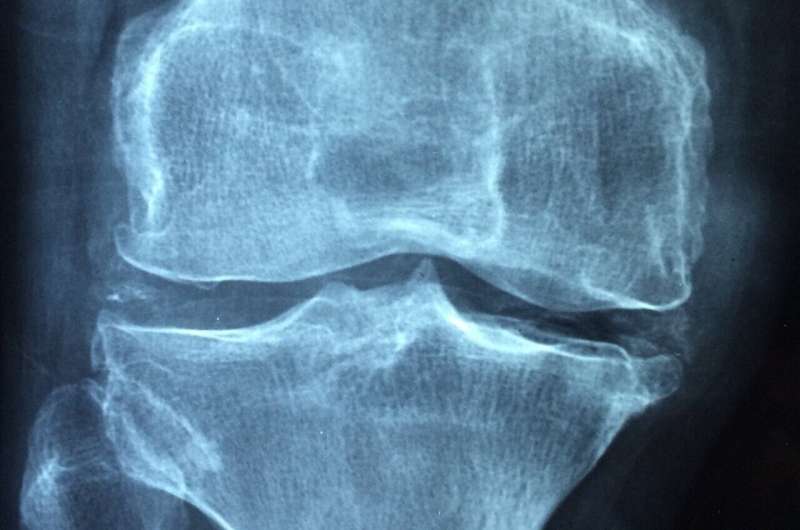
As we age, our bones become weak and brittle, a process called osteoporosis. This bone loss is caused by changes in the cells within the bone marrow microenvironment, such as elevated fat and inflammation-promoting immune cells. One molecular driver of inflammation is the STING signaling pathway, though the role of this pathway in aging bones has until now been unclear.
In a new study, published in Advanced Science, researchers discover that the STING pathway is activated in bone marrow macrophages during aging and could be a target to prevent bone loss.
STING’s effects shift with age
The STING pathway is part of the innate immune system, sensing and protecting against infection, cellular stress and cancer. The researchers found that this pathway is increasingly activated in bone marrow macrophages with age. Bone marrow macrophages (BMMs) are immune cells that protect against pathogens and can increase inflammation, a hallmark of skeletal aging.
The researchers investigated the STING pathway with mice lacking the STING protein in bone marrow cells. Surprisingly, at a young age, mice lacking STING showed reduced bone density, but later in life, mice lacking STING were protected against bone loss.
Aging fat cells trigger inflammation
To determine what activated the STING pathway in BMMs, the researchers turned to a different bone marrow cell: fat cells, called bone marrow adipocytes (BMAds). By isolating BMAds from older mice and culturing them with BMMs from young mice, they found that BMAds promoted STING activation in BMMs.
Aging BMAds can stop dividing and functioning properly, a state called senescence. Senescent BMAds can also secrete harmful factors. The researchers identified DPP4, a protein secreted from BMAds, as a harmful factor that activated the STING pathway, induced inflammation and contributed to bone loss.
NAD⁺ depletion undermines bone repair
Looking downstream of STING activation, the researchers discovered a depletion of NAD⁺ in surrounding bone marrow cells. NAD⁺ is an essential molecule involved in metabolism, signaling, DNA repair and more. Decreasing NAD⁺ in bone marrow stem cells prevented them from differentiating to form and repair bone, which contributes to skeletal aging.
In this study, the researchers elucidated how the STING pathway contributes to bone loss, connecting a molecular pathway across three cell types implicated in skeletal aging.
“Consequently, these findings position STING signaling in bone marrow macrophages as a pivotal integration hub, highlighting its targeting potential for comprehensive management of the complex bone marrow microenvironment during skeletal aging,” the authors wrote.
Publication details
Zhichao Li, et al. Bone marrow macrophage STING signaling is a direct nexus linking marrow adipose expansion to NAD+ depletion and osteogenic decline in skeletal aging, Advanced Science (2026). DOI: 10.1002/advs.77571
Journal information:
Advanced Science
Clinical categories


Citation:
Can we take the STING out of bone loss? Pathway presents potential treatment target for skeletal aging (2026, October 15)
retrieved 15 October 2026
from https://medicalxpress.com/news/2026-10-bone-loss-pathway-potential-treatment.html
This document is subject to copyright. Apart from any fair dealing for the purpose of private study or research, no
part may be reproduced without the written permission. The content is provided for information purposes only.