The first- and last-generation Packards have been parked in Jay Leno’s Garage. The “grandpa” and “grandson” have been shipped across the country all the way from Newport, Rhode Island, where they have been residing in the Audrain Auto Museum, to Los Angeles, California, to be on Jay Leno’s show.
The one who accompanies the Packards is Donald Osborne, Classic and Exotic Car Appraiser and Consulting Director of the museum. The grandpa is a 1902 Packard Model F, one of the four known to have survived, while the grandson is the 1956 Packard Caribbean.
The story of the Packard automobiles dates way back. The company was founded in 1899 in Warren, Ohio, by brothers James Ward and William Doud Packard, and their business partner, George Lewis Weiss.
It all started after James Ward Packard bought a car from the Winton Motor Carriage Company in Cleveland. Unhappy with its frequent mechanical failures, he went to give his honest feedback to Alexander Winton. Winton told him to build a better car. And that is exactly what he did.

Photo: Jay Leno’s Garage | YouTube
The trio completed its very first motor car, the Packard Model A, in 1899. They originally operated under the umbrella of their already existing electrical and wire-making business in Ohio. Before the company relocated, wealthy investor Henry Bourne Joy bought an early Packard and absolutely loved it.
Big in Detroit
He traveled to Ohio to meet its creators. Realizing the company needed major capital growth, Joy and a group of investors financed the business, leading to the company reorganizing as the Packard Motor Car Company in 1902 and physically relocating to Detroit, Michigan, in 1903.
That is the era the 1902 Packard Model F comes from. The Model F dropped as somewhat of a revolutionary car at the time, a massive shift from the fragile “horseless carriage” that Packard used to build before. It was, however, the final single-cylinder vehicle that the company produced.
That single-cylinder engine was a massive, four-stroke 184-cubic-inch (3.0-liter) unit, which produced 12 horsepower. It idled at a very low 200 rpm and redlined at just 800 rpm, pushing the car to a top speed of 30 mph (48 kph).
A three-speed Selective Sliding-Gear Transmission with an “H-pattern” shift layout put the power down through those fragile-looking rear wheels. Still, they were far more solid than the flimsy bicycle-style wire wheels of the previous Packards.

Photo: Jay Leno’s Garage | YouTube
Speaking of which, the open-top model rode on 14-spoke artillery wood wheels equipped with 33 x 4-inch pneumatic tires. The Model F also implemented the steering wheel as we know it today, while many vehicles of the era still used steering tillers, similar to those of a boat rudder.
Ford F-150 Raptor money
The Model F was Packard’s most expensive model in 1902, aimed exclusively at wealthy buyers. It came in two flavors: the two-seat open-air variant priced at $2,250, and the four- or five-passenger versions, which started at $2,500, the equivalent of approximately $77,000 today, which is nearly Ford F-150 Raptor money.
To prove that cars were practical for long-distance traveling and not just short-trip toys, a modified Model F named “Old Pacific” completed the famous San Francisco-to-New York cross-country route. It took the Packard employee 61 days to reach his destination. There were no roads, no maps, not to mention navigation…
Packard built only 179 units of the Model F across 1902 and 1903. Today, only four original examples are known to have survived, which makes them priceless collectibles.

Photo: Jay Leno’s Garage | YouTube
Fast forward to 1956, and Packard rolls out the final model, the Caribbean, before production halted. The model that was advertised back then as America’s most glamorous sports car. Jay Leno has the poster up on the wall of his garage, right above his own Packard Caribbean. That ad was not Packard overpromising and underdelivering.
The most powerful Packard engine
The convertible is powered by Packard’s largest-ever engine, an overhead-valve V8 with a displacement of 374 cubic inches (6.1 liters). Fitted with dual four-barrel Rochester carburetors, it produced 310 horsepower and 405 pound-feet of torque. In 1956, the Caribbean was the highest output of any American production car.
A Twin-Ultramatic automatic transmission, which featured a futuristic, electronic push-button gear selector pod mounted on the steering column, put the power to the ground through the rear wheels. In fact, pretty much everything was futuristic about the car.
Instead of the traditional steel springs, the Caribbean came with chassis-length torsion bars connecting the front and rear wheels. An electric motor and sensors automatically adjusted shorter leveler bars to keep the car perfectly flat, regardless of passenger weight or luggage, offering a “magic carpet glide.”

Photo: Jay Leno’s Garage | YouTube
Developed by Dana specifically for Packard Caribbean in 1956, one of the first mass-produced limited-slip differentials were fitted to the car, channeling power away from a slipping wheel to improve handling on slippery roads.
As for the looks, the model came with a striking three-tone paint scheme, separated by thick chrome moldings. It featured dual fiberglass hood scoops, elegant cathedral-style taillights, dual power rear antennas, and a standard Continental tire kit.
The hand-stitched interior featured unique reversible cushions with leather on one side and plush brocade cloth on the other. Unlike competitors where luxury features cost extra, the Caribbean came standard with power steering, power brakes, power windows, dual heaters, a Wonderbar signal-seeking radio, and electronic swiveling power seats. Factory air conditioning was one of the very few options.
Only 539 such units were built before production permanently ended at the factory in Detroit in June 1956, with 276 convertibles and 263 hardtops. So the one in Jay Leno’s Garage is one of the 276 that saw the light of day.

Photo: Jay Leno’s Garage | YouTube
Back then, the Packard Caribbean convertible started at nearly $6,000, the equivalent of roughly $70,000. It was the second most expensive car on the American market, trailing only the ultra-exclusive Continental Mark II.
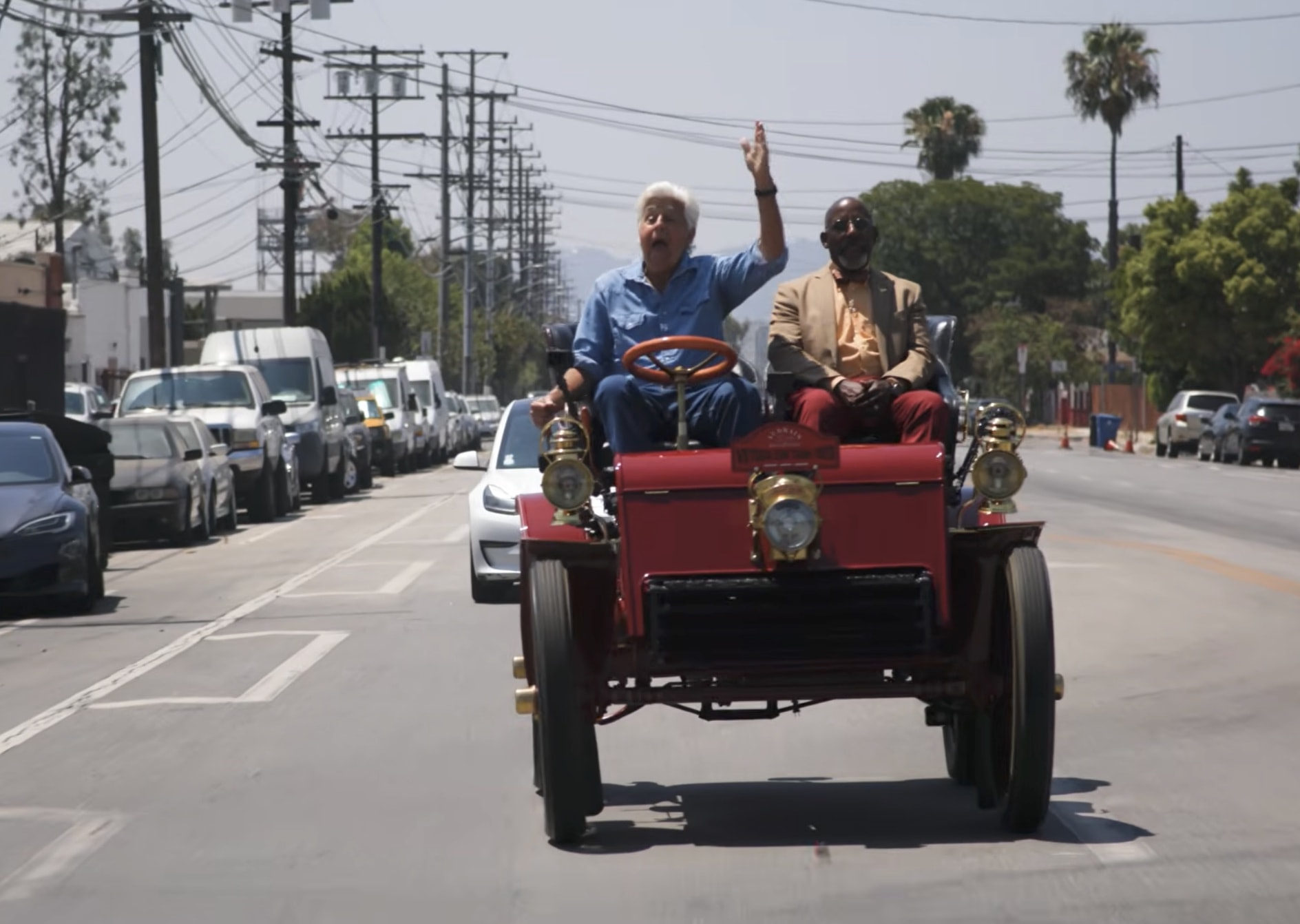
But that’s not what Jay Leno drives on the latest episode. He has driven the Caribbean a gazillion times before. It is the 1902 Model F that he takes out for a spin. The moment he fires up the engine of the 1902 Packard Model F, the car starts vibrating as if an earthquake just started, and the studio fills up with smoke. Once out in the wild of the city, people wave at them, and they wave back.
The vibration is still there, giving them the feeling that it is a wild horse, ready to throw them off. It is actually 12 horses, but all are tamed. Jay Leno feels inspired: “Shift into high and wave bye-bye.” To him, the Packard Model F feels like the perfect car for going out to get ice cream on a Sunday morning