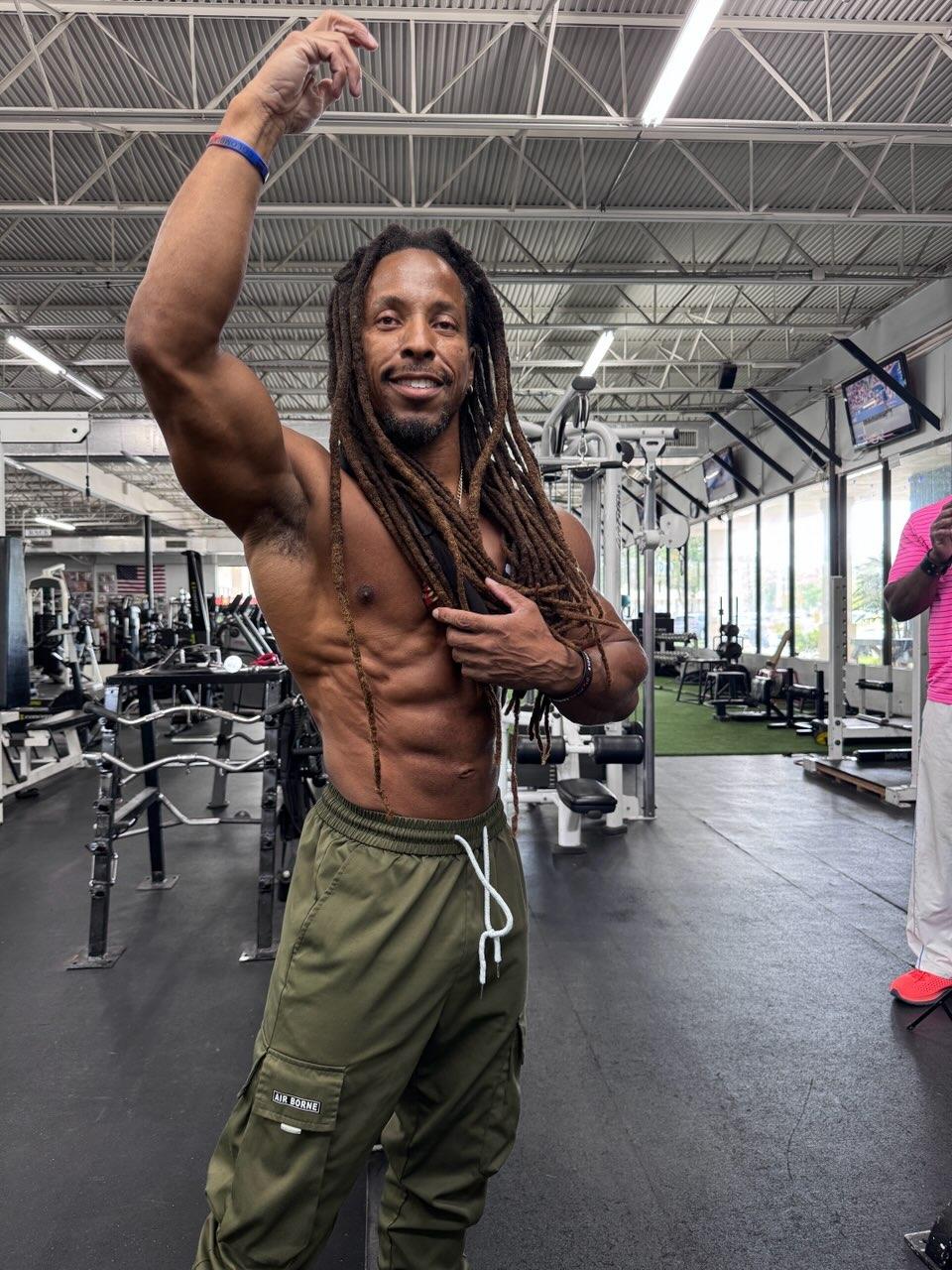
When bodybuilder Torre Washington stepped on the stage of the Las Vegas Convention Center the morning of September 26th to compete in the men’s physique category of Olympia 2026, that he is 52 and all-natural—has tested negative for performance-enhancing drugs, that is—were the least unusual things about him. There was something else that set Washington apart from all his opponents in men’s physique, and, indeed, from everyone else who has ever competed in any Olympia event—male bodybuilding’s biggest contest, whose previous era-defining champions include Arnold Schwarzenegger, Lee Haney, Ronnie Coleman, Dorian Yates, and others.
Washington is a vegan.
Washington was raised vegetarian in a Seventh-Day Adventist household with, he says, “the idea that we should be eating as they ate in the Garden of Eden,” alluding to the fact that Genesis does not describe meat-eating until after the Fall. In his teens, he moved to Jamaica to live with his grandparents for a few years. That’s where he first encountered Rastafarianism, which advocates what’s known as ital, a plant-based diet that prohibits most additives and processed foods. “In Jamaica, we don’t bring animals into the house,” Washington says. “We don’t consume animals. We don’t consume flesh.” Going to an entirely plant-based diet brought noticeable health benefits, even at this early age. “When I was younger, I had asthma,” Washington recalls, describing how he would get short of breath when running sprints in Alabama and later in Jamaica. “Once I went fully vegan, I never saw that happen again.”
Washington returned to the US for college, then worked as a mechanical engineer for about 14 years, with some of that time in Japan and the Philippines. In 2009, he started entering natural bodybuilding competitions; the natural designation means that competitors must submit to and pass urine and polygraph tests for performance-enhancing drugs. “I was running through the ranks of all the natural bodybuilding organizations,” Washington says. “At a certain point it became easy for me to win or place in the top three.”
A few years later, he began competing on Vegan Strong’s PlantBuilt team, a collective of more than 60 elite plant-based athletes, coaches, and educators that has had members compete in the major competitions of bodybuilding, powerlifting, strongman, and other events. Washington eventually earned his International Federation of Bodybuilding (IFBB) pro card in 2018. He had long set his sights on the Olympia, but, having not qualified by age 50, he considered giving up competitions. “I’m getting older,” he recalls thinking. “I guess it’s that time.” After his mother’s death in early 2025, though, he redoubled his efforts, vowing to win for her. He subsequently took first place in the Las Vegas Pro/Am open and over 40 in May, and in the men’s physique open and over 40 at the Ben Weider Natural in November. It was those two triumphs that qualified him for the Olympia.
Despite Washington’s achievements and the achievements of others in Vegan Strong, there are still misconceptions that being a bodybuilder, or even being fit, means eating lots of animal flesh. “Vegan still has that stigma that we’re small, skinny, don’t have enough muscle to compete,” Washington says.
As a high-level competitor and a trainer in his own right (he has a NASM certification), Washington has suggestions for those considering going vegan or starting to train, for vegans who want to improve their diet and fitness, and for the few with aspirations to compete. “The first thing,” he says, “is just to start.” Many people hesitate to make the change, worrying that they won’t get enough protein. But, he points out, “When they’re not vegan, they’re not even thinking of protein,” Washington says. “The assumption is that because they’re consuming animal flesh, they’re getting enough protein, but they might not be.” Nearly all plants contain some protein, with leafy greens and sprouts (such as of broccoli or lentils) being especially high in protein and dense with macronutrients.
For good sources of protein, Washington also recommends spirulina (a supplement made from blue-green algae and available as a powder or tablet), tofu (made from fermented soybeans), textured vegetable protein (also made from soy), fava bean tofu (a no-carb, no-fat variant made with fava beans), seitan (made from vital wheat gluten), and pea protein. There are also various protein shakes (often made from some blend of pea, hemp, soy, amaranth, quinoa, chia seed, and brown rice), which can be good for increasing protein intake and promoting satiety without adding in too many additional carbohydrates or fats. Nut butters also provide plenty of protein, though Washington notes these are often also high in fat.
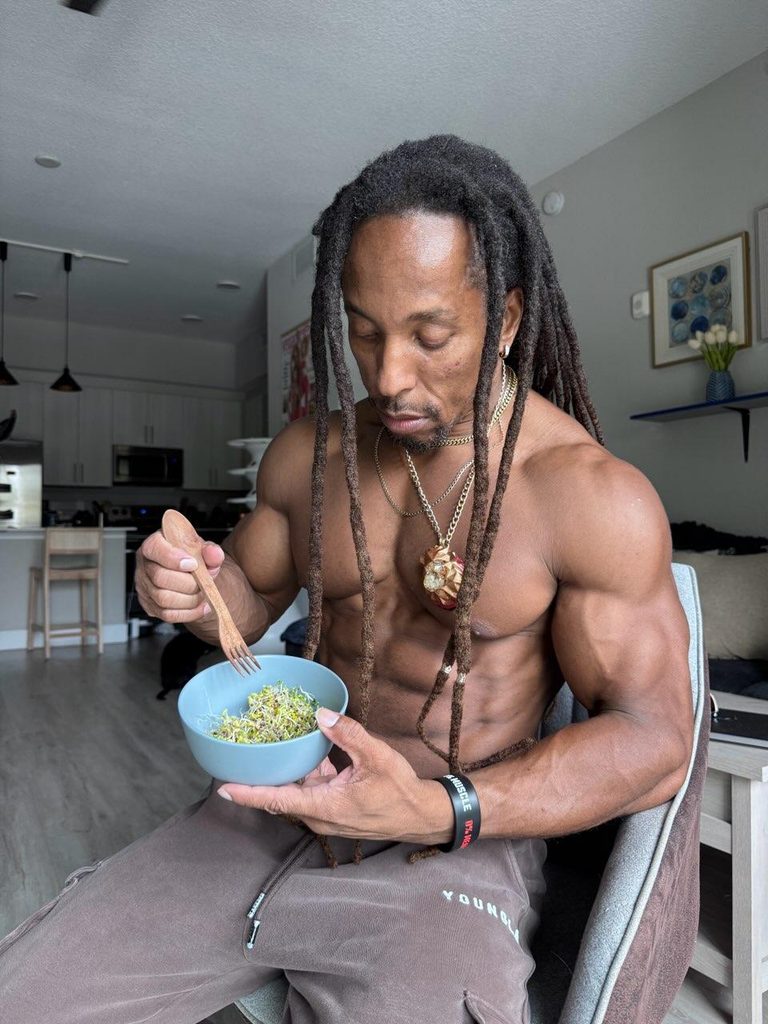
For people concerned with general health, those general guidelines may be enough. For those with athletic goals, however, more calculation is necessary. “Say the average individual is a 180-pound male,” Washington says. “He should be consuming 195-200 grams of protein with the goal of 25-30 grams or more per meal.” The longstanding belief that the body can’t absorb more than about 35 grams of protein from a meal, he says, is “not necessarily true,” though in his experience some forms of protein (such as divided wheat gluten) can take longer to digest. Knowing his recommended protein intake and daily caloric needs, the trainee can subtract the protein calories (4 calories per gram of protein) from the overall caloric budget for the day. Of this remainder, Washington recommends getting 70% of calories from carbohydrates (4 calories per gram) and 30% from fats (9 calories per gram). As for supplements, Washington recommends protein shakes (high in protein and low in carbs, to “meet the protein amount without the detriment of going over too much in my other nutrients”), creatine (“I basically live by that now. I like to have it in my system prior to training”), and, the supplement he has been using the longest, green tea (for which, he says, there is some scientific data showing that drinking it after training helps “support testosterone sticking around a little longer after a workout”).
As for training, Washington recommends that complete beginners start with bodyweight exercises. By practicing the form on fundamental movements such as squats, pushups, pullups, and lunges, Washington says new trainees can become “comfortable with how the muscles of their bodies work.” From there, people can progress to using bands, which stress the muscles differently since the tension in the band increases through the range of the movement. Then come free weights such as dumbbells and barbells. “Free weights is another ball game,” Washington says. “Now you’re having to stabilize yourself.”
When training for hypertrophy—that is, for adding muscle mass—Washington recommends training opposing muscle groups together, pairing large muscles with smaller ones—back, shoulders, and triceps on one day, chest and biceps on another, and legs on their own day. Whichever group one is focused on growing should be trained two to three times per week (as is also the case for calves, “which can be stubborn because they’re so used to activity”), with weight heaviest on the first day, somewhat less heavy on the second day, and light on the third. Reps should be done in all ranges but mainly higher ones, such as 12-18 per set. “Sometimes I like to do 20-30 reps,” he says. “Volume does help build muscle and is less intense on the joints. We’re looking for longevity.”
After about 12 weeks, the rep range should be varied to continue challenging the muscles. For elite-level training, such as for competitions, Washington suggests training twice a day, doing, for example, chest in the morning and biceps in the evening. “It all depends on the time you have to put toward the lifestyle or body you’re looking for,” he says.
Rep ranges and splits are not, however, the only important variables. “People say they train,” Washington remarks, “but are they intense?” People may be going to the gym but not challenging themselves. “This is where a lot of people fall,” Washington says. “We don’t know how far we can go until we push ourselves.” He recalls a time earlier in his career when he trained with someone he respected. “It changed how I saw what true intensity was,” he says. “I saw the difference.”
Washington’s own preparation for the Olympia has certainly been intense. In the 20 weeks leading up to the contest, he progressively cut his normal intake of 3,500-5,000 calories to 1,300-1,400 to reduce fat and bring out muscle definition. “When you’re competing, you’re looking to have a body fat [percentage] in the sub-tens,” he says.
In the week before Olympia, he drank two gallons of water a day, then drastically cut that to near-dehydration levels in the day before the show. “I’m truly hyper-focused on Olympia,” he said three weeks before the show. “I want to present my major strengths and showcase my physique in the best light possible so the judges can see what can be accomplished on plants, at my age, and all natural.”
Although the judges ultimately awarded first place in men’s physique to Ryan Terry (who also won in 2024 and 2025), in the weeks leading up to the Olympia, Washington felt that making it to the contest stage was itself an accomplishment. “There used to be a time when people would say you’ll never see a vegan in Olympia,” he remarked. “Being a vegan and being on that stage, I think we already won.”