In the unnerving docu “Third Land,” director and Iranian émigré Farzad Khoshdast chronicles the permanent limbo of a family living on the margins in Turkey.
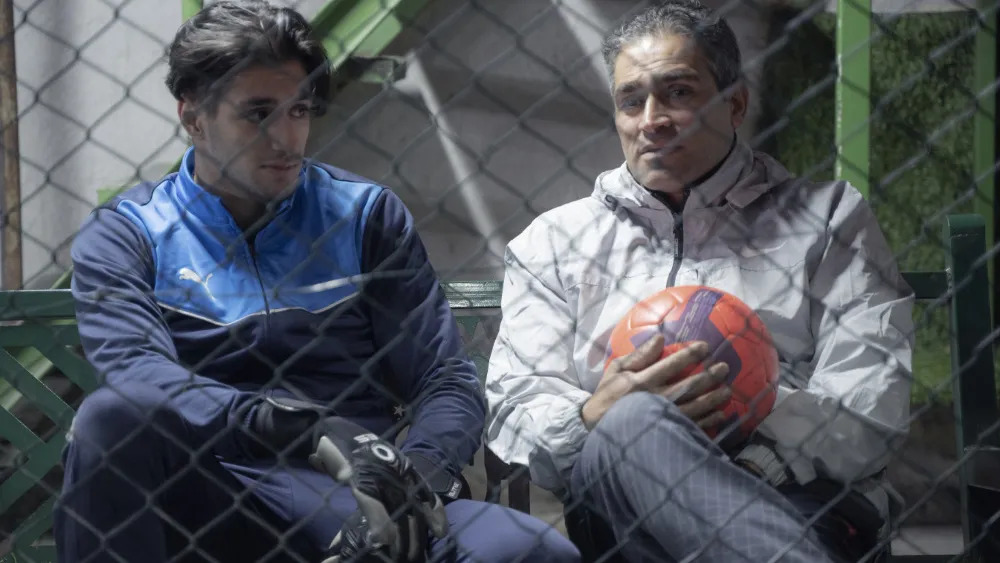
Screening at the Ji.hlava Documentary Film Festival this week, the film follows an Iranian engineer, his wife, Hananeh, and son as they deal with the daily contradictions of life as refugees in a third land – that is, one where their refugee status has been recognized by international aid organizations but their legal residence has not been.
Khoshdast, who more than once risked arrest while filming his subjects, says he felt it was essential to capture the bare bones of his subjects’ existence.
Gaining their trust, he says, took “around two years, perhaps a little less, but across three distinct periods. I had become familiar with their lives and understood the repetitive cycle of their daily routines. I decided to bring together footage shot during those three periods as the film’s opening three episodes, creating the impression that everything was happening over just one or two days, as though three crews had been filming simultaneously.”
He calls this approach to storytelling, and the way it brings different periods of time together, “one of the film’s important structural features.”
Khoshdast and his wife were traveling in Turkey about four years ago, he says.
“That was when we met Hamid and his family. I told him about my own life and the harm I had suffered at the hands of the Islamic Revolutionary Guard Corps. Hamid asked me, ‘If I tell you my story, will you write it down?’ I replied, ‘As it happens, I’m a documentary filmmaker, and I’d like to make a film about you.’ They later invited us into their home, and everything began to take the shape I had hoped for as a filmmaker.”
Indeed, Hamid’s family shares the exhaustion, trauma and confusion they experience as they face maddening delays in getting work permits while forced to find employment under the table.
Meanwhile, a sense of paranoia grows as police interest represents a constant threat.
“We filmed in three locations: Ankara, our main location; Alanya, where Hananeh worked; and an industrial town near Istanbul, where Hamid worked,” Khoshdast explains.
“The circumstances were extremely tense and frightening. We were detained two or three times. The most serious incident happened in Ankara, some time after a terrorist attack. One night, following the filming of an elevator scene, officers came to Hamid’s home intending to detain me. Friends intervened that night and gave assurances that I would report to the police station the following day.”
“On another occasion, a Turkish citizen falsely reported that we had been filming President Erdoğan’s home! When I was detained, I thought I was going to have a heart attack. I had filmed inside prisons in Iran and had been arrested there, but this was something else entirely.”
As worries grew that Hamid and his family might be under surveillance, their story became still more complicated.
It illustrates what may be happening to as many as half a million Iranians who have been forced to flee their home country, the director says.
“But for me, as an artist,” he says, “even one family trapped in such circumstances is one family too many.”
“Depression and homesickness can be particularly severe for Iranians in countries such as Turkey. They have left their homeland, yet in a sense they have not truly been able to begin a new life elsewhere. They remain in limbo.”
“Many eventually return home with nothing. But Hamid and his son can never return. Hamid struggles to carry on, but he has no other choice.”
This father’s journey is doubly poignant, the director says, because he chose to leave a promising career in Iran once he realized his technical skills were being used as part of the country’s missile system.
“An Iranian once told me that if Hamid had stayed in Iran and agreed to work on missile launchers, he would now be wealthy, with an entire staff working for him. Had he been in Europe or the United States, he would have become an outstanding engineer.”
“Instead, he lives a nomadic, precarious existence in Turkey because nobody supports him. Recently, he told me he is not even permitted to have a bank account.”
“What kind of world allows such talent to go to waste while everyone simply watches?” the director asks.
Khoshdast found while shooting that his subjects’ emotional burdens are often overwhelming – so much so that he chooses to work with a cinematographer at all times so that he himself can remain close to them.
“Sometimes they cried in my arms. I would hold them, comfort them, and then guide them in front of the camera, making sure they neither saw the cinematographer nor felt his presence. I also had to prepare my cinematographer to work in this way.”
Khoshdast developed the approach, he says, while working on his previous docu, “Narrow Red Line,” which follows young people incarcerated, working with Morteza Poursamadi, “whom I consider the greatest cinematographer in the history of Iranian documentary cinema.”
“Third Land” came about, the director says, because “my wife and I spent all our savings on the film’s production and shooting. When it was over, we had no money left. Worse still, the security situation in Iran meant I could not return.”
That status he now shares with the family whose struggles unfold onscreen.
“Third Land” screens in the Czech Joy section of the Ji.hlava fest, running through Nov. 1.