Tracking starts with a choice between a plugin inside WordPress and an external service. A native WordPress plugin runs within the site’s installation. An external service can monitor its brand or domain without being installed in WordPress. Monitoring a WordPress site doesn’t, by itself, mean a tool offers native integration.
This comparison covers SuperbThemes AI Rank Tracker, Peec AI, Rankscale AI, and Amicited AI Visibility, in that order. SuperbThemes publishes this article and owns the first tool on the list.
The right fit depends on integration, what each tool measures, and cost. Brand mentions and website citations measure different outcomes. An AI answer can name a business without linking to its website.
What AI search visibility and citation tracking measure
A visibility score needs context because each provider defines it differently. AI search visibility tracking measures how often a brand appears in tracked answers. SuperbThemes AI Rank Tracker defines visibility as the proportion of answers naming a brand. Its share of voice divides that brand’s mentions by all tracked-brand mentions, while position records its mention order among tracked brands. SuperbThemes’ metric definitions
For AI citation tracking, SuperbThemes counts answers linking to the tracked websites. Its answer rate measures successful responses, and failed checks are excluded from absence counts. An unsuccessful check therefore doesn’t count as an answer in which the brand was absent. SuperbThemes’ tracking details
Peec AI separates sources used to produce an answer from URLs explicitly cited in it. Using a page as source material doesn’t establish that the answer contains a visible citation to that page. Peec AI’s source tracking
AmICited AI Visibility calculates visibility as tracked prompts containing at least one domain citation divided by all tracked prompts. Its average rank measures mean citation position. Those scores aren’t directly equivalent to SuperbThemes’ brand-mention metrics. They count domain citations and their placement, rather than brand names and their mention order. AmICited’s visibility metrics
SuperbThemes AI Rank Tracker inside WordPress
Inside WordPress, SuperbThemes AI Rank Tracker tracks answers from ChatGPT, Perplexity, Claude and Gemini. The plugin is included in the SuperbThemes Premium catalogue. Google AI Overview support is planned. SuperbThemes’ product details
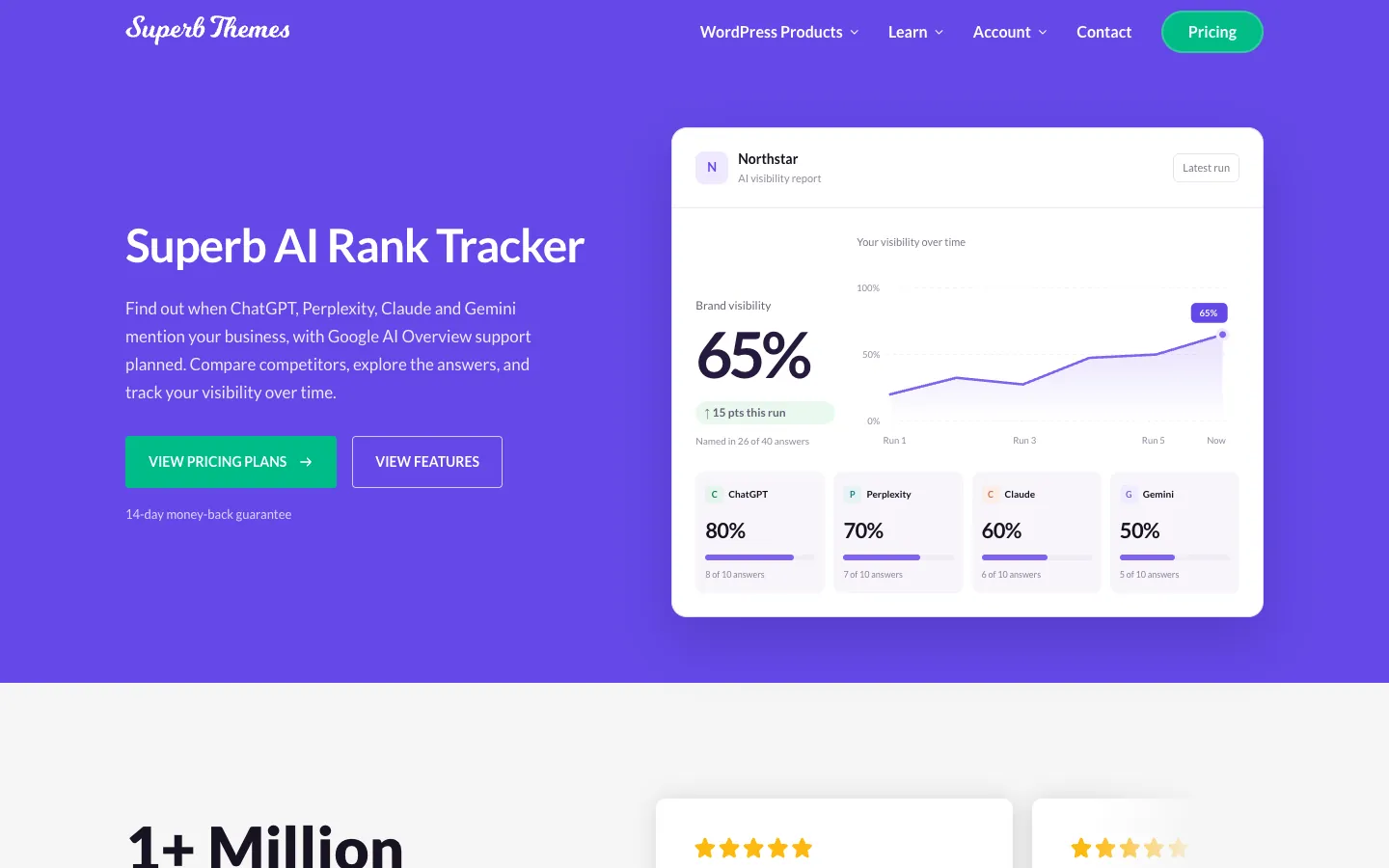
The engines draw on different information sources. ChatGPT, Perplexity and Claude use web search, while Gemini uses model knowledge and does not measure website citations. That limitation matters when assessing Gemini results for website visibility. Checks run through provider APIs, so their answers can differ from results shown in the consumer apps. SuperbThemes’ engine coverage
Full answers and sources are available for inspection, providing context for the tracking results. Optional tone classification marks mentions as positive, neutral or negative. This distinguishes a brand mentioned in an unfavorable answer from one that’s missing entirely and helps explain how an AI answer presents a business. SuperbThemes’ answer and tone reporting
Installing and maintaining the AI rank tracker for WordPress
Running the AI rank tracker for WordPress requires:
- WordPress 6.3+
- PHP 7.4+
- Outgoing HTTPS connections
- At least one supported provider API key
Checks run on the site’s installation using personal provider API keys, without an intermediate SuperbThemes server. SuperbThemes’ requirements and connection details
Setup follows five actions:
- The site administrator installs and activates the plugin through WordPress’s Plugins menu. Installation instructions
- Next, the administrator connects an AI engine.
- The brand and competitors are confirmed.
- Prompts are added.
- The administrator runs a first check. Setup instructions
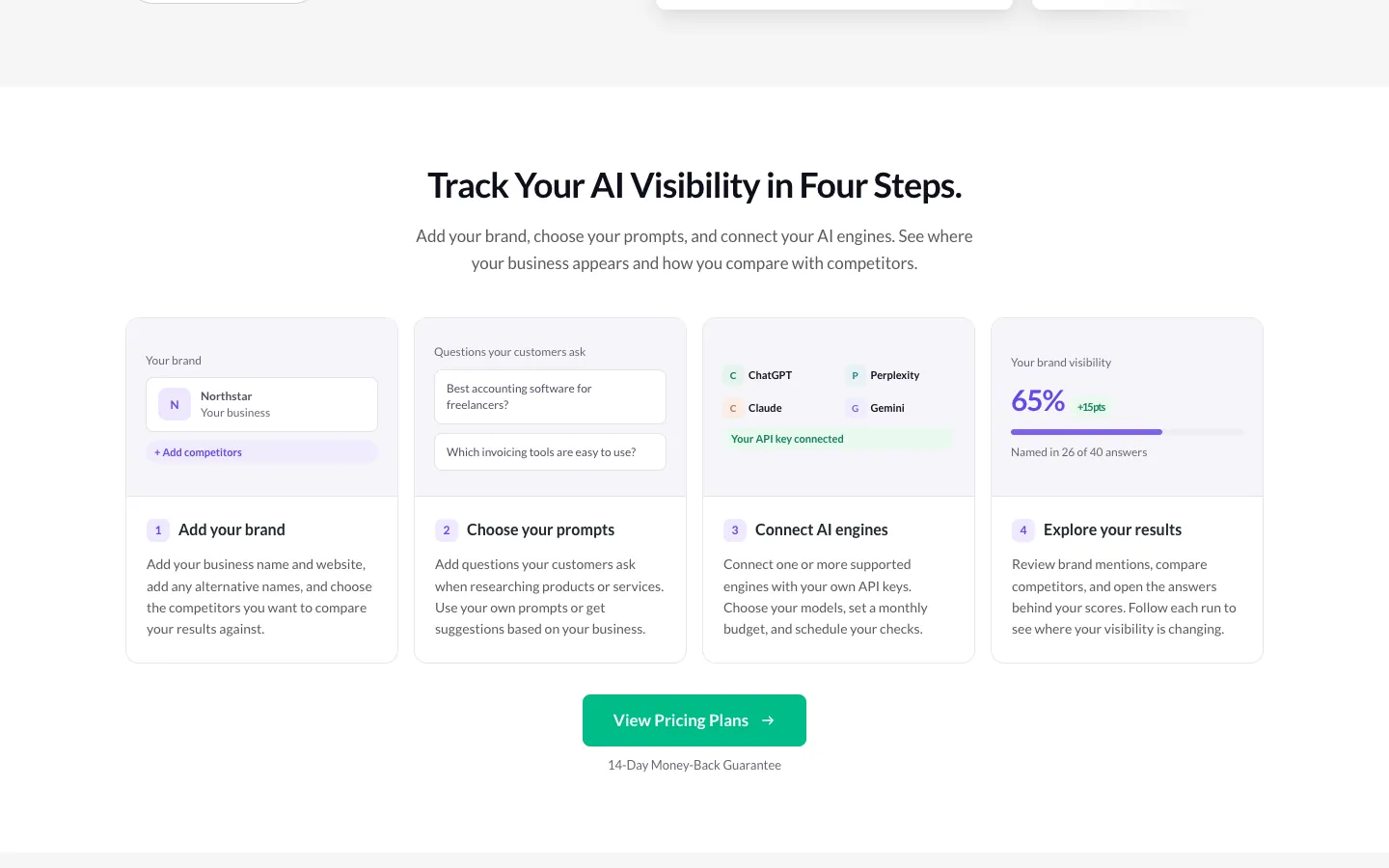
Checks default to weekly. Spending controls and summary emails are configurable, and weekly email summaries are available. SuperbThemes’ scheduling and email options
Updates use WordPress’s standard plugin update mechanism. Prompts, brands, recorded answers, API keys and settings remain in the site database. Update and data retention details
Peec AI for external monitoring and source reporting
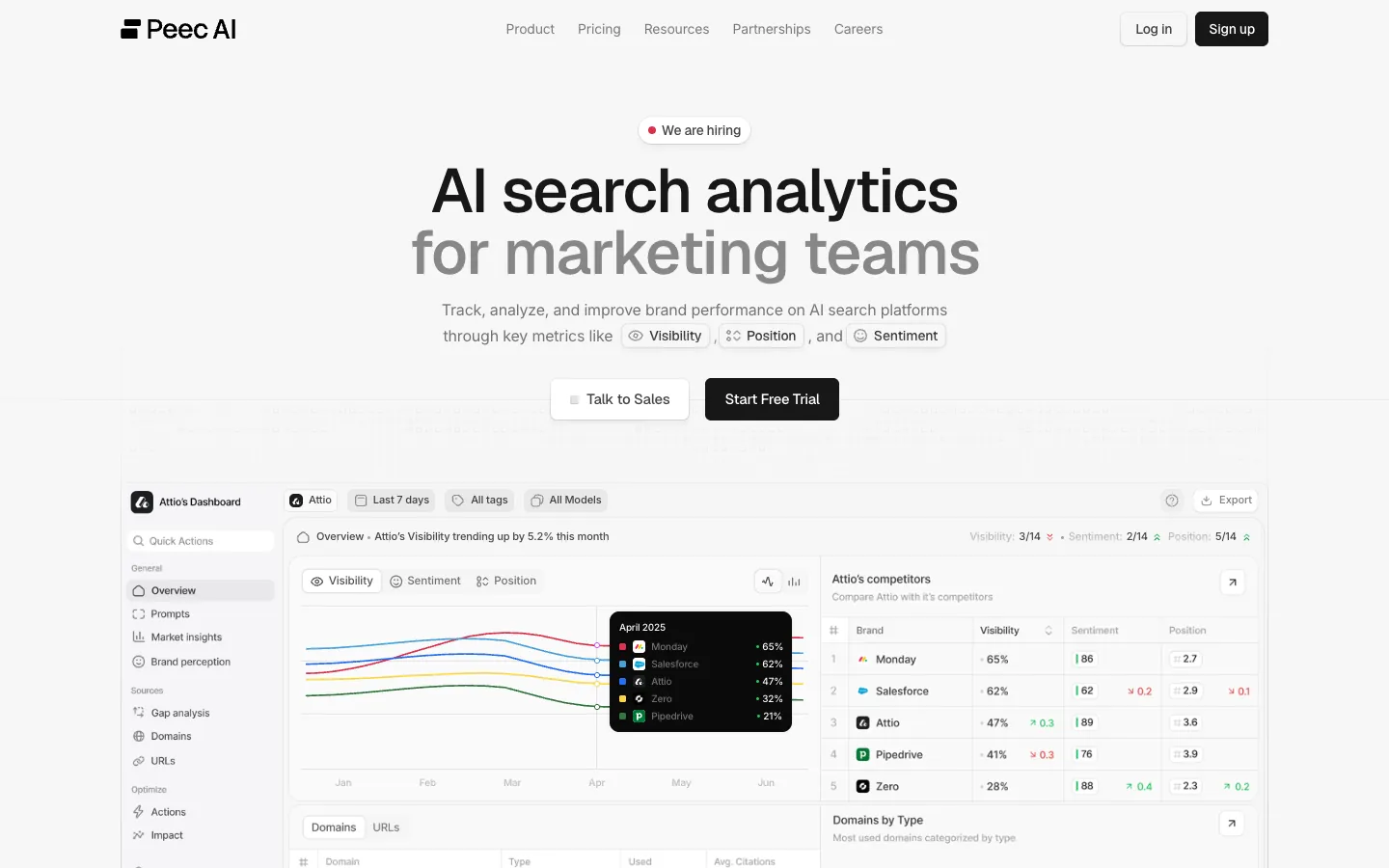
Peec AI configures monitoring with a brand name and domain, allowing a WordPress site’s brand to be tracked through its external service. Its homepage doesn’t establish that it offers a native WordPress plugin. Peec AI
Named engine coverage includes:
- ChatGPT
- AI Mode
- AI Overviews
- Microsoft Copilot
- Gemini
- Naver AI
- Perplexity
Enterprise offers up to 13 models, and additional models can be purchased without changing plans. Prompts run every 24 hours per selected model. The platform tracks visibility, position and sentiment, with results filterable by model, country and tags.
Reporting connections include:
- Looker Studio
- REST API
- MCP
These connections support reporting outside the platform.
For agencies monitoring several clients, options include tracking customized by client and white-label reporting across brands.
Rankscale AI for engine coverage, audits, and scheduling
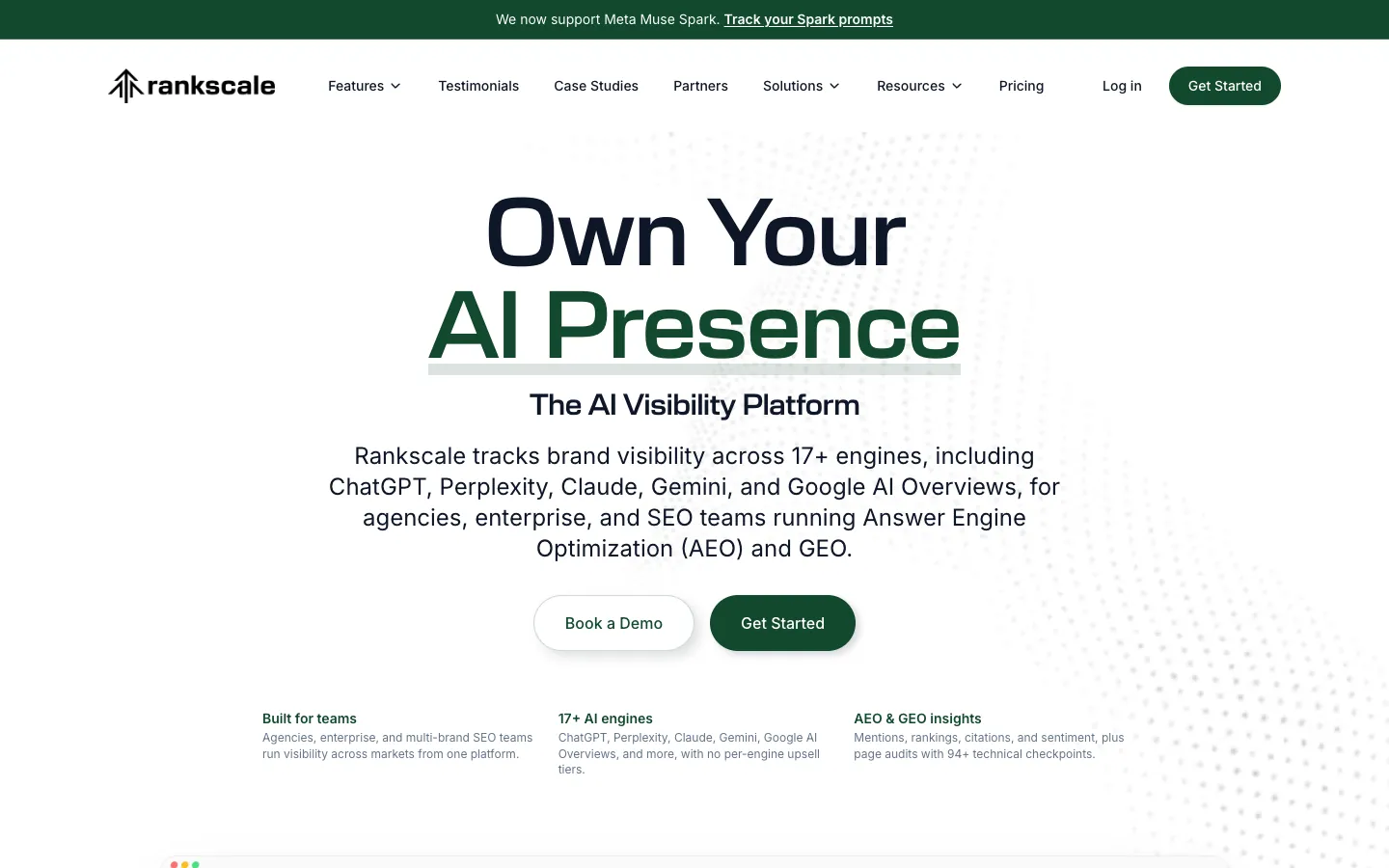
As a web application, Rankscale AI advertises 17+ engines. Its named coverage includes:
- ChatGPT, Perplexity and Muse Spark
- Claude and Gemini
- Google AI Overviews and AI Mode
- DeepSeek and Grok
- Copilot and Mistral
These engines are listed on Rankscale’s homepage. A native WordPress integration isn’t established, so its role for WordPress sites is external monitoring and analysis.
Its features cover tracking results, researching prompts and assessing page readiness:
- Competitor benchmarking compares visibility scores and rankings across tracked brands.
- Sentiment tracking records how brands are presented in answers.
- Citation frequency and source-domain and URL analysis help assess which websites and pages appear as sources.
- Query fanouts show related queries, while shopping or sponsored placement tracking records those appearances.
- Prompt research supports planning what to track, and page-readiness audits assess pages for AI search.
This feature set is described on Rankscale’s homepage.
Prompt creation is unlimited, but execution consumes credits. Saving a prompt and running it are separate actions, with credits charged when checks execute. Scheduling ranges from hourly to monthly, so run frequency affects credit use.
Reporting connections include:
- Data Studio
- MCP
- CSV/Sheets exports
- REST API
GA4 and Search Console connections are marked beta, as are prioritized recommendations. These connections and their status are listed on Rankscale’s homepage.
AmICited AI Visibility and its WordPress connections
Two checking schedules are advertised for AmICited’s AI visibility service:
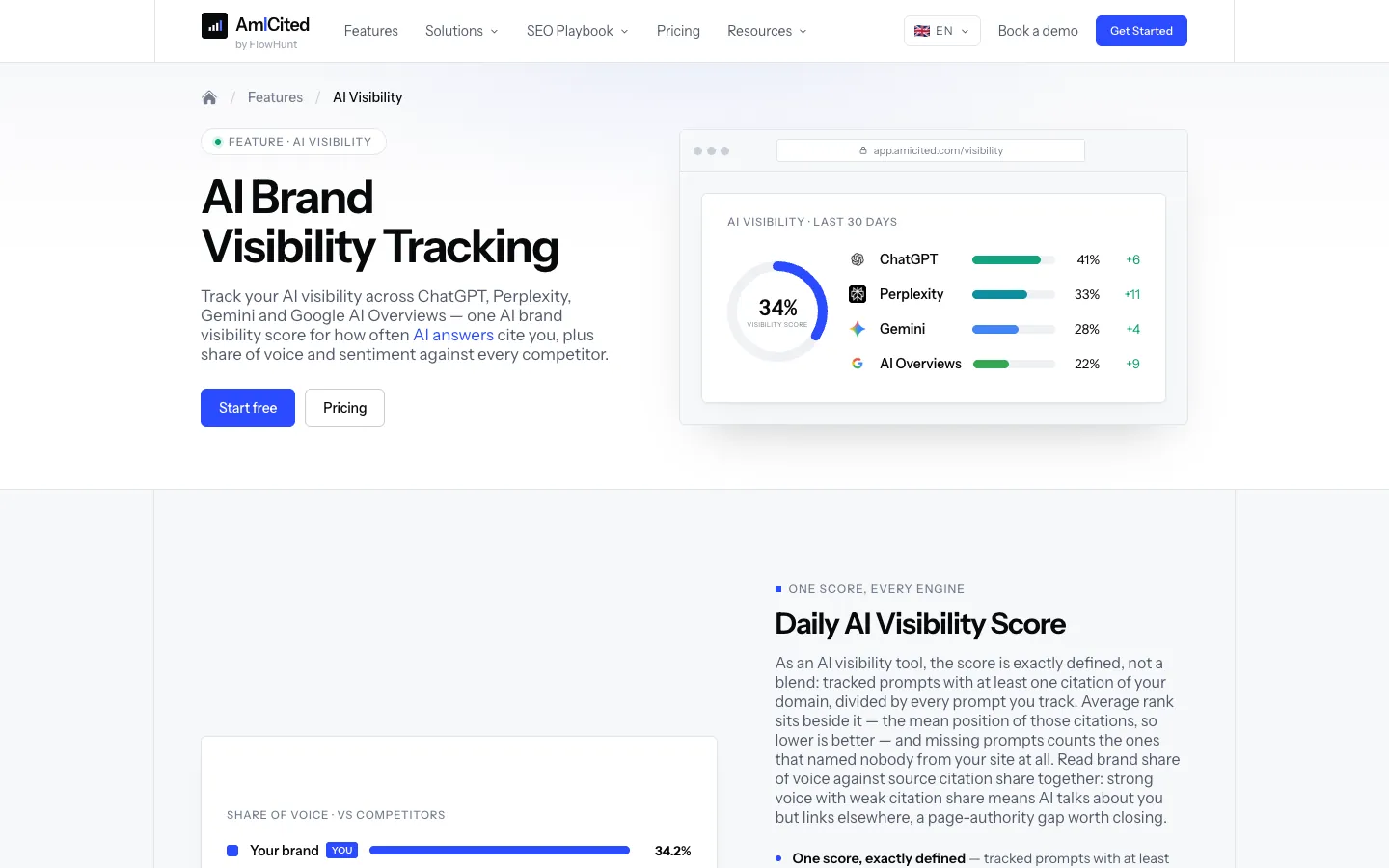
- Daily checks cover ChatGPT, Google AI Overviews, Google AI Mode, Gemini, Claude, Perplexity and Copilot.
- Weekly checks cover Grok, DeepSeek, Meta AI, Mistral and Brave Leo.
These schedules appear on AmICited’s homepage. Actual engine access depends on detailed plan entitlements, covered in the pricing section.
The service archives full answers and records mentions, cited domains, answer ranks and retrieval times. It supports sentiment and attribute tracking by engine and topic, with drift alerts flagging changes. These records help explain shifts in visibility through the wording of an answer and the domains it cites.
Visibility audits require no site integration. WooCommerce commerce/revenue integration is advertised from Pro, with store connectors available on request. Revenue attribution requires a commerce connection. This establishes a WordPress ecommerce connection, but doesn’t establish a general native WordPress rank-tracking plugin.
WordPress is also listed among publishing and workflow integrations alongside Zapier, MCP, REST API and webhooks. That listing concerns publishing and connected workflows, which serve a separate purpose from the WooCommerce revenue connection. It doesn’t establish that rank tracking runs through a plugin installed in WordPress.
AI rank tracking tool pricing and plan limits
What the fee covers matters when comparing AI rank tracking tool pricing. SuperbThemes charges for a plugin license with separate provider costs, while the other services organize their plans around prompts, projects or credits.
| Attribute | SuperbThemes AI Rank Tracker | Peec AI | Rankscale AI | Amicited AI Visibility |
|---|---|---|---|---|
| Prices | For 1/3/50 websites, promotional yearly prices are $29/$39/$49, normally $39/$59/$79. Promotional lifetime prices are $59/$79/$99, normally $79/$119/$159. Pricing | Numeric subscription prices remain unconfirmed. Pricing | Monthly plans are Pro $99, Pro+ $229, Growth $385 and Enterprise $780. Essentials appears yearly-only with $20 and $17/month figures, but its complete allowances are unclear. Pricing | Monthly prices are Starter €50, Pro €120 and Premium €500, excluding VAT. Enterprise pricing is custom. Pricing |
| Allowances | License options cover 1, 3 or 50 websites, as shown in the price row. | Starter includes 50 prompts, one project, unlimited users and daily tracking. Pro includes 150 prompts and two projects. Advanced includes 350 prompts, five projects, multiple countries and Looker Studio. Enterprise adds custom coverage, API access and SSO. | Pro includes 1,200 credits and up to 4,800 answers. Pro+ includes 3,000 credits and up to 12,000 answers. Growth includes 5,500 credits and up to 22,000 answers. Enterprise includes 12,000 credits and up to 48,000 answers. | Starter includes 50 credits, up to 3,000 AI responses and 1 domain. Pro includes 120 credits, up to 8,000 AI responses and 5 domains. Premium includes 500 credits, up to 33,000 AI responses and 50 domains. |
| Usage costs | Provider usage costs are separate. Monthly budget controls are available. Usage costs | Separate usage charges are unconfirmed. | Execution typically costs 0.25 credits per engine/prompt, with some engines costing more. | One prompt run on one engine costs 0.015 credits. Other actions also consume credits, and unused credits do not roll over. |
| Engine restrictions | No license-tier engine restrictions are specified in the pricing information. | Starter includes three selected models. | Some engines consume more credits than the typical execution rate listed above. | Detailed pricing places Copilot from Pro and Claude/Grok/DeepSeek from Premium. These explicit entitlements take precedence until the conflicting homepage claim that all plans include the full engine list is clarified. |
| Trial or refund conditions | Advertised refund guarantee of 14 days. Refund conditions | Trial and refund conditions are unconfirmed. | Pro offers a seven-day trial. | The seven-day trial requires a card. |
A comparison of AI rank tracking tools can’t rank these plans by headline price alone. Different currencies and billing periods complicate the comparison, while prompts, credits and response allowances measure different things. Separate provider charges also affect the total cost of SuperbThemes’ license options.
Choosing a tool for WordPress AI visibility monitoring
For tracking inside the WordPress dashboard, SuperbThemes AI Rank Tracker is the closest fit. An external service may suit teams whose work depends more on shared reporting or client workflows. Selection rests on a few practical criteria:
- Dashboard-based tracking requires a native plugin and a willingness to manage provider API keys. That responsibility matters alongside convenience when assessing the WordPress option.
- External reporting should be assessed against the SEO team’s requirements for source detail, reporting connections, engine access and client workflows. A connection matters only if it supports the team’s actual reporting needs.
- Commerce-focused monitoring should distinguish visibility results from revenue attribution. The latter depends on a connected store, so a visibility tracking service alone doesn’t meet that requirement.
- A matched evaluation should use the same brand, competitors and prompts across candidate tools, while accounting for differences in visibility definitions, checking schedules and engine entitlements.
Documented fit matters more than headline scores. Comparing tools under matched conditions gives each site’s team a sounder basis for choosing than a visibility percentage viewed on its own.