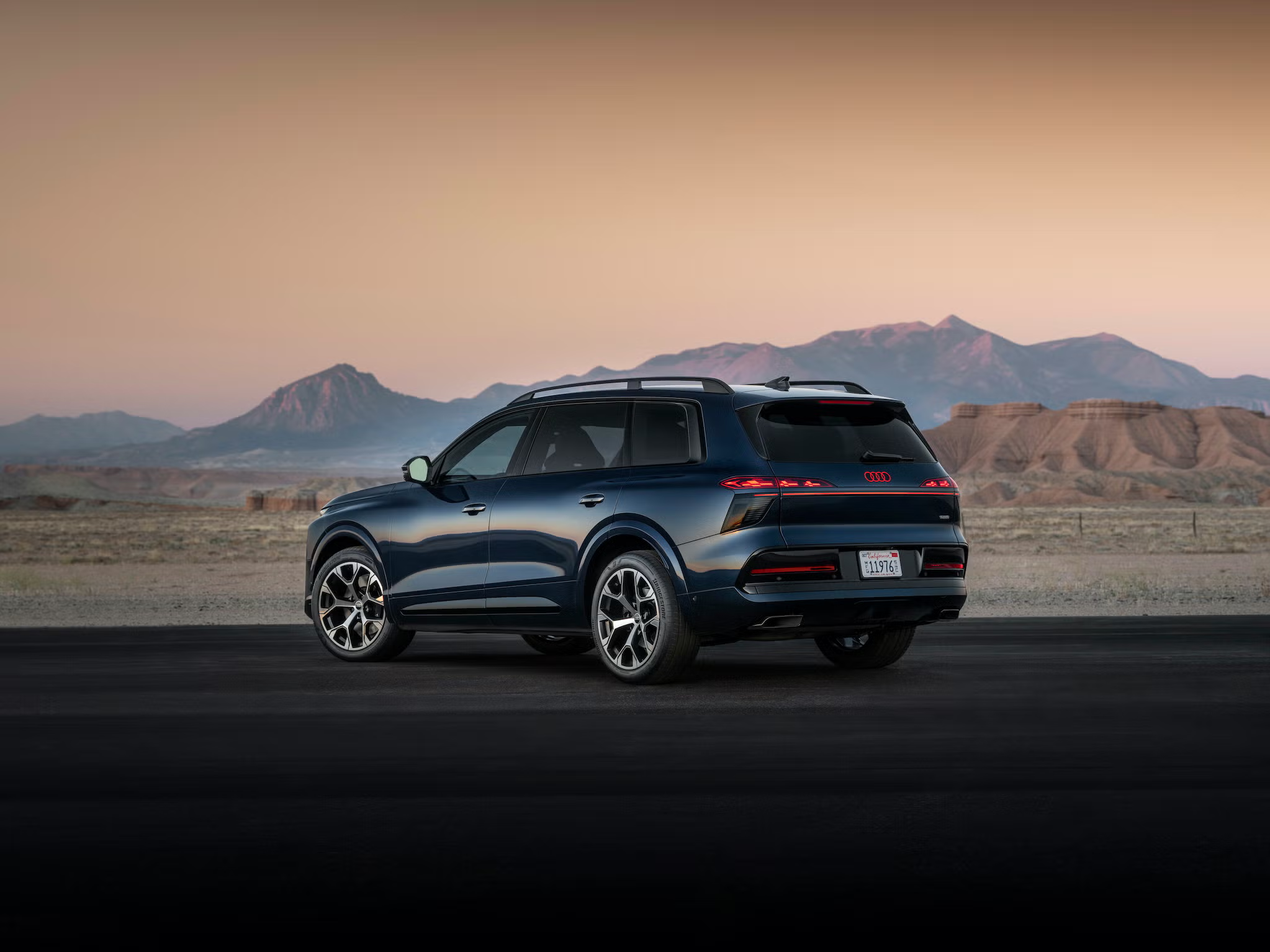
Bigger than the Mercedes GLS and BMW X7, Audi’s new Q9 (pictured), along with the even faster, and even heavier SQ9 is far from subtle. And you only need to take one look at the front end of all three to know this is what the customer base wants. Lexus, Lincoln and Cadillac are other targets for this additional model: no surprise when margins are especially high in this segment.
The Q9 will surely also be one of the several SUVs due to come down the production line at a just-announced US factory. Specifics are a little vague for now, only the expected annual capacity (200,000 vehicles), budgeted cost (US$4 bn) and non-specific location (‘Middle Georgia Mega Site’) having been stated. Construction is supposed to commence in 2027. The first vehicles are due in 2030.
So what else do we know about the largest model that the marque has ever released? Some two thirds of production is due to be exported to the US and pricing there starts at a little below 90,000 dollars. It will be a lot more than that in Europe (from 108,400 euro in Germany*, equivalent to US$120,900). Build is at the parent firm’s Bratislava factory, long a location for big Audi and VW SUVs.
MHEV TDIs for Europe, gasoline V6 and V8 for USA
The Q9 for North America has a standard 2.9-litre mild hybrid V6 while the SQ9 gains the Volkswagen Group’s equally well-known 4.0-litre V8 with outputs of 591 hp and 590 lb-ft (US spec). Each has two turbochargers and sends torque to both axles via an eight-speed automatic transmission.
Only the SQ9 gets a locking rear-differential, the Q9 having a centre diff for its AWD system. Four-wheel steering is either standard or optional, and seating layouts are 2+2+2 or 2-3-2. There are also 180 kW + 500 Nm and 220 kW + 630 Nm versions of a 3.0-litre biturbo mild hybrid V6 for relevant markets.
*in the German market, Audi notes this price is for the ‘entry level’ 220 kW TDI
The first examples of the giant new model will reach buyers in a few days’ time. As for the life cycle, that should be eight years, so a facelift would be expected in the final quarter of 2030, probably to coincide with the US plant coming online. Production in Slovakia would at that point be wound down.
‘New’ Q7 with a fresh Q8 coming next
As a 5.8 billion euro operating loss for Q3 shows, maximum profit is now an urgent priority for the Volkswagen Group. So it’s hardly surprising that Audi sees a big future for high-priced SUVs. And after the Q9, the Q7 is another example of that aim. Re-engineered and relaunched earlier in 2026, the ‘new’ model is a major facelift of the old Q7. The related Q8 should have the same treatment in 2027 with both models to be replaced in 2030 respectively. These will surely be US-made and what will succeed the brand’s three large SUV at the Bratislava site is not yet known.
Coming down the model-number size scale (or not in fact) we find the Q6. Oddly, this is not a sub-five metres long model but is 5,099 mm from end to end. Built in and for China, this model is due to switch over to EREV powertrains for its second generation in 2029/2030.
There is also a Q6 e-tron and this PPE platform EV is manufactured in Ingolstadt, mostly for the European region. It and its SQ6 counterpart are about a year away from being refreshed, their successors then likely for launch in 2031. China’s Q6L e-tron, meanwhile, should also be facelifted in 2027 and replaced by FAW-Audi five years from now.
San José Chiapa & Changan for future Q5 & Q5L?
Now we come to Audi’s most important model, the Q5, a worldwide best-seller. Generation three was freshly launched in 2025 (platform: PPC) and so should have a refresh in 2028/2029 and a successor in 2031 or 2032. It is too early to say whether or not today’s main plants in México and China will also be the lead ones for the respective L and standard length replacements.
Electric-only, the Q4 e-tron and its Sportback variant (facelifts were announced earlier in 2026) should make way for replacement models in 2029. And then below this pair, is another big seller worldwide, the Q3/Q3 Sportback series. New around the same time as the Q5, this pair of SUVs won’t be facelifted until 2028 or 2029, their next generations then being set to arrive commencing during the second half of 2031.
Margins seen as too small for a new Q2 or a Q1
For now, there is no news of any possible smaller SUVs, the decade-old Q2 having gone out of production six months ago, while a ‘Q1’ is not in Audi’s future model strategy.
Cars make up a far smaller percentage of Audi’s worldwide sales than they did even two to three years ago. Some, such as the A8 and S8, have even now disappeared due to extremely low sales. There is a belief however, that the company has found a way to justify next generation models, namely having them manufactured by Porsche at that firm’s Leipzig plant. A debut date of 2028 is rumoured.
The A6 series, still fairly new, does OK, but things are tough in not only China and Europe for such high-priced vehicles but also in the USA. At least the Avant continues to have a fairly good amount of business coming out of Germany and certain Scandinavian markets. The current A6/A6L may therefore be the final one, replaced by the next generation of today’s A6 e-tron.
A word here on the Chinese market is especially relevant as Audi used to do a huge amount of business with a long wheelbase A6. September was an especially grim month for the brand, wholesales of locally-built Audis plunging by 42 per cent year-on-year (to 33,600), and 21 per cent YtD (321,582). Still, it remains ahead of BMW and far ahead of Mercedes-Benz. The combined A6L and A6L e-tron remain the brand’s number one models (82,378) but their total is down by 48 per cent YoY according to CAAM and CPMA data.
A2 e-tron production gets underway in Ingolstadt
Dropping down from the embattled ‘sixes’ to four and three, an A4 e-tron should arrive in 2029, two years after the premiere of the next A3. And as we know, there is now an A2 e-tron, the first deliveries of which will commence in December. Build of this Golf-sized tall hatchback has just begun. The life cycle should be seven years, so a facelift is planned for 2030.
Finally, two sports cars. The first is known as the C-Sport project, an electric TT-style model. Previewed by the Concept C which debuted in September 2025, it will be manufactured in Germany at the Böllinger Höfe plant commencing in 2027.
At the top of the price tree will sit the Nuvolari supercar. Also set for launch next year, its construction will be based around a new ‘Audi Space Frame’ with carbon panels attached. Only 499 examples of this V8-powered car will be made. Outputs are claimed to be 588 kW (799 PS) and 730 Nm with the 4.0-litre engine said to have its redline set at 10,000 rpm. Additional boost comes via 110 kW motors, two at the front with a third one positioned between the engine and transmission.