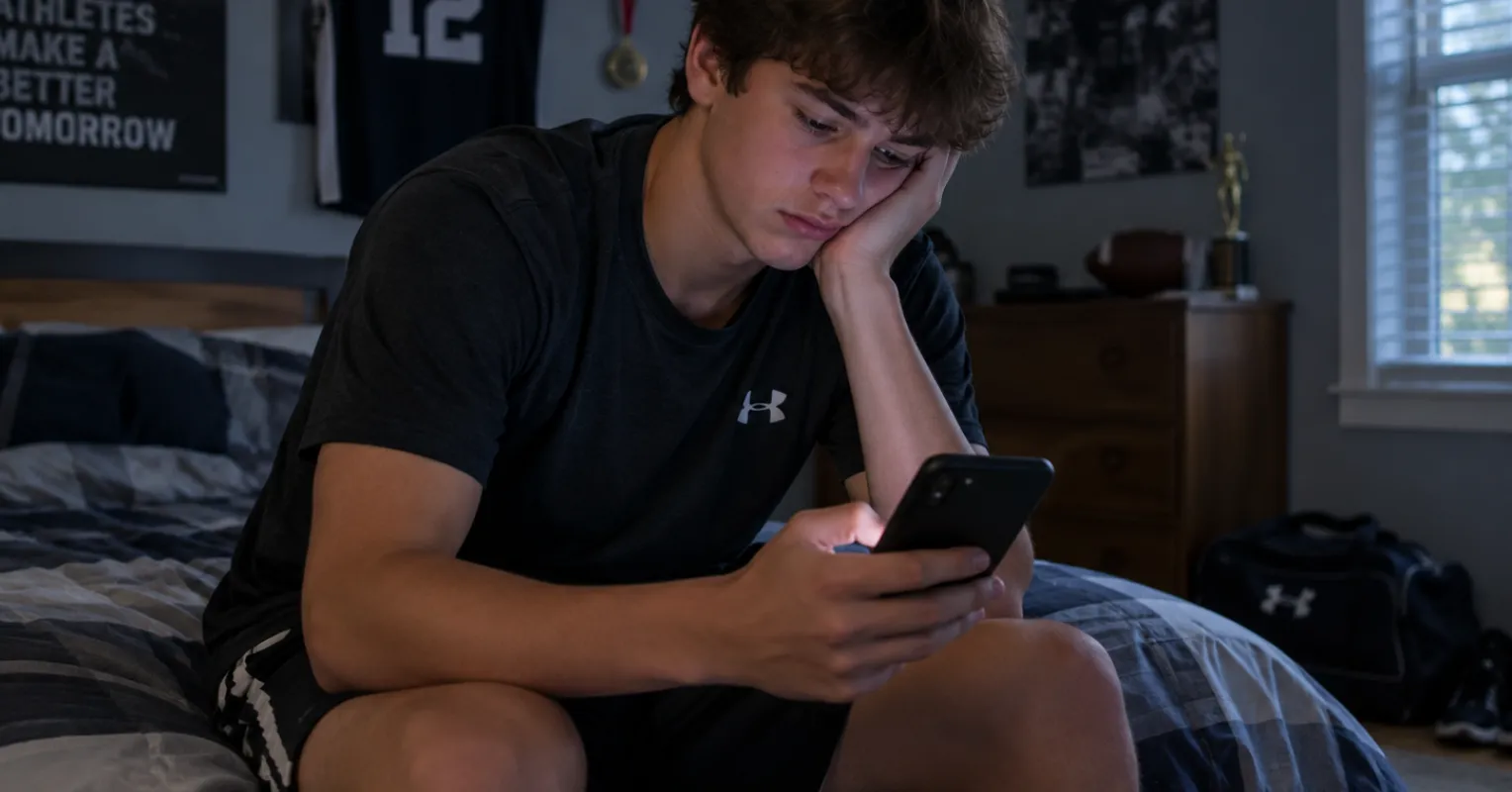
Sad and bewildering.
A surprising predicament has emerged in recent years for many young people. It’s a difficulty that’s become a common experience for athletes, especially for those whose sporting careers have grinded to a halt for various reasons.
Many middle school, high school, and college youth are anxiously perplexed with what to do with all the unstructured free time they now possess since the ending of the overstructured time produced by their organizational athletic involvement. They are bothered to the point of sadness and even depression. It’s an issue shared by young people in my office on a daily basis.
They often spend much of that time alone, idly sitting and pondering what to do while endlessly scrolling a screen. Many view such aimless phone or computer time as a waste (true), multiplying their distress. A further bother is the belief that they are supposed to be constantly busy with structured activity. Unbusy time, especially when alone, is experienced as confusing, unproductive, and problematic.
One descriptor frequently crops up when kids share this problem: boredom.
Not that long ago, such extended, unbusy time after school, between classes, during weekends, vacations, and etc. was viewed with an entirely different perspective—freedom. Free to choose whatever you wanted to do without the externally structured demands of parents, teachers, coaches, and other adults. It was joyously anticipated and experienced as “me time,” purposefully spent with one’s own choosing.
What in the world has happened, causing that change in perspective, and what can be done to flip the switch from “boredom” back to a “freedom” experience? Time to explore.
How We Got Here
There’s a wide range of factors contributing to this surprising quandary, including screens, social media, lack of childhood free play, and overstructured time forced on youth by parents, coaches, and other performance instructors. Research identifying those elements is detailed by Jonathon Haidt in his bestselling book, The Anxious Generous (2024). Simple observation reveals the damage of screens to young people with or without scientific study.
We will focus on what parents, coaches, and the current sports/performance culture have contributed to this struggle with unstructured time experienced by young people.
We will begin, briefly, with parents who have denied young children the liberty to be on their own and engage in free play with peers. Kids granted that freedom learned how to independently use time at an early age without the need for adult supervision and structure. Such conditions were commonplace up until the 1990s.
While parental restriction of independent free play is well intended for safety reasons, it disrupts the ability for young people to develop the skill of purposefully using their own time. Other parental overstructure further limits that ability.
Next, we examine the contributions of youth coaches and instructors.
An Overstructured Youth Sports/Performance Culture
Previous Sports Between the Ears pieces You’re Far More Than an Athlete | Psychology Today The Hazards of an Athletic Identity | Psychology Today detailed the damaging impact of the overscheduled world of youth sports and other skill-based activities. Today’s focus is on how overstructured extra-curricular activity has disrupted young people’s ability to learn how to use their own time.
Examples of this include coach/instructors, demanding year-round, near-daily participation in a sport, music, theater, or other skill-based activity. Other samplings of such behavior are bodybuilding-obsessed trainers expecting young athletes to work out on a daily basis. Many of these coaches, instructors, and trainers not only insist on this regimented commitment to an activity, but they also force or even threaten participants to do it.
Early over-scheduled engagement with sports, music, theater, or other similar endeavors has resulted in young people being immersed in an adult-structured life with little time to themselves. Some kids are signed up for multiple overlapping activities, running from one to another on the same day with little leftover time to make their own choices. Busy, busy, busy.
When asked how much time they have to themselves during a typical school day, most interviewed middle school and high school-aged students typically say one to three hours. The bulk of that time occurs in the evening at home when and where choices are limited. Most of it is spent on homework, scrolling a screen, or napping. The latter two are understandable given their exhaustion from a busy, non-stop day.
They have minimal opportunity to rest, discover new interests and hobbies, and use their own time with independent choices.
The Solution to a Vexing Problem
Hey, youth-involved adults, please knock it off. Stop overstructuring kids and give them time off to make their own choices and learn to live independently.
Parents, please permit free play and allow kids to choose their own activities. They also can stop signing up kids for multiple, overlapping activities and saying “no” to overzealous coach/instructors and trainers. Let kids play and practice sports on their own. Give sons and daughters a chance to develop interests and skills beyond a sport or other adult-organized activities.
Coaches/instructors and trainers can limit their time expectations for youth participants. No need for year-round, daily practice and training. Give ample time off. Not only will that give kids a chance to learn what to do with unstructured time, it will also prevent overuse injuries, physical and mental exhaustion and burnout resulting from never-ending activity as detailed in this study by the American Academy of Pediatrics (AAP), Overuse Injuries, Overtraining, and Burnout of Young Athletes (Brenner et al, 2024). Improve performance, don’t wreck it.
The kids can do something about it as well. They can decide to put the brakes on an unrequired activity. Obviously, they are limited to do that during in-season requirements, but out-of-season practice/rehearsal is a different story. They can also choose to quit a team or other activity if it’s too much.
Their life, their choice.