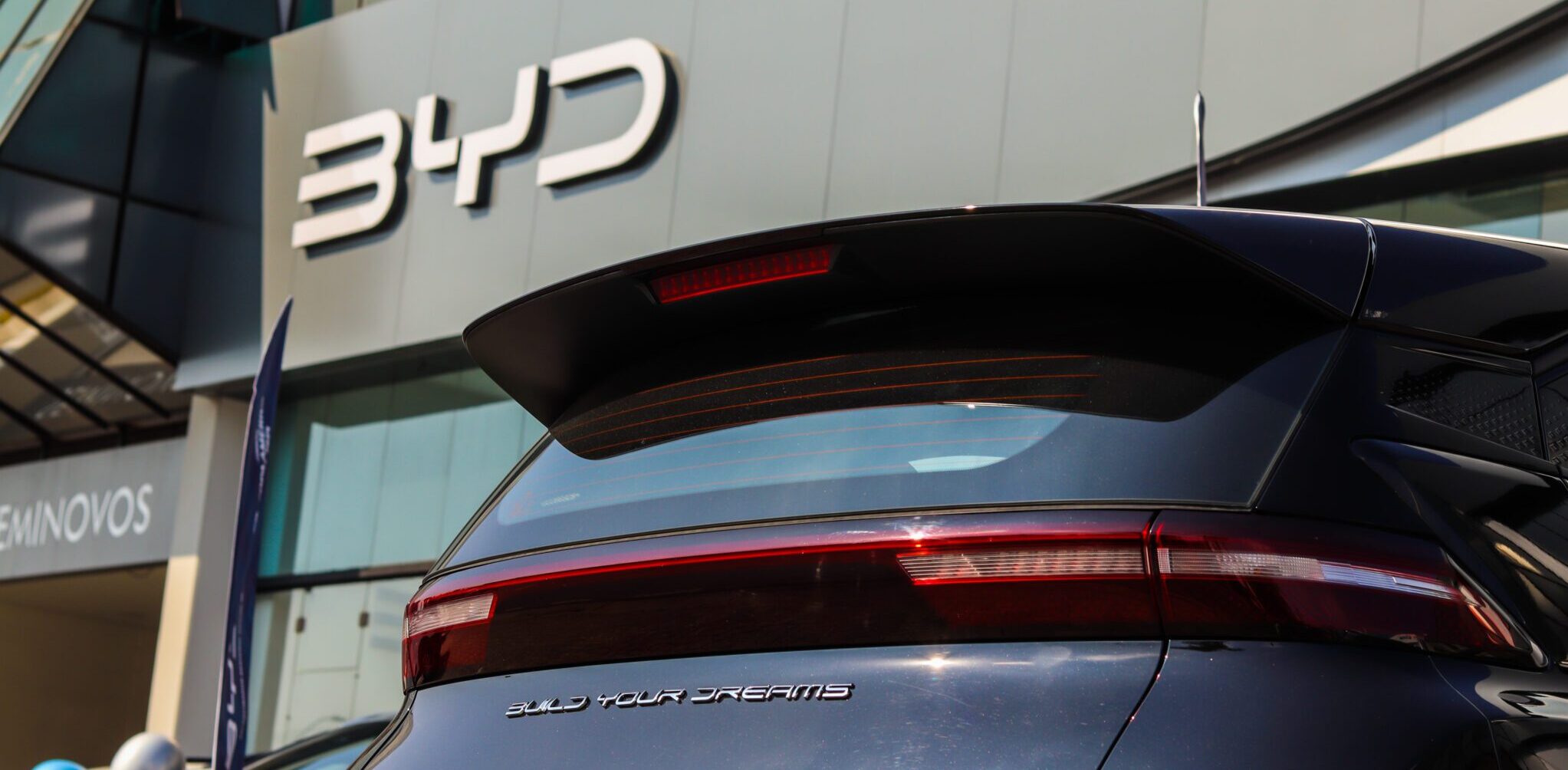
BYD calls geopolitics its biggest obstacle, but the barriers rising in Europe are largely a response to its own hybrid strategy. By Stewart Burnett
BYD Executive Vice President Stella Li has singled out geopolitics as the most difficult obstacle in the Chinese electric vehicle (EV) maker’s global expansion, confirming it has entirely shelved all plans to sell passenger cars in the US. The admission comes as falling domestic sales leave BYD more dependent than ever on overseas growth to stay in the black, just as political resistance in them hardens.
“When we do business, we want to do something and have certainty and visibility then we can control and then we can invest. But with geopolitics, you never understand what’s the angle and what they are doing,” Li told the Milken Institute Asia Summit in Singapore on 8 October. On the US, she spoke more bluntly: “We don’t have clarity, visibility and stability there so we’re saying let’s hold and not to go to the US for passenger cars at this moment.”
The pressure at home is real: BYD’s cumulative sales for the first nine months of 2026 fell nearly 4% to 3.13 million units, with resilient exports offsetting weak domestic demand. Its shares have lost 22% this year, and earlier in October JPMorgan downgraded the stock to Neutral, citing sluggish home sales, rising input costs and trade barriers that threaten overseas growth.
Europe is where the most important part of that growth has come from, largely due to the margins it can command there running exports—even with tariffs in place. BYD’s UK registrations rose 80% year-on-year in September to 20,140, led by the Seal U DM-i plug-in hybrid. Total overseas volumes surged 152% to 180,700 units year-over-year.
Now, the UK is reportedly considering implementing tariffs in the same vein as Europe to better align with anticipated Made in Europe content requirements. Of course, there is a glaring omission in this scheme. While it is true that, since October 2024, the EU has charged BYD an extra 17% on its imported EVs on top of the 10% baseline, it is also true that hybrids pay only the baseline. Little surprise, then, BYD has tilted its European range accordingly.
That gap, at least on the EU side, may soon close. EU and Chinese officials have begun talks in Beijing over a temporary tariff quota on hybrids, after Beijing declined to offer voluntary export cuts. Paris, South Korea and 14 other economies agreed joint measures against industrial overcapacity that explicitly named EVs and batteries. The uncertainty Li describes is, in large part, governments responding to BYD’s success at exploiting exactly these gaps.
Localisation is the obvious answer, and BYD is pursuing it in Hungary, Brazil and Thailand, with Li saying last month that it wants to become a “European company”. Potential brownfield acquisitions in Southern Europe, possibly a Stellantis site, are also under discussion. Yet even that route is politically exposed: Mexico paused incentives for Chinese automakers under US pressure. Li also ruled out partnering with other Chinese firms, saying: “We’re a leader in multiple businesses, not only cars.” That leaves BYD building every plant itself, unlike Chery, which is in talks to use Nissan’s Sunderland factory.
The scale of the ambition makes those constraints bite. BYD delivered around 4.6 million vehicles in 2025 against roughly 11 million for Toyota, which Chairman Wang Chuanfu aims to overtake within five years. Yet the US, Japan and India together account for around a quarter of global passenger car sales, and BYD has little meaningful access to any of them.
Against that backdrop, BYD’s US$2.5bn order, alongside SAIC Anji Logistics and Cosco, for around 20 large car carriers looks like a bet that exporting from China will stay viable longer than Li’s own warning implies. Her remarks amount to an admission that the six-million-plus units separating BYD from Toyota will be slower and costlier to win than its first 4.6 million. Indeed, they may very well have to come from factories abroad rather than ships from Shenzhen.