Malaysia wanted an export hub and BYD wanted the home market; a contract assembler now fills the gap between the two. By Stewart Burnett
BYD has appointed Sime Darby subsidiary Inokom to assemble its cars in Malaysia after shelving plans for a wholly-owned local plant, leaving it reliant on a contract assembler to keep its mainstream models competitive. The move comes after BYD lost its position as Malaysia’s leading electric vehicle (EV) brand to domestic player Proton, whose market position local rules are designed to protect.
The memorandum of understanding was signed at BYD’s Shenzhen headquarters by Liu Xueliang, General Manager of its Asia Pacific Auto Sales Division, and Jeffri Salim Davidson, Group Chief Executive of Sime. Inokom already assembles vehicles for several automakers at its Kulim plant, while fellow Sime unit Sime Motors distributes BYD’s cars. The precise models and the timing of their manufacture have not yet been disclosed. “Local assembly is an important part of BYD’s long-term commitment to Malaysia,” said BYD Malaysia Managing Director Jacob Ma.
BYD announced its own plant at Tanjung Malim in August 2025, but negotiations reportedly stalled over government conditions that :require it to export up to 80% of output and sell the remainder locally above MYR 200,000 (US$49,000). The disagreement reflects a reversal of BYD’s European experience: Malaysia wanted an export hub, while BYD primarily wanted access to the domestic market.
As a result of this dynamic, local assembly has become essential. Malaysia’s tax exemption for imported EVs expired at the end of 2025. Since 1 July, fully-built EV imports must have a declared value of at least MYR 200,000 and output of at least 180 kW, excluding several of BYD’s best-selling models. Locally assembled EVs are wholly exempt from import duty, excise duty and sales tax until the end of 2027, although they must be priced above MYR100,000 (US$24,500). One Kuala Lumpur-based analyst, speaking off the record to Nikkei, said that BYD’s CKD model will not be able to compete with Proton and Tesla on both price and features.
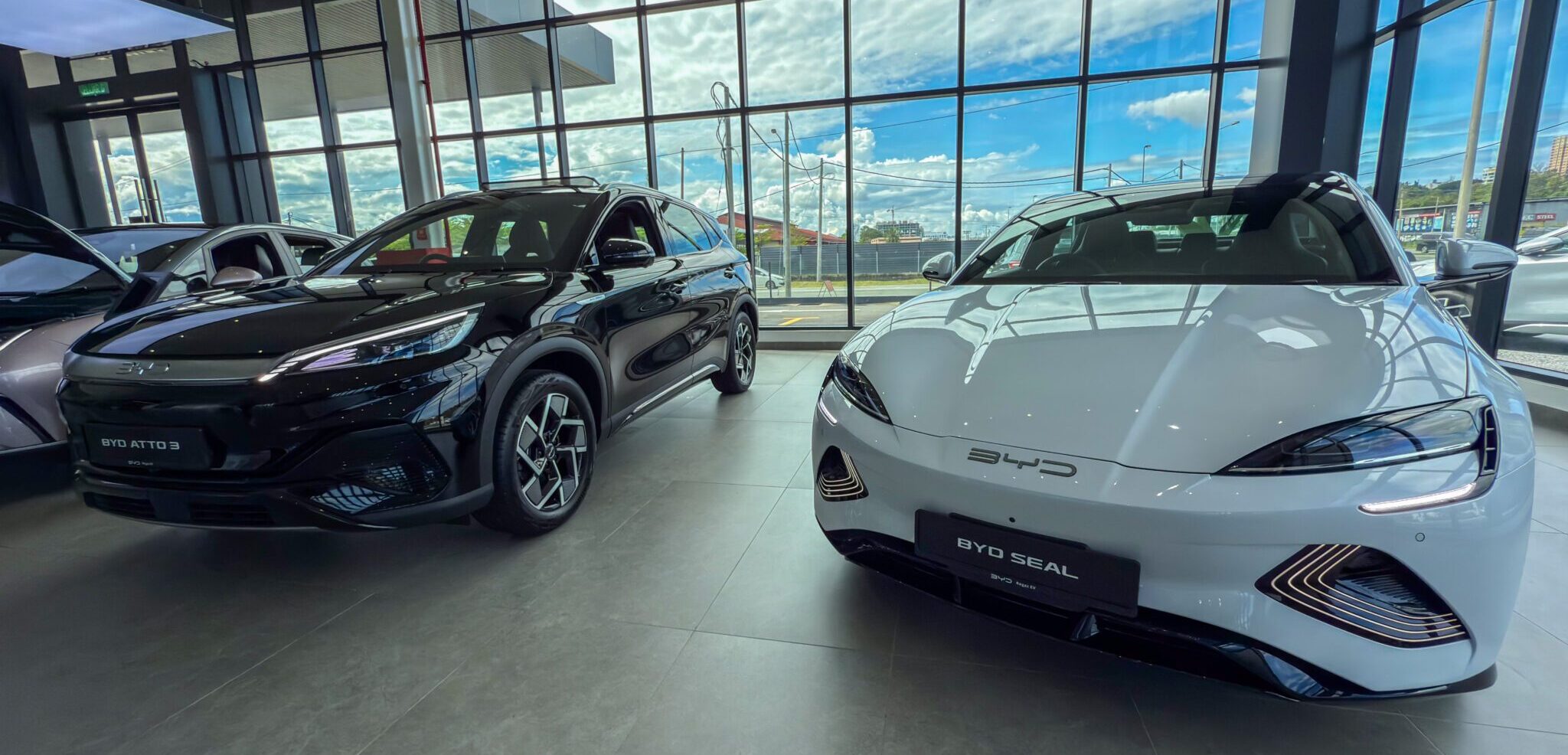
For a company like BYD, this market is worth fighting for. Malaysia is one of the region’s biggest auto markets, with 820,752 vehicles sold in 2025—more than Indonesia’s 803,000 despite having a fraction of its population. EV sales alone more than doubled in the first half of 2026, and this is a segment that BYD led in 2025 with 14,407 units delivered.
Unfortunately, that lead has quickly evaporated. Proton, in which Geely holds a 49.9% stake, launched the e.Mas 5 in October 2025 at MYR 56,800, and registered 24,857 EVs in the first nine months of 2026 against 8,087 for BYD. The same off-the-record analyst told Nikkei: “The gap [between BYD and Proton] is likely to stay due to the government’s regulation that put [the] CKD floor price [of 100,000 ringgit] […] to protect national carmakers.”
Malaysia contrasts sharply with BYD’s approach in Europe, where it insists on owning factories outright and has entirely ruled out partnering with other Chinese firms. Having explored acquiring underused European brownfield sites, BYD is now seeking sites for two more wholly owned facilities alongside Hungary. It is also looking toward a battery plant to meet forthcoming EU ‘Made in Europe’ rules. In Malaysia, this adamant ‘go-it-alone’ approach is nowhere to be seen, conceding to the necessity of kit assembly by its distributor’s sister company.
The Inokom deal shows that BYD’s localisation strategy is calibrated to each market’s rules, building its own plants where regulations reward deep localisation and using kits where they do not. It will keep BYD’s mid-priced models on sale, but the MYR100,000 floor leaves the mass market to Proton. BYD has effectively conceded volume leadership in Malaysia, and its next challenge will come when CKD tax exemptions expire at the end of 2027.