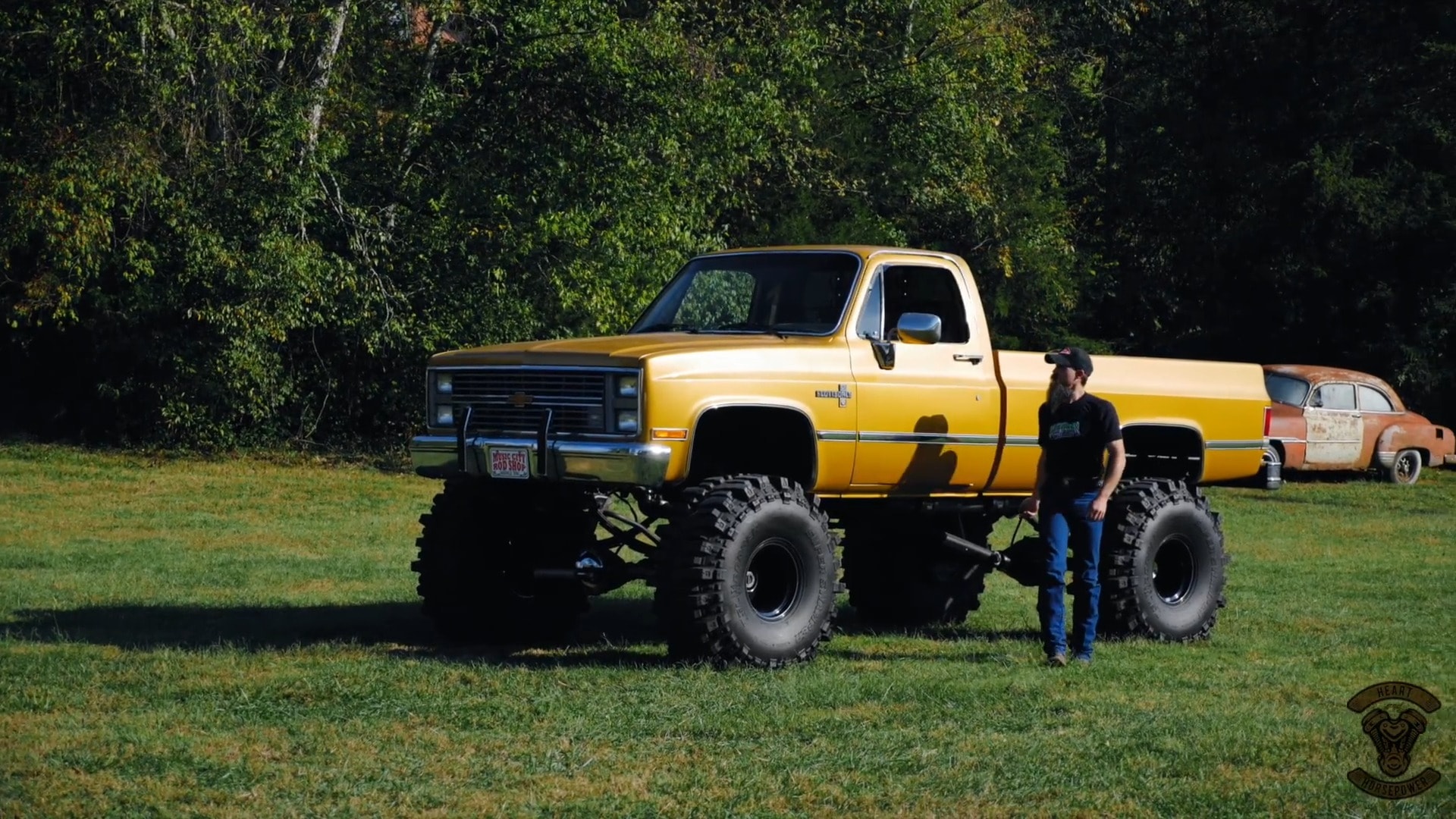
Typically, when we look at a pickup truck with big tires, hockey puck-sized tread blocks, high road clearance, and a beefy rear diff, we instinctively think “Off-Road.” After all, what’s the purpose of a lifted utilitarian, if not to go over ravines and ditches and rocks and stuff that’s doesn’t reside on the blacktop? I’ll tell you what: the fun of it. Josh Anderson, from Franklin, Tennessee, put his square-body K20 on 44-inch rubbers just because he likes the look of it.
Raising pickup trucks purely for recreation began in rural America during the 1970s, evolving from utilitarian necessity into a flamboyant subculture of mechanical one-upmanship. Southern and Midwestern drivers originally elevated four-wheel-drive workhorses to clear deep ruts, swamplands, bogs, agricultural mud holes, fallen trees, deep fords, and whatever Mother Nature had planted in their paths.
Soon, young enthusiasts realized that towering suspension lifts delivered unmatched street presence, turning functional farm rigs into flashy Saturday night cruisers built solely for visual drama and youthful rebellion.
That skyward obsession fueled the parallel culture of big-inch tires on pickups. In 1973, builders scoured commercial catalogs for 12-by-16.5-inch highway rubber before Dick Cepek popularized wide off-road floatation tires and Bob Chandler created Bigfoot on 66-inch terra tires. After Interco launched its aggressive Super Swamper tread in 1978, pairing 15-inch steel wheels with bulbous 44-inch bias-ply mud tires defined classic four-wheel-drive proportions.

Photo: YouTube/Heart and Horsepower
That was long before flashy modern 22-inch rims appeared, which are absolutely frowned upon by old-schoolers who think there’s nothing better than lifting your truck with the sole purpose of making an entrance in big style (pun intended), and leaving life-long memories to rugrats who come to a car show and are left with their tiny jaws dangling three thirty-seconds of a inch above the ground when sitting next to the giant pickup towering above all else.
Preserving that golden era of sidewall-heavy Americana is what Erik Larsen, the man behind the camera on the Heart and Horsepower YouTube channel, brought in front of the entire internet in his latest episode. The feature spotlights Josh Anderson of Franklin, Tennessee, and his majestic 1985 Chevrolet K20 Scottsdale pickup, built solely to honor his 1990s high school youth.
“I wanted the truck to be exactly the way it would have been when I remember these trucks rolling around,” Anderson explains with a nostalgic flashback to an age when having fun meant busting knuckles and going on a full analog search of parts, with a lot of physical travel involved.

Photo: YouTube/Heart and Horsepower
Long before it towered above traffic, this pickup started out in life as a stock 1985 Chevrolet K20 Scottsdale three-quarter-ton, four-wheel-drive Fleetside work truck. Remarkably, its original buyer commissioned the pickup in Colorado Gold Metallic, a rare special-order factory finish designated by paint code 51 and WA7953 that dealers almost never stocked.
Anderson tracked the survivor down in Gruetli-Laager, Tennessee, a remote mountain community atop Monteagle Mountain (some two hours away from Franklin, and about 40 miles north west of Chattanooga), and bought it. The rest he did himself.
The Chevrolet C/K moniker debuted for the 1960 model year, using “C” for two-wheel-drive models and “K” for four-wheel-drive trucks, paired with 10, 20, and 30 capacity ratings. Production spanned four generations from 1960 through 2002: the first from 1960 to 1966, the second from 1967 to 1972, the third from 1973 to 1991, and the fourth from 1988 to 2002, totaling over twenty million C/K trucks built across its lifespan.

Photo: YouTube/Heart and Horsepower
General Motors officially dubbed the third-generation trucks the Rounded Line, though enthusiasts universally call the 1973 to 1987 pickups “Square Bodies,” with R/V badging continuing on specialty models through 1991. Total third-generation output exceeded 10,000,000 units, opening with 666,619 Chevrolet trucks in 1973 and peaking in 1978 when division volume hit 1,317,466.
For 1985, Chevrolet built over 650,000 C/K pickups, including roughly 48,000 K20 trucks and 30,000 military K-series utility pickups. Because General Motors never archived complete 1985 K20 production totals broken down by individual option codes, historians analyze the model year through factory configuration matrices.
Buyers in 1985 selected from three trim levels: utilitarian Custom Deluxe, mid-tier Scottsdale, and top-spec Silverado, with Scottsdale and Silverado representing roughly 75 percent of sales. All K20 pickups of 1985 used a 131.5-inch wheelbase as two-door regular cabs with 8-foot Fleetside, Stepside, or chassis-cab bodies.

Photo: YouTube/Heart and Horsepower
Straight-sided Fleetside beds represented over 85 percent of 1985 K20 output, while 164.5-inch-wheelbase four-door Bonus and Crew Cab bodies were reserved for C20, C30, and K30 chassis. Factory 1985 C/K engines included two Sixes (the 155-hp 4.3-liter V6, and a 115-horsepower 4.8-liter inline-6), and four V8s.
The entry-level motor was a 160-horsepower 5.0-liter V8 (307 cubic inches), followed by volume-leading 165-horsepower 5.7-liter V8 (Chevy’s long-standing 350 small-block), accompanied by a 130-horsepower 6.2-liter diesel V8. The lineup was completed by the 230-horse 7.4-liter V8 (the famous 454 big-block). Transmission-wise, the C/Ks of ’85 came paired with 4-speed manuals, or 3- and 4-speed automatics.
Working solo inside his garage, Anderson completed the entire frame-up transformation, bodywork, and fresh Colorado Gold paint in just 4 months. To achieve its period-correct altitude, he installed 12-inch Superlift leaf springs alongside a 3-inch body lift, revised shock mounts, dual steering stabilizers, and transfer case drops. Beneath the fenders sit 44-inch Super Swamper Bogger bias-ply tires mounted on 15-by-15-inch black steelies.

Photo: YouTube/Heart and Horsepower
“I’ve always thought you had to have a bigger tire than you did wheel,”
Anderson says of his 15-inch rims, noting that when 22-inch wheels arrived, “that’s the day that I knew that four-wheel drives were going south.” Inflated to 12 psi, the bias-ply Boggers flat-spot when parked for months. “You better pay attention. It steers like it looks. It takes a 40-acre field to turn it around,” he laughs. But hey, you can fist-bump semi drivers and look them dead in the eye without raising your chin.
To turn that massive unsprung weight, Anderson replaced the original engine with a 385-cubic-inch small-block Chevrolet stroker V8 topped by an Edelbrock intake, paired with a 3-speed Turbo Hydra-Matic 350 automatic transmission and a gear-driven New Process 205 transfer case. “To pull these big tires around, you got to have something a little bit different. This truck runs and drives good at 60 mph all day long,” he proudly notes.

Photo: YouTube/Heart and Horsepower
It can’t imagine what it’s like going 60 on tarmac with those rubbers clunking along. The builder/owner never even thinks about going off asphalt. That’s not what his truck was built for. It’s a statement of skill and personal preference, not a tool to haul logs or bags of hog feed up and down the mountain. Impressing kids at car meets – yes. Actually using it to its full capacity – never. He just put it on grass for the sake of cinematic good looks, but that’s about as far as he will go with it.
Instead, it recreates the Saturday nights he spent cruising with his wife in high school and delights children at car shows, whom he gladly invites up in the cab (he probably has a ladder with him for that). And yet, after all the work put into it, Josh Anderson doesn’t hesitate a fraction of a second when asked about selling it: “The only reason I’d sell it is because I know if I wanted another, I’d just build another.” Which would also keep his passion alive.