Chevrolet didn’t go well into the seventies. In fact, all of GM had it rough for the debut of that emotional roller-coaster decade. Strikes (the biggest in US automotive history), the oil embargo, the EPA, the imports – all coaxed fortunes to bring the hammer down hard on the corporation. Even so, the Bowtie still manage to deliver, and this 1971 Nova survivor is the perfect example of that resilience.
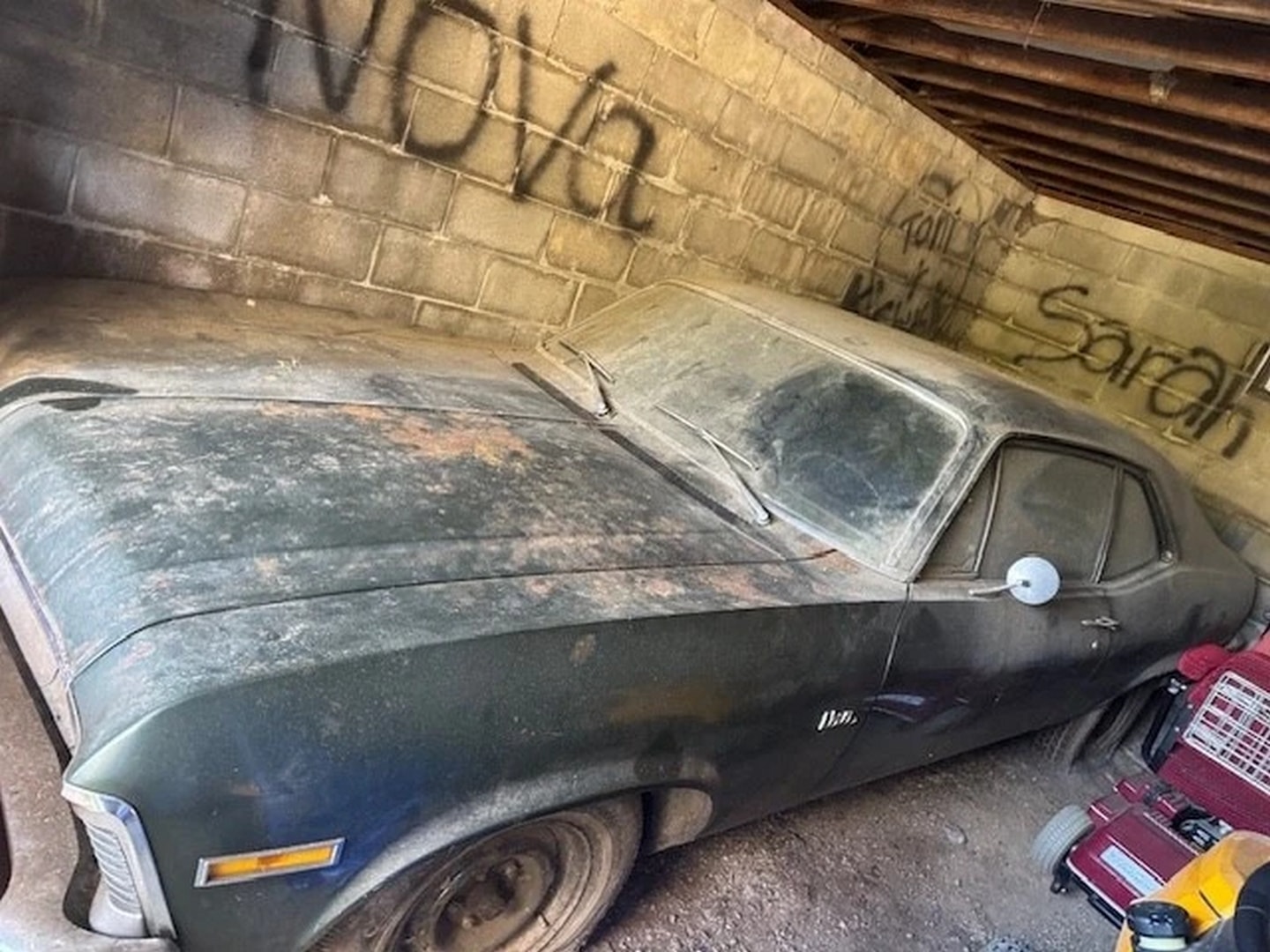
Tucked tightly against a graffiti-sprayed cinder-block wall where the word “NOVA” shares space with the names “Toni,” “Chuck,” and “Sarah,” a 1971 Chevrolet Nova coupe has emerged from decades of peaceful slumber. This original-owner garage find shows 40,489 miles (65,161 kilometers) on its odometer and remains in running, unmolested condition, wearing a thick blanket of dry storage dust rather than the damp rot that ruins many forgotten classics across America.
Finished in factory dark green, the exterior sheet metal is straight and complete, showing only honest surface oxidation across the hood and roof where the original paint has thinned over the past 55 years. All factory brightwork remains in place, including the chrome front bumper, window moldings, round driver-side mirror, amber side markers, and front fender scripts, while the car sits on deflated tires mounted on plain 14-inch steel wheels.
Inside the cabin, the seller’s claim that the car is dusty rather than moldy rings true when inspecting the olive-green upholstery and trim. The perforated vinyl headliner is taut with intact factory stitching, flanking the original dome lamp and shoulder-belt clips, while the driver-side door panel retains its manual crank and armrest. A vertical split marks the green dash pad above the horizontal-sweep 120 mph instrument cluster speedometer.

Photo: eBay.com/netr2
Popping open the trunk reveals solid floor pans still coated in factory black-and-aqua spatter paint, housing a vintage spare wheel and tire secured by its wing-nut clamp alongside a plastic bag of original literature. Under the hood, the untouched engine bay cradles the factory inline-six powerplant beneath its single-snorkel air cleaner, accompanied by a manual drum-brake master cylinder on the firewall that confirms unassisted four-wheel drum brakes and manual steering.
Chevrolet introduced the Chevy II for the 1962 model year after developing the conventional compact in just 18 months to counter the runaway success of the Ford Falcon. Initially, Nova served as the top trim level of the Chevy II before becoming the model’s sole nameplate in 1969. The iconic moniker spanned five separate generations across 22 production years, running from 1962 through 1979 and returning from 1985 through 1988.
Those five iterations comprised the first generation from 1962 to 1965, the squared-off second generation from 1966 to 1967, the semi-fastback third generation from 1968 to 1974 (from which this car stemmed), the European-styled fourth generation from 1975 to 1979, and the front-wheel-drive fifth generation built jointly with Toyota from 1985 to 1988.

Photo: eBay.com/netr2
Among enthusiasts and sales ledgers alike, the third generation reigns as the best all-time generation, blending muscular proportions with massive commercial appeal.
Across its initial 18-year rear-wheel-drive run from 1962 to 1979, Chevrolet manufactured 4,698,781 units of the Chevy II and Nova. The best all-time year of production arrived in 1974, when oil-crisis demand for compact cars pushed factory output to a record 390,537 units. That peak surpassed the 372,626 cars built in 1963 and the 369,509 cars assembled in 1973, although 1973 set the all-time Super Sport record with 35,542 examples.
For the 1971 model year, a 67-day United Auto Workers strike in late 1970 curtailed assembly schedules, dropping total Nova production to 194,878 cars across the two body styles. Buyers ordered 143,235 units of the two-door coupe and 51,643 units of the four-door sedan. Base prices started at $2,175 at launch and rose to $2,376 for the 6-cylinder two-door coupe like this car, while V8 coupes carried a $2,471 base sticker.

Photo: eBay.com/netr2
Chevrolet streamlined the 1971 engine roster by retiring the 153-cubic-inch (2.5-liter) four-cylinder, 230-cubic-inch (3.8-liter) inline-six, and big-block V8s. Of the 194,878 US-built cars, 94,928 carried the 250-cube inline-six (65,891 coupes and 29,037 sedans), while 99,950 featured V8 power, split between 77,344 coupes and 22,606 sedans.
Including Canadian Acadians, transmission installations totaled 126,921 Powerglide 2-speed automatics, 71,810 Turbo Hydra-Matic 350 3-speed automatics, 31,626 column 3-speed manuals, 3,950 Muncie 4-speeds, and 2,993 Torque-Drive semi-automatics.
The green coupe in this story belongs to the 65,891-unit cohort of six-cylinder two-door coupes and retains its RPO L22 250-cubic-inch (4.1-liter) Turbo-Thrift Six. Equipped with a seven-main-bearing cast-iron block, an 8.5:1 compression ratio, and a single-barrel Rochester carburetor, this powerplant delivered 145 hp (147 PS) gross or 110 hp (112 PS) net at 4,200 rpm and 235 lb-ft (319 Nm) of torque at 1,600 rpm to its 2-speed Powerglide.

Photo: eBay.com/netr2
Buyers wanting V8 muscle in 1971 had a trio of small-block choices with 8.5:1 compression. The L14 307-cubic-inch (5.0-liter) 2-barrel V8 generated 200 hp (203 PS) and 300 lb-ft (407 Nm), while the L65 350-cubic-inch (5.7-liter) 2-barrel V8 produced 245 hp (248 PS) and 350 lb-ft (475 Nm). The best engine offered in 1971 was the L48 350-cubic-inch (5.7-liter) 4-barrel V8, delivering 270 hp (274 PS) and 360 lb-ft (488 Nm) gross.
Special factory variants for 1971 included 7,015 examples of the RPO Z26 Nova SS—which mandated the 270 hp (274 PS) L48 350 V8—and 7,700 examples of the striped RPO YF1 Rally Nova. Earlier third-generation models also spawned iconic dealer-built titans, led by Don Yenko of Canonsburg, Pennsylvania. After building 37 big-block 427-cubic-inch (7.0-liter) 450 hp (456 PS) Yenko Super Novas in 1969, Yenko commissioned 175 COPO 9010 Yenko Deuce Novas.
Those 1970 Yenko Deuce coupes packed the solid-lifter 350-cubic-inch (5.7-liter) LT-1 V8 rated at 360 hp (365 PS) and 380 lb-ft (515 Nm), while high-performance dealerships such as Baldwin-Motion, Nickey Chevrolet, Fred Gibb, and Dick Harrell shoehorned 427-cubic-inch (7.0-liter) and 454-cubic-inch (7.4-liter) big-block V8s into third-generation bodies.

Photo: eBay.com/netr2
Because so many humble six-cylinder coupes were later gutted to build big-block clones, finding an uncut, original-paint 1971 survivor has become somewhat of a treat nowadays. Particularly when said find is still titled in the original buyer’s name, has under 50k miles on it, and looks like it teleported itself to 2026, instead of sitting through the decades hidden in a garage/graffiti studio.
Whether kept as the patinated six-cylinder cruiser or used as a rust-free canvas, this 40,489-mile (65,161-kilometer) 1971 Chevrolet Nova is currently offered for sale on eBay at $8,000 – or best offer. The coupe is sold as-is with a clean original title, and the buyer must pay for and arrange transportation. The seller plans to inflate the tires and roll it outside for full undercarriage photos – unless some quick-draw car nut snatches it first.