Support CleanTechnica’s work through a Substack subscription, on Patreon, or on Stripe. Help us produce all of the high-quality, original content we publish week after week despite the challenges of content-scraping AI, antisocial media, inflation, and other hurdles.
Hydrofoils have an obvious appeal. Lift a boat’s hull clear of the water, reduce drag and move passengers faster while consuming less energy. I’ve written before about the proposed electric hydrofoil ferry between Vancouver, Bowen Island and Gibsons, where floating logs, coastal conditions and uncertain passenger demand make the economics difficult. Hydrofoils have been commercially available for decades, but their operating niche remains narrower than their technical appeal suggests.
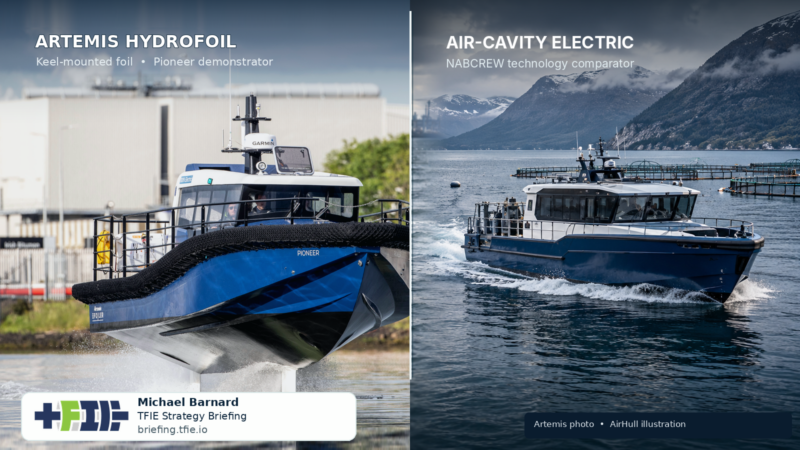
A different opportunity emerged when Antwerp pilotage operator Brabo ordered an Artemis EF-12 electric hydrofoil pilot boat in August 2024. The vessel combines electric propulsion with submerged foils and active controls. Artemis has also demonstrated ship-contact manoeuvres using its EF-12 workboat platform, while the EF-12 Pilot design entered sea trials in 2026. The handling benefits are relevant to pilot transfers even when the boat isn’t operating at full speed.
The financial question is whether a hydrofoil can spend enough of its working life taking advantage of its design. Antwerp pilot boats work around locks, docks, ship movements and changing assignments. Reaching a high maximum speed is of limited value when the vessel spends much of its day manoeuvring or travelling through constrained waterways.
I tested that question using a Python-based operating model with synthetic assignments and three hypothetical sets of port-speed permissions. Depending on how much suitable high-speed water was available, the EF-12 spent zero, approximately 6% or approximately 13% of its underway time foilborne. These are modeled scenarios, not measurements of Brabo’s operations or actual Antwerp speed authorizations.
The resulting financial comparison was unflattering to the hydrofoil. In the central case, the EF-12’s modeled fifteen-year discounted cost was approximately €5.32 million, compared with €3.81 million for a conventional diesel tender, a premium of about 40%. Both figures include purchasing new vessels, rather than comparing a new hydrofoil with the marginal cost of keeping an existing diesel boat.
Electric propulsion still brought substantial energy benefits. The hydrofoil’s problem was that lower purchased energy did not compensate for the assumed capital cost and the limited opportunity to operate in its most efficient regime. Its active controls and potential ride-quality benefits remain relevant, but the available evidence did not justify assigning them a financial value.
An alternative electric approach also deserves consideration. Norway’s Moen Marin and Pascal Technologies have developed an air-cavity electric personnel vessel that reduces hull resistance without lifting most of the vessel above the water. It performed better financially than the hydrofoil in the exploratory comparison, although the existing craft was designed for aquaculture work and would require appropriate adaptation and certification before serving as a pilot tender.
The lesson resembles the one I drew from the Vancouver hydrofoil ferry proposal. Hydrofoils can be excellent machines, especially where sustained high-speed passages and suitable sea conditions allow them to exploit their advantages. In congested harbours, their additional complexity and capital cost need much stronger justification.
Different routes, operating permissions and vessel prices could produce different results. For commercial fleet decisions, the relevant benchmark is the work the vessel actually completes and the total cost of providing that service.
My full TFIE Strategy Briefing analysis examines seven vessel and fuel pathways, modeled dispatch performance, charging, weather, capital costs and fuel-price sensitivities. The detailed comparisons show where different technologies become financially competitive and what operators would need to verify before investing. Available to paid subscribers.
Sign up for CleanTechnica’s Weekly Substack for Zach and Scott’s in-depth analyses and high level summaries, sign up for our daily newsletter, and follow us on Google News!
Have a tip for CleanTechnica? Want to advertise? Want to suggest a guest for our CleanTech Talk podcast? Contact us here.
Sign up for our daily newsletter for 10–15 new cleantech stories a day. Or sign up for our weekly one on top stories of the week if daily is too frequent.


CleanTechnica uses affiliate links. See our policy here.
CleanTechnica’s Comment Policy


