Europe’s regulatory debate over car emissions targets is becoming a contest over where battery and EV production jobs will be located
Diluting EU CO2 standards for cars and vans could eliminate as many as 185,000 passenger car industry jobs in Europe by 2035, according to the International Council on Clean Transportation (ICCT). Retaining current targets would keep the workforce broadly stable, as gains in electric vehicle and battery work offset combustion engine losses.
Brussels is reviewing the rules, which demand fleet car emissions cuts of 55% for 2030 and 100% for 2035 against 2021. Some proposals would delay or loosen those goals on the grounds that electrification endangers European jobs.
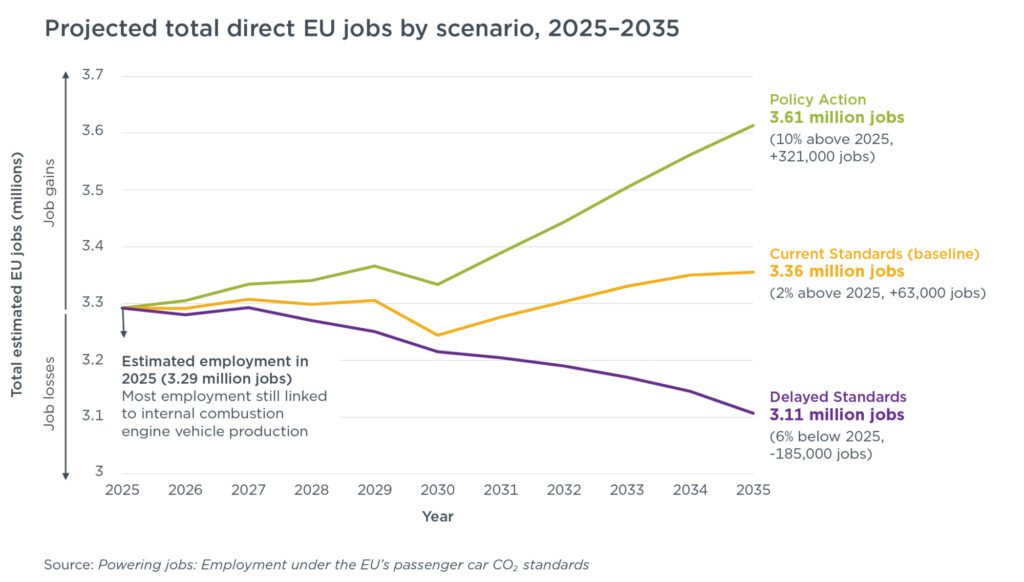
Of three modelled pathways, the current rules keep 2035 employment close to 2025 levels, while adding support for EU-based production creates around 320,000 jobs, or 10%. A five-year delay could push employment up to 6% below 2025, half a million jobs short of the best case.
“Weakening the CO2 standards is being presented as a way to protect jobs, but our analysis shows the opposite,” Sandra Wappelhorst, ICCT Research Lead and the study’s main author, said. “Instead, the EU should consider complementing its standards with measures to strengthen domestic EV supply chains. Clinging to an obsolete technology like the internal combustion engine won’t help workers in the long run.”
Gaps stay small until 2030, with vehicle production driving most of the later divergence. The findings cover electrification alone, however, excluding automation, productivity and indirect jobs such as retail and after-sales.
Source: ICCT