General Motors, the largest US automaker, usually lets its main brands like Chevy, Buick, Cadillac, and GMC ‘do the talking’ about what’s new and upcoming. Not recently, and not this time around, as they just wrapped up the GM Forward 2026 event.
Sure, there’s also the Cadillac Formula 1 Team, which just designed a custom Texas-themed livery for the upcoming United States Grand Prix, but GM as a whole has been very active thanks to the GM Forward 2026 event, announcing how they are “building toward a future that gives people more capability, more confidence, and ultimately, more time for what matters most:” through a combination of AI, software-defined platforms, intelligent manufacturing, and trusted autonomy, of course.
First and foremost, they will seek to have enterprise AI that helps them reduce development times – up to cutting them in half. GM will seek to significantly lower the traditional four-to-five-year vehicle development timeline, aiming to cutting it in half via enterprise AI and virtualization. More precisely, they will use a unified digital thread from day one to bring together design, engineering, and manufacturing.
For example, their latest advancement in EVs, which focuses on lithium manganese rich battery chemistry, or LMR, was tested virtually on more than 300,000 battery designs before creating a single physical prototype, enabling the team to move from the first LMR battery pack concept to formal program approval in one month!
That’s how we ended up with the Generation 4 platform for mainstream electric vehicles, a unified new architecture that will use LMR battery chemistry for “an exceptional range-to-cost ratio, improved performance, and enhanced durability.” It will also include new propulsion systems that reduce parts count by 40%, as well as a new, central compute and electrical architecture serving as the vehicle’s new foundation with “smarter energy management, seamless software updates, and richer in-cabin experiences.”
The latter next-generation electrical and compute architecture will be decoupled in terms of software relative to hardware, consolidating perception, propulsion, active safety, and chassis controls onto a single, high-speed Central Compute Unit (CCU). It will enable sophisticated in-cabin AI and autonomous driving, both running simultaneously. GM promises 40x more computing power with 30% less wiring length and mass, plus up to 50% faster cellular connectivity than in previous systems.
The platform will debut on the 2028 Cadillac Escalade IQ and then quickly roll out on the company’s “highest-volume gas-powered full-size SUVs and trucks, our three-row crossovers and our fourth-generation electric vehicles,” including the Chevy Silverado.
Meanwhile, OnStar is celebrating its 30th anniversary, and GM’s present for the system is the morphing into a “multimodal intelligence platform” – it is set to become a “connected intelligence layer that will make every drive more personal and enjoyable through AI-powered features, while continuing to provide the timely assistance customers trust.”
More precisely, it will be underpinned by the launch of the OnStar AI Assistant in the 2027 Cadillac Lyriq in the coming months through an over-the-air update, with additional GM vehicles to follow later. It will be an AI trained with “GM’s extensive vehicle knowledge,” offering anything from personalized guidance to actual, trusted human support, as well as a new mobile app.
The latter will be the new GM OnStar mobile app, which is set to replace the current OnStar Guardian and Buick, Cadillac, Chevrolet, and GMC vehicle brand apps, striving for a unified experience across vehicles and devices. Additionally, GM announced last year that it is introducing autonomous highway driving starting with the 2028 model year of the Cadillac Escalade IQ.
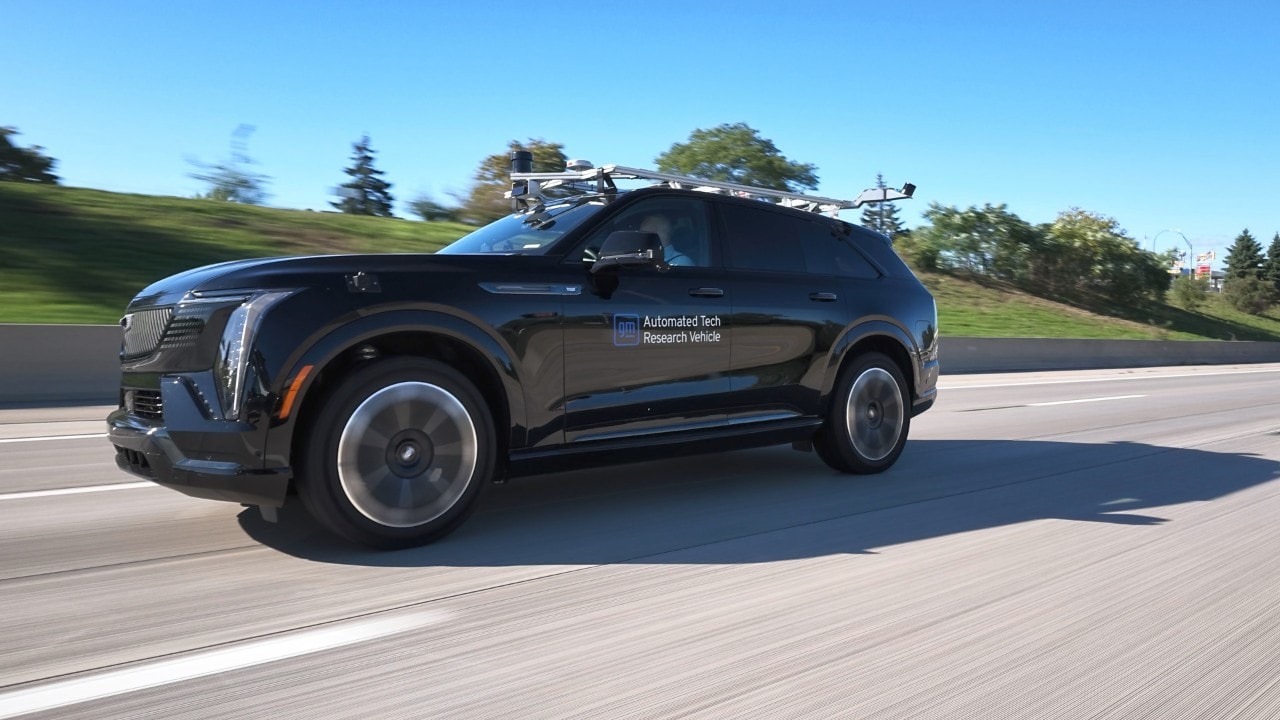
Now the company said they have started testing pre-production vehicles on closed courses and decided to expand autonomous highway driving to all the “highest-volume, best-selling vehicle lineups, including full-size SUVs and light-duty pickups.”
That means moving beyond EVs to gas-powered vehicles, and to achieve that, they have “hundreds of data-collection vehicles that are driving across the country around the clock, generating approximately 1 million miles of full-rate, multisensory data each month to correlate with and augment a much larger pool of generated data.”