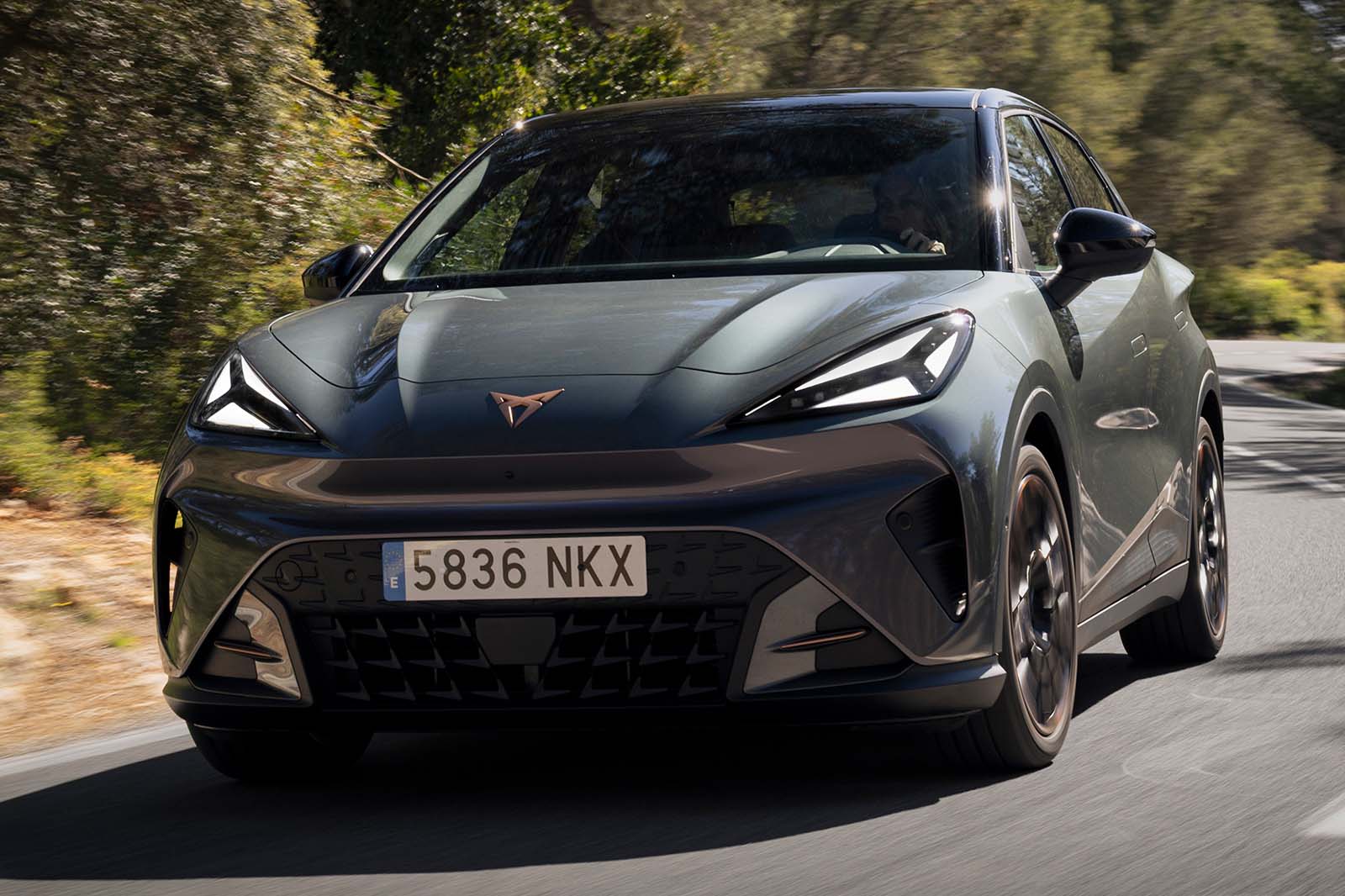
Cupra has aimed for a materially rich, sporty, pseudo-premium ambience with the Raval’s interior. Just as on the exterior, there are plenty of places where the brand’s trademark copper-bronze metallic trims are deployed, alongside interesting 3D-printed dashboard foils and, even in our mid-spec test car, sports seats with bucket-style integrated head restraints.
Upper trim levels of the car push the premium-tech appeal further still, using projected animated ambient lighting patterns for the door panels (although not in the V1 specification of our test car). However, there are places where the car’s materials look a lot less expensive. One such is the textured but shiny upper dashboard rolltop, which has a habit of reflecting its pattern, a little distractingly, onto the underside of the windscreen in bright daylight. Overall, though, this is among the more inviting and materially appealing interiors in the supermini class.
However, it’s particularly interesting that Cupra hasn’t followed the lead of sibling brands Volkswagen and Skoda in returning notably more physical switchgear to the cockpit than it has used in recent products. While both the ID Polo and Epiq each have a row of simple fixed buttons under the main multimedia screen, for easy access to ADAS functions, park assist, heater temperature and the like, the Raval retains touchscreen access for all of these. It also retains the often criticised touch-slider controller for audio volume and heater control (see Multimedia).
The driving position isn’t particularly low-set, even for an electric hatchback. But it is well configured, in front of carefully and conventionally positioned controls, and being adjustable and well supported by the front seat. Occupant space in the front feels quite generous by small car standards and storage space is likewise thanks to a roomy lower storage area in the split-level centre console, as well as good-sized armrest and door bins.
The Raval earns even more convincing and distinguishing practicality points for both back-seat and boot space. According to our measurements, it beats a Renault 5 for second-row space by significant margins and even levels with a Kia EV2 for head room and leg room. Adults of average height can sit behind each other quite comfortably and access involves no particularly tricky bodily contortions.
In the boot, meanwhile, a variable-height floor allows you to have a smaller cargo area flush with the loading lip or an expanded one whose capacity swells to 441 litres underneath the window line – which is the sort of carrying capacity you’d expect of a Golf-sized, C-segment hatchback.
Multimedia – 3.5 stars
The 12.9in ‘One Infotainment’ touchscreen in the Raval isn’t a great change of direction compared with the firm’s other recent models, and in some ways – with a physical cursor controller, for example – it could be made simpler to operate and a little less distracting.
It does grant access to key systems quite easily, though, and can be configured to keep the shortcuts for the menus you most commonly use on the periphery of the home screen, so you’re never more than a couple of inputs from any given adjustment or function.
Our V1 test car came with a factory navigation system, but base-spec Origin models won’t so you’ll need smartphone mirroring for navigation. (A little counter-intuitively, Origin is also the only grade of the Raval that doesn’t include wireless smartphone charging.) The factory nav works well and is easy to program, as much as you are likely to prefer navigating via your mobile phone.
On that score, the system had a habit of forgetting an Apple CarPlay connection between journeys and needing re-pairing, but it worked fine once it was paired.