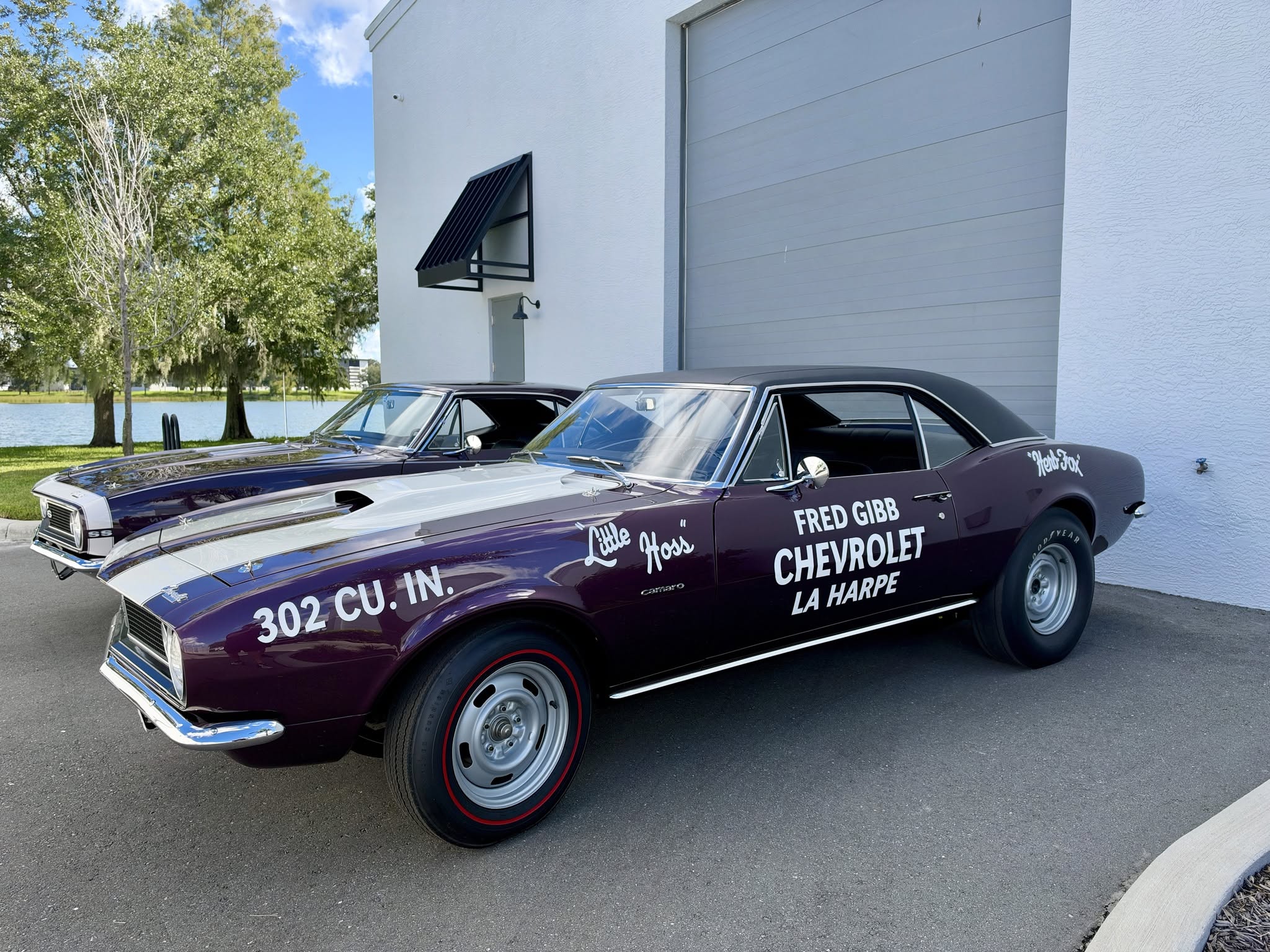
Imagine side-stepping the clutch at 6,000 rpm while a solid-lifter small-block V8 screams past 8,500 rpm down a Midwestern dragstrip. Before the legendary aluminum-block ZL1 ever terrorized quarter-mile asphalt, one 1967 Chevrolet Camaro Z/28 put rural La Harpe, Illinois, on the high-performance map. Known simply as “Little Hoss,” this giant-slaying pony car won 65 out of 68 races and shattered 11 national records across two unforgettable seasons of stock-class warfare.
Today, Little Hoss sits in the private stable of Bradenton, Florida collector Ryan Snyder, who recently showcased the historic machine alongside automotive journalist Jim Campisano on the Muscle Car Campy YouTube channel.
White hand-lettered livery announces “302 CU. IN.” on the front fenders, “Little Hoss” on the doors, “FRED GIBB CHEVROLET LA HARPE” along the rear quarters, and “Herb Fox” above the wide rear Goodyear racing slicks. Up front, 15-inch silver steel rally wheels without trim rings or caps wear redline bias-ply tires, while the black vinyl cabin shows a 5,759-mile (9,268-kilometer) odometer reading.
Inside that sparse cockpit, a dash-mounted tachometer, two under-dash auxiliary gauges, and a floor-mounted 4-speed manual shifter are just about all the driver got back in 1967. When Chevrolet introduced the Camaro for 1967 across its Norwood, Ohio, and Van Nuys, California plants, total production reached 220,906 units, comprising 160,648 coupes and 25,141 convertibles alongside 64,842 Rally Sport packages, 34,411 Super Sport models, and 104 Pace Car replicas.

Photo: YouTube/Muscle Car Campy
Yet the lineup lacked a dedicated road racer, one that would really bring the heat hard down on Carroll Shelby’s Mustangs. To homologate the Camaro for the Sports Car Club of America Trans-American Sedan Championship, Product Promotion Engineering manager Vince Piggins created Regular Production Option Z28 in December 1966.
Because Trans-Am rules limited engine displacement to 305 cubic inches (5.0 liters), Chevrolet engineers mated a forged-steel 283-cubic-inch (4.6-liter) crankshaft featuring a 3.00-inch stroke with a 327-cubic-inch (5.4-liter) block featuring a 4.00-inch bore to arrive at the sweet-spot 302 cubic inches (4.9 liters).
Equipped with an 11.0:1 compression ratio, solid lifters, aluminum intake, and an 800-cfm Holley four-barrel carburetor, the 302 V8 carried a rating of 290 hp (294 PS) at 5,800 rpm and 290 lb-ft (393 Nm) of torque at 4,200 rpm, while real output neared 360 hp (365 PS). Stock Muncie M21 4-speed cars reached 60 mph in 6.7 seconds and ran 14.9-second, 97-mph quarter-mile passes.

Photo: Facebook/Ryan Snyder
When new, a 1967 Camaro Sport Coupe carried a base price of $2,466 in 6-cylinder trim or $2,572 in standard V8 form. Adding the $358.15 Z28 package, mandatory $100.10 power front disc brakes, heavy-duty F41 suspension, and the $184.35 Muncie 4-speed manual gearbox brought base Z/28 pricing to $3,215. Unbadged and barely promoted in 1967, Z/28 sales totaled 602 cars before surging to 7,199 in 1968 and 20,302 in 1969.
One of those 602 inaugural Z/28 coupes arrived at Fred Gibb Chevrolet in La Harpe, Illinois, on June 27, 1967, entering dealership inventory as a Demo 302 Camaro Racer. Gibb and his star salesman, drag racer Herb Fox, christened the Royal Plum coupe “Little Hoss” after Dan Blocker’s Bonanza television character Hoss Cartwright and the small-displacement 302 V8. Raced initially with a cowl-plenum intake, Little Hoss went undefeated throughout 1967, with a track record (pun intentional) of 35-0.
In September 1967, Little Hoss claimed its first American Hot Rod Association world record just as East St. Louis tuning wizard Dick Harrell partnered with Fred Gibb. Harrell fortified the 302 V8 with forged JE pistons, a Howard’s solid-lifter camshaft, Hooker headers, a Hays clutch, and a Lakewood scattershield. That combination propelled Little Hoss to an all-time best quarter-mile Elapsed Time of 11.75 seconds at 118.42 mph.

Photo: YouTube/Muscle Car Campy
After setting a 7.85-second 1/8-mile record at Beardstown Dragstrip on October 22, 1967, the team resprayed the exterior Cardinal Red for 1968 to match Harrell’s Funny Cars, leaving the door jambs and underside of the trunk lid in factory Royal Plum. Fitted with Corvette knock-off wheels, a rear spoiler, and a cross-ram dual-quad intake shipped by Vince Piggins, Little Hoss captured the 1968 American Hot Rod Association Top Stock championship.
Winning Top Stock Eliminator at the August 1968 World Series of Drag Racing in Cordova, Illinois, plus Top Chevrolet Points Leader honors, convinced Fred Gibb to pursue even wilder factory race cars. As Ryan Snyder told Jim Campisano, it was this very 1967 Camaro Z/28 Little Hoss that directly sparked the fuse and inspired Gibb to order the first 50 examples of the fabled COPO Camaro with the all-aluminum ZL1 427-cubic-inch engines.
Gibb expected a price increase of about 400 bucks. He was off by one zero: the shocking $4,160.15 surcharge forced Chevrolet to redistribute most of them, as not many car nuts hoarded ZL1s from dealerships. As far as chevy performance went, only Baldwin-Motion could brag with a higher sticker price for Camaros, but those weren’t factory made racers like the ZL1s.

Photo: Mecum
As for the Z/28 moniker, it went to become a legend, capturing back-to-back titles in 1968 and 1969 on the road racing circuits of Trans Am. However, as Little Hoss proved it in full, the car was more than capable of going very fast and very quick in short bursts of straight-line acceleration. Preserved with its original doors, trunk lid, and a New Old Stock 1967 CE-coded 302 short block, Little Hoss crossed the block in its red 1968 livery twice at Mecum Auctions, selling for $200,000 in Indianapolis in May 2022 and $195,000 in Kissimmee in January 2023.
Following that last sale, the historic Z/28 was stripped of Herb Fox’s red respray and refinished in its original Royal Plum metallic racing glory, just like Fred Gibb had originally launched it into legendhood.