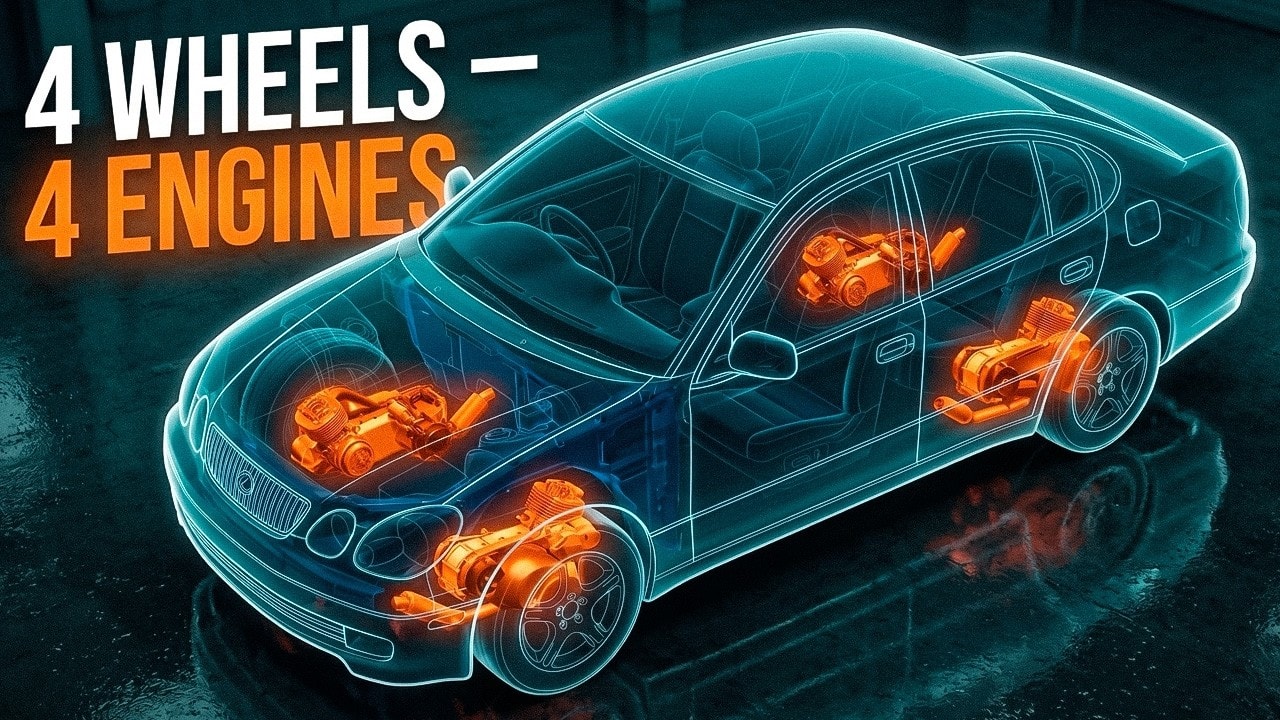
The most wide-spread internal combustion engine architecture of today is the four-cylinder version, for may substantiated reason that meet several requirements imposed by distinct sectors, from financial to engineering to marketing to production. Typically, the four cylinders happily coexist within a single block, reciprocating in tandem and working in harmony to make a car move. But what if they didn’t?
If IT’s stupid but it works, don’t fix IT. IT ain’t stupid, you just don’t get IT. Four engines in a four-wheeled automobile are perfectly reasonable. I mean, if a wheel is designed to turn, why should it only be a passive participant to the ride, instead of doing some work? Oh, right, there that AWD thing. But that means four wheels share one engine. That’s not independence, is it? Garage 54 has a solution for this.
You probably remember the Russians from Novosibirsk (that’s in Siberia, in the middle of the biggest country of Earth), that constantly challenge everything the automotive universe holds dear. They don’t mean any harm. They just do it because it’s fun. And sometimes, simply because “If you could, you should.”
Garage 54 is never tired of finding new automotive limits to break. This time, they didn’t have to venture to frontiers no one has gone before. Quite frankly, they didn’t have to dig for inspiration, too. After all, we’ve all heard about multi-motor EVs, right? Well, why can’t internal combustion have poly-engined representatives?

Photo: YouTube/Garage 54
Vladislav Barashenkov and his fearless crew of Siberian wrenching gremlins looked at modern quad-motor electric hypercars and decided that silent, computer-controlled torque vectoring is for cowards. Why let microchips and copper windings have all the fun when you can cram four separate gasoline engines into one car?
It is a glorious monument to mechanical overcomplication, built on the unshakable philosophy that four tiny, uncoordinated pistons beat one sensible, cohesive, time-tested drivetrain.
To turn this fever dream into reality, the team bypassed exotic racing crate motors and bought the cheapest powerplants on the Russian market for 32,500 rubles (or about $340) apiece. Spending 130,000 rubles in total, they acquired four Chinese-built 150-cc single-cylinder, four-stroke, air-cooled engines based on the ubiquitous GY6 utility architecture. Normally, these humble units are designed to propel lightweight quad bikes, small agricultural trikes, and budget recreational dune buggies.

Photo: YouTube/Garage 54
What these miniature powerhouses lack in prestige, they make up for in sheer packaging convenience. Each 150-cc unit churns out a pavement-wrinkling 10 horsepower, giving the four-engine automobile a theoretical combined output of 40 horsepower. Better yet, every motor comes factory-equipped with an electric starter, a continuously variable transmission, an integrated differential, and a reverse gearbox, meaning this Franken-car can theoretically creep forward and backward just like that.
Every crime against automotive engineering requires a willing victim, and the crew selected their battle-scarred Toyota Aristo—also known as a first-generation Lexus GS—which had already endured numerous engine-swap experiments. Because the executive sedan left the factory as a rear-wheel-drive machine, its front wheel hubs lacked drive splines.
Worse still, routing half-shafts toward the front 15-inch wheels meant colliding directly with the shock struts, control arms, and original factory steering linkages.

Photo: YouTube/Garage 54
Rather than surrendering to basic geometry, or automotive common sense, the mechanics decided to tear out the entire front suspension and convert the luxury sedan to all-wheel drive the hard way. After briefly considering components from a front-wheel-drive Lada Samara, they settled on transplanting the front subframe and suspension from a rugged Lada Niva 4×4.
This unholy Japanese-Russian marriage consumed two weeks of non-stop cutting, grinding, and heavy structural welding inside the Siberian workshop. Plus a heavy dose of Russian optimism, which can be best resumed to this generic idea “It probably won’t work as planned, so let’s do it anyway.”
Fitting a narrow Lada Niva crossmember beneath the wide body of a Lexus required fabrication techniques that would make a structural engineer weep. Instead of gutting the thick factory frame rails completely, the crew grafted sections of Niva frame rails directly into the chassis and fabricated custom upper spring towers. They then sliced the Niva crossmember in half, widened it to match the track, and bridged the gap with steel pipe.

Photo: YouTube/Garage 54
With the suspension cobbled together, shoehorning the four powerplants into the car took another full week of trial and error. Because the two front engines were too wide to sit side by side, one motor had to be mounted slightly higher than its neighbor. Rather than using direct shafts, the builders linked each engine to its corresponding CV axle via exposed roller chains, steel sprockets, and custom-welded shaft sleeves. Safety is for weaklings in Russia, and Garage 54 doesn’t believe in all this New Age fad.
An initial spin test on the workshop lift revealed craftsmanship that could generously be described as artisanal. As the front wheels turned under power, the engines wobbled on their mounts, the chains rattled angrily, and one sprocket rotated with a noticeably square eccentricity. While the massive gear reduction promised brisk low-speed torque rather than highway velocity, the mechanics openly debated whether the spliced axles or suspension would snap in half first.
Out back, the fabricators carved away chunks of rusty sheet metal—carefully sparing the last shreds of chassis reinforcement—to stuff the remaining two engines over the rear axle. Synchronizing this mechanical quartet required one full day just to rig four separate Bowden cables to a single gas pedal. At one point, the car casually began smoking rather vigorously while the welder worked inside, a minor inconvenience the crew greeted with peak Siberian nonchalance.

Photo: YouTube/Garage 54
Physics delivered its first reality check the moment the sedan was lowered off the lift onto its wheels. As the suspension compressed under the vehicle’s weight, the axle geometry shifted, turning the carefully calculated chain tension into slack metal spaghetti and tilting the front mounts at alarming angles.
Firing up all four engines produced a glorious, buzzsaw symphony of 600-cc fury as the sedan lurched out of the garage at full 107% percent capacity. Almost immediately, a bracket weld snapped and a chain jumped its misaligned sprocket, trimming propulsion to 75 percent. Unbothered by the carnage, Barashenkov pressed on as two more chains derailed, systematically cutting output to 50 percent and finally 25 percent of total available power.
Herein lies the accidental genius of this absurd multi-engine architecture: ultimate mechanical redundancy. Even after three drive chains had surrendered their will to live, that final 10-horsepower engine faithfully pulled the heavy sedan forward, shifted into reverse, and drove the car back into the shop.
It is a chaotic, chain-snapping triumph that proves poly-engined combustion actually works (efficiency not withstanding). Once the Garage 54 band of wrenching rebels finds a way to devise a sound plan and stick to it, electric vehicles should officially have a mighty 40-horsepower reason to be terrified.