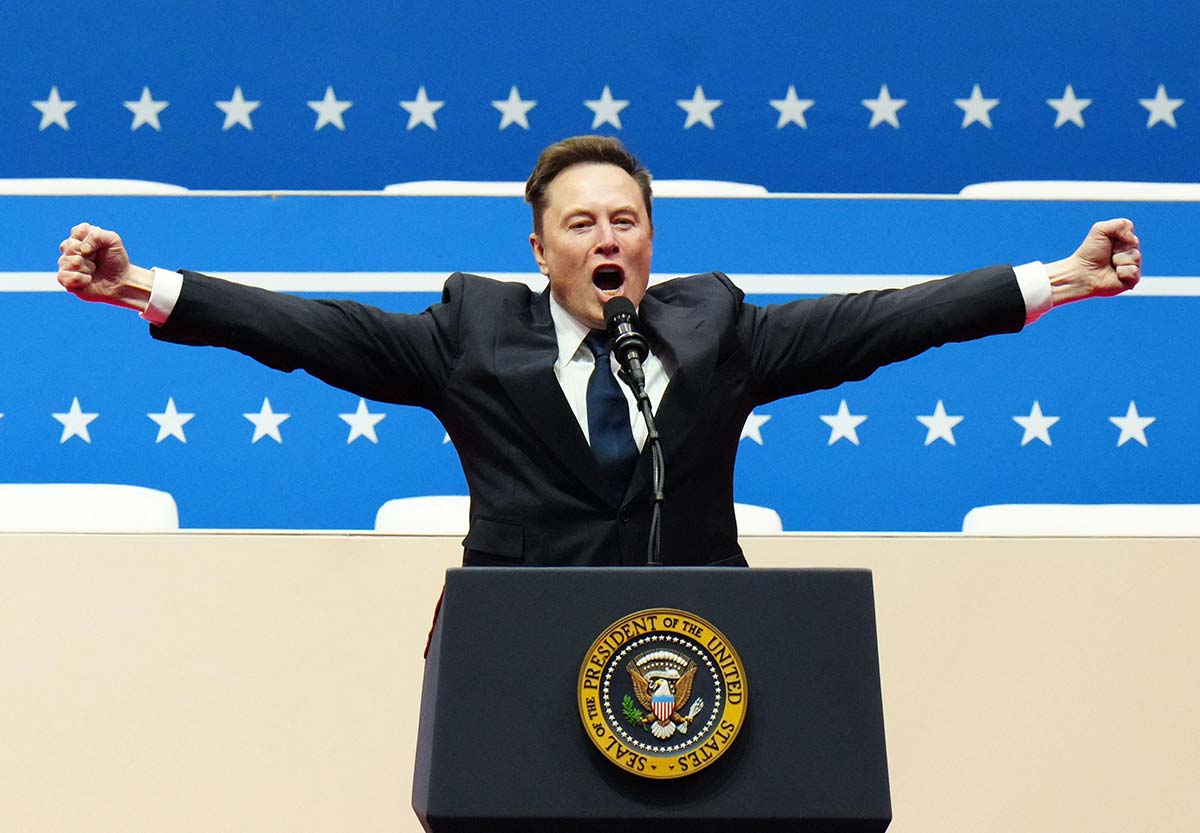
Alex Gibney has spent decades making documentaries about powerful men who behave badly, from the corporate criminals in “Enron: The Smartest Guys in the Room” to the inner workings of Scientology in “Going Clear.” But Elon Musk is a particularly slippery subject. Here’s a man who has become one of the richest people on Earth, bought himself a global megaphone, helped elect a president, and still somehow found time to feud with strangers on the internet. Where do you even begin? And, perhaps more importantly, when do you stop?
For Gibney, the answer to that last question turned out to be considerably later than expected. His sprawling, nearly four-hour documentary, “Musk,” began production in 2022 and was ostensibly finished by spring 2024. Then the billionaire threw his weight behind Donald Trump, and suddenly the film needed another act. As we noted in our Venice review, the resulting documentary is a grim, sometimes overwhelming examination of Musk’s rise, his carefully manufactured mythology, and the damage that can follow when immense wealth collides with unchecked power.
Following a recent New York screening, Gibney and Ashley St. Clair, the mother of one of Musk’s children and one of the film’s most revealing participants, discussed the difficulties of making the documentary, the legal threats that followed, and the billionaire’s increasingly troubling behavior. The Playlist attended the Q&A, which also included an account of Gibney’s interview with Musk’s father, Errol, and pointed accusations from St. Clair about how Musk’s inner circle treats the women in his life.
Gibney explained that when Musk began aligning himself with Trump following the assassination attempt against the former president in July 2024, he considered releasing the film as it was. HBO, however, had other ideas. “I thought, well, maybe the film should be released anyway quickly, and HBO said no, you just hang on, keep following the story,” Gibney recalled. The decision extended production and resulted in a 225-minute documentary, which he joked had been “ruthlessly” cut down from something even longer. It also helped him recognize a pattern: Musk’s behavior rarely changes much, only the consequences do.
To illustrate the point, Gibney reached for an unlikely comparison from professional football: legendary coach Vince Lombardi. “He famously ran three plays, and he ran them over and over and over again, and that’s kind of what Elon Musk does,” Gibney said. Those plays, as Gibney sees them, include the misleading technological promises he attributes to Tesla, the chaotic mass firings at Twitter, and, ultimately, the Department of Government Efficiency, where Musk applied similarly indiscriminate methods to federal agencies. But Gibney believed there was another agenda behind DOGE: “I think it’s fair to say that fraud, waste, and abuse was not really the motivation. The motivation was to destroy the regulatory powers of the federal government, particularly those which pertain to him, and also to obtain all the data on all of us,” potentially, he suggested, to train artificial intelligence.
For St. Clair, the consequences were much closer to home. Asked why she participated in the documentary despite the potential legal and personal repercussions, she explained that she was reluctant to become a public figure in the Musk saga. “I always hate when people say that I’m central or critical to it because I don’t want to be. My hope is that one day I don’t have to be,” she said. “Unfortunately, I am one of the only people who’s allowed to speak right now.” And she suggested her experiences were hardly isolated. “There were a lot of people who had very similar and harmonious stories to me, but they were scared, they were terrified, or legally they couldn’t speak.”
St. Clair hopes speaking publicly might set an example for her children. Still, she directed much of her frustration at Jared Birchall, Musk’s longtime associate and financial adviser, whose dealings with her feature prominently in the documentary. Describing him as a “demon” and a “henchman,” she reserved some of her harshest criticism for his alleged treatment of the mothers of Musk’s children. “When I had that call that all of you have now heard a piece of, I was very freshly postpartum,” she recalled, referring to a recording featured in the film. “And this is what they do. They go to women who are postpartum and coerce them into signing on this dotted line.” She added, “I hold more contempt for him than many other people because of the role that he plays in harassing not only me, but the other mothers and the other people around.”
Gibney said his team contacted Birchall during the documentary’s fact-checking process and received a response that included legal language such as “reckless disregard for the truth.” Given Musk’s reputation for litigation, the filmmakers had already taken extensive precautions. “We did our own fact check. We hired an independent fact checker to fact-check us. We had a couple of lawyers who looked over every frame and every utterance,” Gibney explained. And still, Musk’s attorney, Alex Spiro, came calling.
“Sure enough, on the first announcement that the movie was going to play at Venice, Elon Musk’s attorney, Alex Spiro, threatened to sue, of course, over something he said was in the movie that wasn’t in the movie.”
As The Playlist previously reported, Spiro sent a letter to Gibney’s Jigsaw Productions warning that litigation was reasonably anticipated. The threat raised questions about Universal Pictures, which acquired the film’s international rights in 2023, and whether it would proceed with an overseas release. However, no evidence showed that Musk or his representatives directly pressured Universal to reconsider. Gibney also cited Musk’s dispute with Tesla co-founder Martin Eberhard over his right to call himself one of the company’s founders, arguing that litigation has long been part of Musk’s arsenal. With virtually unlimited resources, the threat of a lawsuit can be almost as effective as winning one.
READ MORE: Universal Reportedly Getting Cold Feet About Releasing Alex Gibney’s ‘Musk’ Documentary
St. Clair also recalled an experience that fundamentally changed how she viewed Musk. Already pregnant with his child, she said she saw communications between Musk and musician Grimes, whose real name is Claire Boucher, concerning their children. According to St. Clair, Grimes pleaded with Musk, who abruptly responded that he was blocking her. For St. Clair, already a mother before meeting Musk, the exchange struck a personal chord. “And in that moment I could feel her pain as a mother, like just deeply instinctually that I was like this is really not good,” she said. She also began reconsidering the implications of Musk’s online behavior. “I was over here for all intents and purposes, shit posting on Twitter. And now all of a sudden I’m seeing these consequences play out at a very massive scale with someone who tangos with truth and reality,” she recalled. “And that was rather terrifying.”
One of the Q&A’s more surprising revelations concerned Musk’s father, Errol Musk, whose appearance in the documentary is among its stranger and more uncomfortable moments. Gibney had struggled to persuade people in Musk’s orbit to speak on camera. “We talked to hundreds of people on background who were off the record, you know, trying to persuade some of them to come forward,” he explained. “A few brave people like Ashley did. But it was hard, really hard.” Getting Errol, however, proved different. “To get Errol to talk required just calling him up,” Gibney said. The elder Musk agreed immediately, and a crew was dispatched to his home.
What followed was an unusually revealing encounter. “The interview was actually a four-hour interview. Sometime it might be interesting to show more of it,” Gibney revealed. One passage particularly disturbed him, involving Errol’s recollection of shooting intruders. “I had to cut it short. It’s a three-hour and 45-minute film, but going on about the pink blood, the dark blood, the normal-looking blood,” Gibney recalled. “That’s somebody who’s clearly seeing that memory in a very fond way, which was distressing.” Given the documentary’s examination of Musk’s upbringing and complicated relationship with his father, the interview provides unsettling family context.
As the discussion turned to Musk’s political relationship with Trump, Gibney recalled an old cartoon from his Enron documentary, describing a story that begins as a comedy, becomes a farce, and ends in horror. The comparison seemed increasingly apt as he considered the final stretch of “Musk,” when the billionaire’s influence extended into the federal government. Gibney pointed to Musk’s control over technological infrastructure, including Starlink, and the implications for communications and the war in Ukraine. But it was Musk’s relationship with Trump that particularly troubled him. “Trump felt that his power would keep Musk in the money and Musk felt that his money would keep Trump in power,” Gibney argued.
St. Clair, surprisingly, found a more encouraging interpretation of Musk’s fixation on public perception. “The through line here is how much Elon tries to control the narrative and manipulate the public perception,” she said, pointing to his purchase of Twitter and his efforts to influence public opinion. “If the people did not have the power to fight back against this, then he would not have spent his entire life trying to change the narrative that they consume.”
Gibney agreed, citing Musk’s fondness for a line from “Dune,” which the billionaire adapted to fit his internet sensibilities. “He really is needy that people accept the narratives that he projects, even if they’re completely false,” Gibney said. Musk has become a kind of human meme himself, his public identity increasingly dependent on the stories people are willing to believe about him. For all the billions, companies, political influence, and self-mythologizing, he still wants to write his own story, preferably without anyone interrupting.
If anyone needs one more reminder of how much Musk’s own words can reveal about him, David Byrne and Daniel Pemberton gave the documentary a musical punchline. Their closing-credits song, “Let Me Sell You a Dream,” turns Musk’s public statements into a satirical sales pitch. After nearly four hours spent dismantling the billionaire’s mythology, it seems appropriate that Musk gets the last word, even if he inadvertently becomes the joke.
“Musk” premiered at the Venice Film Festival and opened in select theaters October 9 through Bleecker Street, with a nationwide expansion beginning Friday, October 16.