
DeFi lending protocol Morpho’s [MORPHO] RWA deposits have crossed the $2 billion milestone, underscoring that the tokenized assets have grown beyond a typical buy-and-hold strategy.
Morpho allows institutions to deposit collateral and borrow against it. As such, the $2.14 billion milestone means institutions bought over $2 billion in tokenized real-world assets (RWA), such as BlackRock’s BUIDL or Ondo Finance’s USDY.
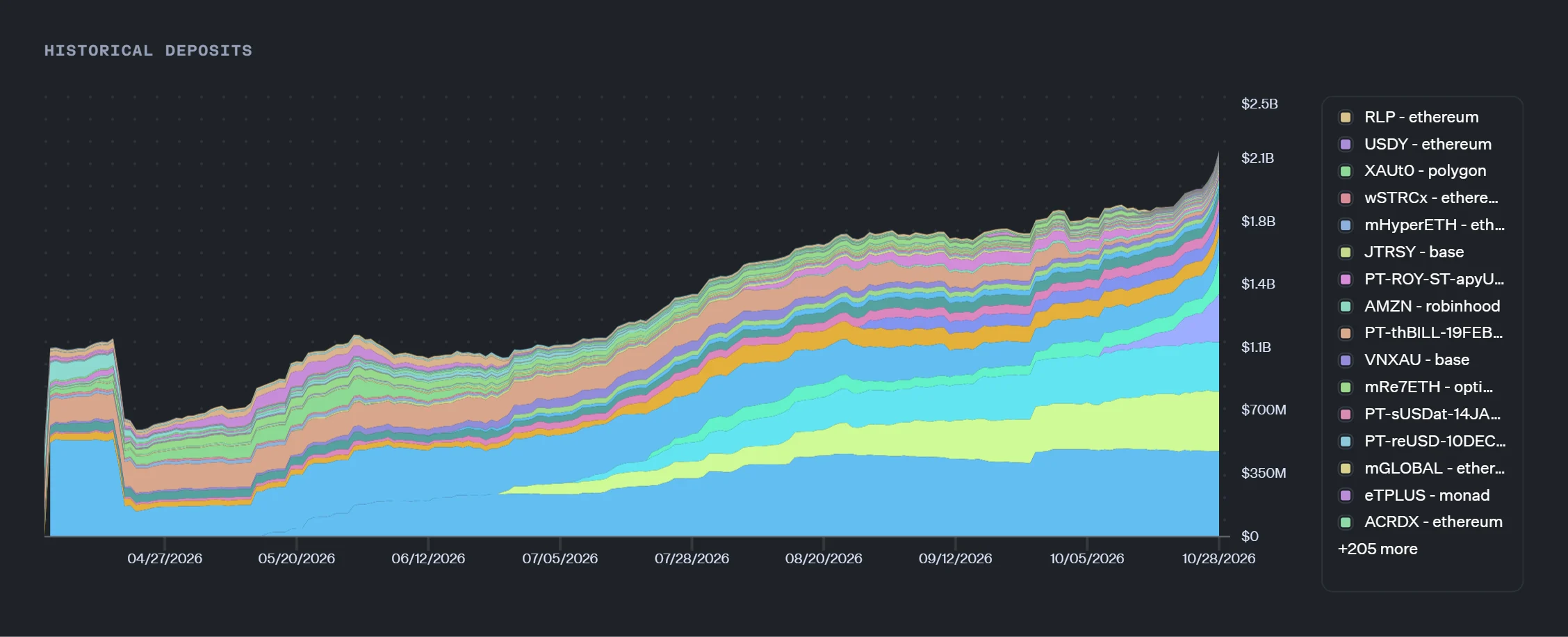
In return, they’ve requested loans worth $894 million, using the $2.14 billion deposits as collateral. That translates to a 42% utilization rate, underscoring the utility and productive use of RWAs.
The borrowed capital is used to amplify low-risk yield strategies like buying more tokenized U.S. Treasury bonds for more interest. According to Morpho Co-Founder and CEO Paul Frambot, this is the second phase of tokenized asset adoption.
Morpho’s RWA markets just crossed $2B in deposits. Tokenizing assets was step 1. Using them to unlock financing and build cheap, global, credit markets onchain is step 2. Morpho will make every RWA productive.
Morpho leads DeFi RWA utility
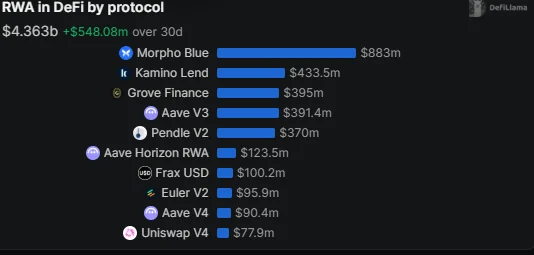
As of Q4 2026, Morpho had a clear lead in making RWA productive on-chain. The broader DeFi active TVL (total value locked) for RWA assets stood at $4.36 billion with an average utilization rate of 14%.
Compared to Morpho’s 42% utilization rate, the lending protocol was driving nearly 4x more RWA utility.
In terms of borrowed loans, Morpho topped the list, followed by Solana-based Kamino Lend’s $433 million, and Grove Finance came in third with $395 million. Aave’s V3 ranked fourth at $391 million, implying a 2x lower RWA utility compared to Morpho.
Interestingly, Morpho’s lead has triggered some clashes with Aave as the two giants push to influence the classification of on-chain vaults and how to approach the regulatory framework for them. That said, the strong traction may influence market sentiment on MORPHO, the protocol’s native token.
However, the traction has no direct value accrual to the token. The protocol’s fee is currently switched off to attract more users as the cheapest lending alternative. So it generates zero revenue to consolidate market share.
Perhaps, if Morpho turns the fee switch on alongside MORPHO buybacks, the token may have a direct value boost.
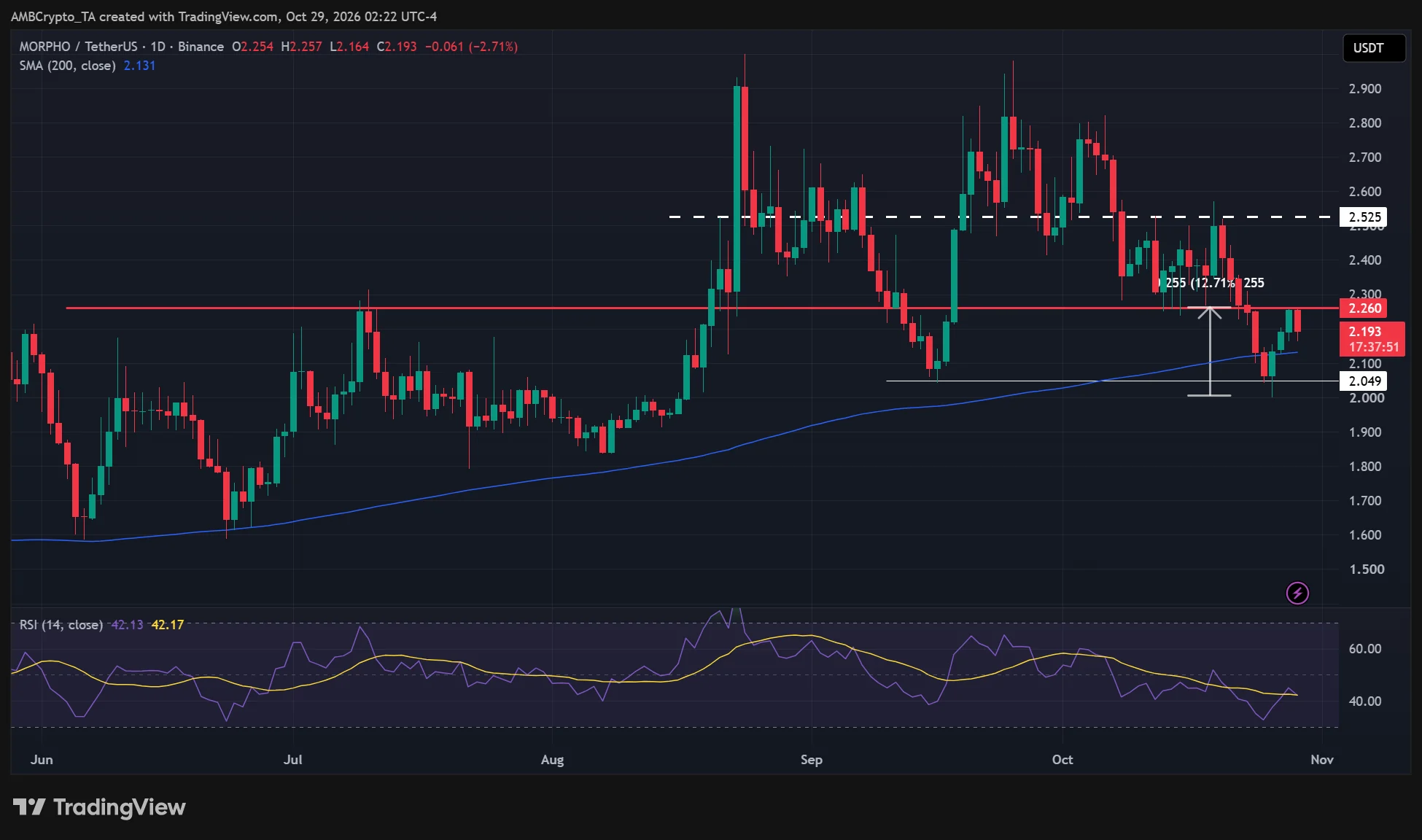
As such, the token’s value depends more on broader market sentiment than the protocol’s growth. On price charts, MORPHO defended $2.0, recovering 12% in the past three days. But it must clear the $2.26 hurdle to extend the recovery.
Final Summary
- Morpho’s RWA deposits hit $2.14B with nearly $900M in loans, implying a 42% utilization rate.
- Morpho CEO believes that making RWA productive will drive more adoption.