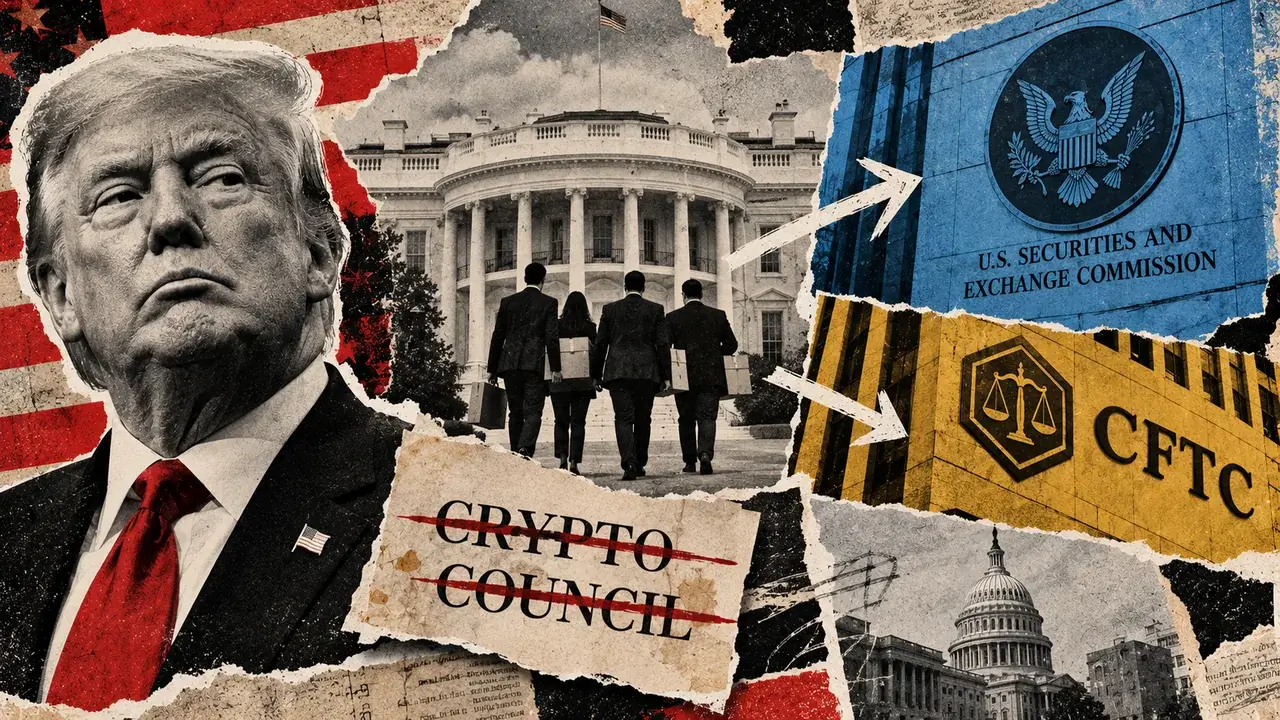
Head of state Donald Trump’s crypto agenda has actually shed a White Residence negotiator as Patrick Witt verifies his departure and the administration’s front runner digital-asset legislation remains delayed in Congress.
On Oct. 15, Patrick Witt, executive director of the White Home Crypto Council, confirmed his departure after virtually 2 years in the management, leaving the government for an undisclosed private-sector function.
In a farewell declaration, Witt defined his federal government service as the benefit of a lifetime, given thanks to Trump and Sacks for their management, and highlighted his function ahead of time the administration’s cryptocurrency agenda.
He indicated the passage of the wizard Act , which developed federal guidelines for payment stablecoins, and recurring initiatives to advance the quality Act, regulation planned to develop a detailed regulatory structure for electronic properties.
His leave complies with the separations of former council director Bo Hines in August 2025, White Home crypto and artificial intelligence czar David Sacks in March, and deputy supervisor Harry Jung in July. No replacement for Witt was identified in his farewell declaration.
Clearness Act loses vital negotiator as Us senate disputes continue
Witt’s departure gets rid of a main number from negotiations over the clearness Act
Your home authorized its variation of the bill in 2025, but initiatives to progress it with the Senate have actually run into resistance over stablecoin benefits, banking competitors and possible conflicts of rate of interest involving Trump’s cryptocurrency companies.
Those arguments added to the failing of a first Senate procedural enact September, leaving the legislation’s potential customers unpredictable in advance of November’s midterm elections.
Banks have actually pushed to restrict incentives used on stablecoin holdings, saying that such setups could draw away down payments from conventional financial institutions. Cryptocurrency firms have withstood those constraints, alerting that they might weaken competitors.
Democrats have likewise demanded stronger safeguards dealing with Trump’s monetary rate of interests in cryptocurrency ventures Democrats questioned whether those restrictions can be applied if the Justice Department, instead of states, made a decision whether to bring an action against the president.
Witt had acted as a prominent White House intermediary among legislators, regulatory authorities and market agents. Days before the failed vote, he warned that losing the chance to advance regulations might postpone thorough cryptocurrency regulations for several years.
Coinbase CEO Brian Armstrong praised Witt’s decision, analytical capacity, and capacity to deal with people holding contending rate of interests.
Alexander Grieve, a federal government affairs executive at crypto investment company Paradigm , stated Witt had spent 2 years browsing contending rate of interests, alternating between legislative technician, arbitrator and political strategist to keep the clearness Act relocating.
SEC and CFTC press in advance under existing powers
The Stocks and Exchange Commission (SEC) and the Product Futures Trading Compensation (CFTC) are already going after components of Trump’s crypto agenda through their own plans and actions
Both agencies have already increased efforts to develop regulatory frameworks utilizing their existing legal authority, decreasing their instant dependancy on congressional activity.
Under Chairman Paul Atkins , the SEC has actually pursued rules covering cryptocurrency issuance, guardianship, and tokenized safety and securities.
The SEC’s efforts consist of an Innovation Exemption for trading tokenized NMS stock and an August proposition for regulative exemptions covering crypto fundraising.
The company subsequently recommended a cryptocurrency custodianship structure on Oct. 1, looking for to develop more clear demands for financial investment consultants and managed funds holding digital properties.
The CFTC is going after a parallel strategy under Chairman Michael Selig
On Oct. 5, the by-products regulatory authority opened up a consultation on policies governing certain leveraged retail cryptocurrency product transactions, consisting of propositions for a specialized registration structure for crypto trading markets.
Selig claimed the initiative would certainly aid establish federal cryptocurrency regulations under the agency’s existing powers, outlining plans to continue with regulative action without waiting on Congress.
The growths recommend both firms could take on a bigger useful role in shaping United States crypto policy as White Residence control deteriorates.
Witt himself recognized their significance in his departure declaration, particularly giving thanks to Atkins and Selig for their collaboration beforehand cryptocurrency regulations over the past year.
Nonetheless, governing activity can not fully change the certainty used by regulation.
Atkins previously recognized that congressional regulations continued to be necessary to developing long lasting cryptocurrency regulations that future managements would certainly locate tougher to reverse.