
ETH can appear on Ethereum and on Arbitrum One, yet the two networks keep separate records of its movement. A cryptocurrency name therefore gives only part of a transfer’s description. It identifies the asset, while the network identifies where the transaction takes place. That distinction explains why a wallet or payment service can display both a cryptocurrency label and a blockchain name.
The terminology becomes less obvious when token standards enter the picture. ERC-20, often displayed beside a cryptocurrency name, describes common rules for fungible tokens: units of the same token that are interchangeable with one another. OpenSea’s explanation of ERC-20 identifies functions for balances, transfers, and approvals. These conventions help software interact with tokens. Ethereum names a network; ERC-20 names an interface used by token contracts.
Online casino payment pages put those labels into practical use because a supported cryptocurrency also has a specified receiving network. Ozoon lists ETH and USDT among its cryptocurrency deposit options, subject to eligibility, and identifies Ethereum mainnet as the accepted network for both. Within that route, ETH is Ethereum’s native asset, and USDT is an ERC-20 token. The two assets share an accepted network while using different technical forms, so the cryptocurrency selection and network description contribute different information to the payment process.
Looking at how a mainstream platform like Ozoon handles this and understanding the different dynamics can be an excellent way to start understanding it in practical terms. When you’re making a deposit, you need to grasp the correct route, and platforms like this make it much easier to do so efficiently.
An asset name and a token standard
A ticker such as ETH or USDT is a short label for an asset. It helps people recognize what a balance represents, but the label alone does not describe every technical detail of that balance. Native ETH belongs to Ethereum’s underlying system. An ERC-20 token is managed through a smart contract, a program operating on the network.
The ERC-20 interface gives such contracts a common set of functions. A balance query asks how many units of the token an account holds. A transfer changes which accounts hold those units. An approval records permission for another address to spend a specified amount on an account’s behalf. These are distinct operations, even though they belong to the same interface. Reading a balance retrieves information; approving spending records an authorization that another operation can use.
ERC-20 also accommodates tokens with different purposes. OpenSea lists stablecoins designed to track a reference currency, governance tokens used for voting, and utility tokens associated with services among its applications. Those categories describe what the tokens do. The standard describes the functions their contracts expose, giving software a consistent way to interact with assets whose roles can differ across the same network.
A contract using ERC-20 has both a standard interface and a location on a network. Software uses the interface to perform a supported operation in that setting. The standard does not assign the token to every compatible chain or combine its balances across them. Ethereum mainnet names the network in this pairing; ERC-20 describes the token’s functions.
One name, separate network records
Arbitrum One provides a documented example of an asset name remaining familiar across networks. It is built on Ethereum as a Layer 2 network, with a separate chain recording its own transactions. That relationship connects the networks without combining all their records. ETH shown on Arbitrum One and ETH shown on Ethereum occupy different network contexts.
Arbitrum’s explanation of bridging describes the mechanism connecting them. In its account of the Ethereum-to-Arbitrum route, ETH is locked on Ethereum, and an equivalent amount is made available on Arbitrum One. The bridge coordinates a movement between networks; an ordinary transfer within one network does not perform that same operation.
The asset label can stay the same while the location of the usable balance changes. That relationship separates bridging from simply changing a wallet’s displayed network. Selecting another network changes which records the software is working with. Movement between those records requires the corresponding cross-network mechanism.
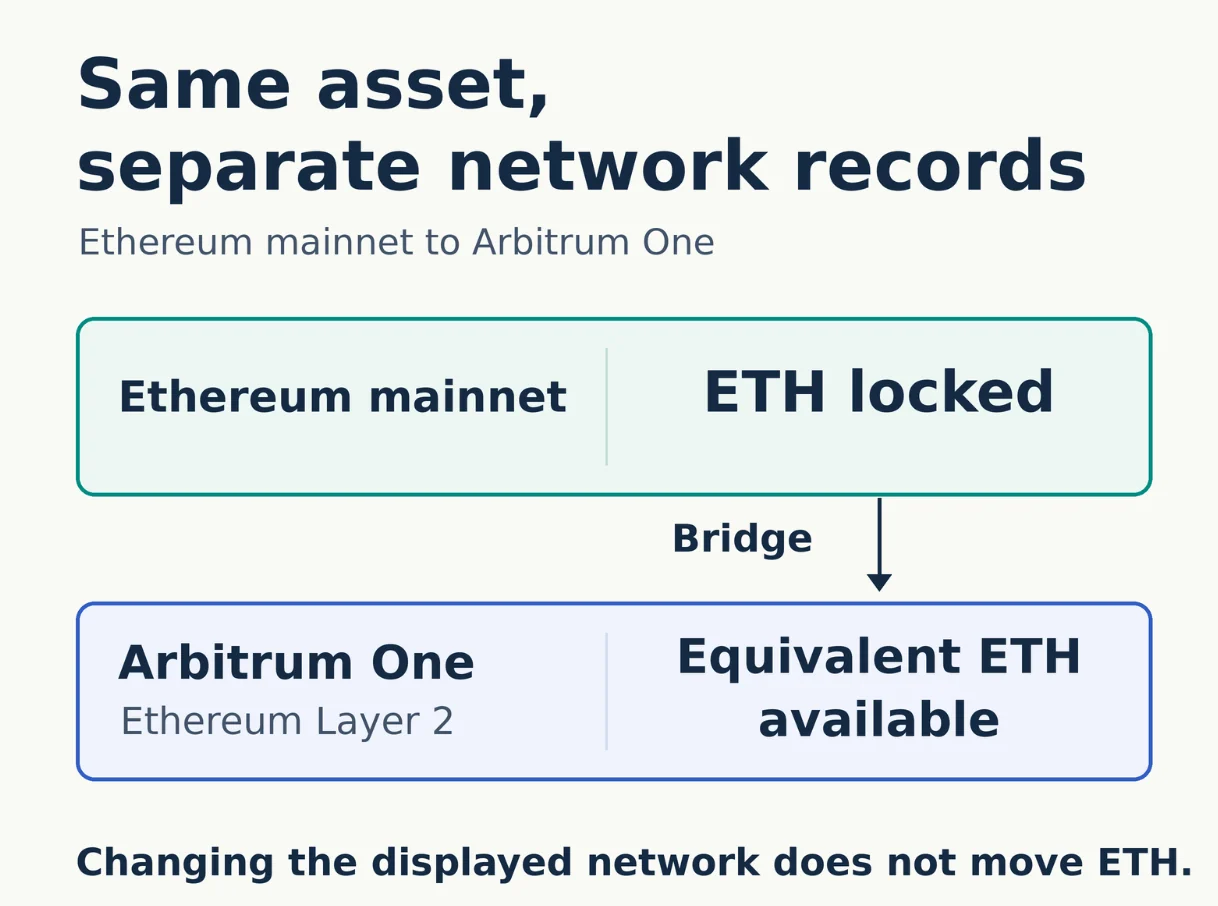
The word “equivalent” in that description concerns the amount represented on the receiving chain, matching ETH committed to the bridge on Ethereum. It describes accounting across connected networks. That connection allows the asset name to remain familiar while the network label identifies where its balance is available.
What a service’s network support means
Shared technical conventions help developers build software that works across compatible networks. The same token interface can make familiar operations available in more than one place. That compatibility concerns the structure of those operations, however. It does not merge network records or decide which transfers a particular service accepts.
Recognizing a transfer function tells software how to request an operation from a token contract. The request concerns that contract on its network. Support for the same function on another chain gives software another setting, with its own distinct network records.
A wallet’s ability to display an asset and a service’s ability to receive it describe different functions. The wallet presents information and enables supported interactions with networks. The receiving service defines the asset and network combinations covered by its payment system. A broad cryptocurrency label cannot express all of those combinations.
The receiving service’s specification is narrower than the software standard. It identifies which asset and network combinations its payment system handles. A standard can help developers build that system, but the implemented support remains specific to the service.
The same asset can remain recognizable across several networks, while each transfer still belongs to a particular set of records. A receiving service handles the combinations it supports, so the network name supplies information that the cryptocurrency name alone cannot provide.
Disclaimer: This is a paid post and should not be treated as news/advice.