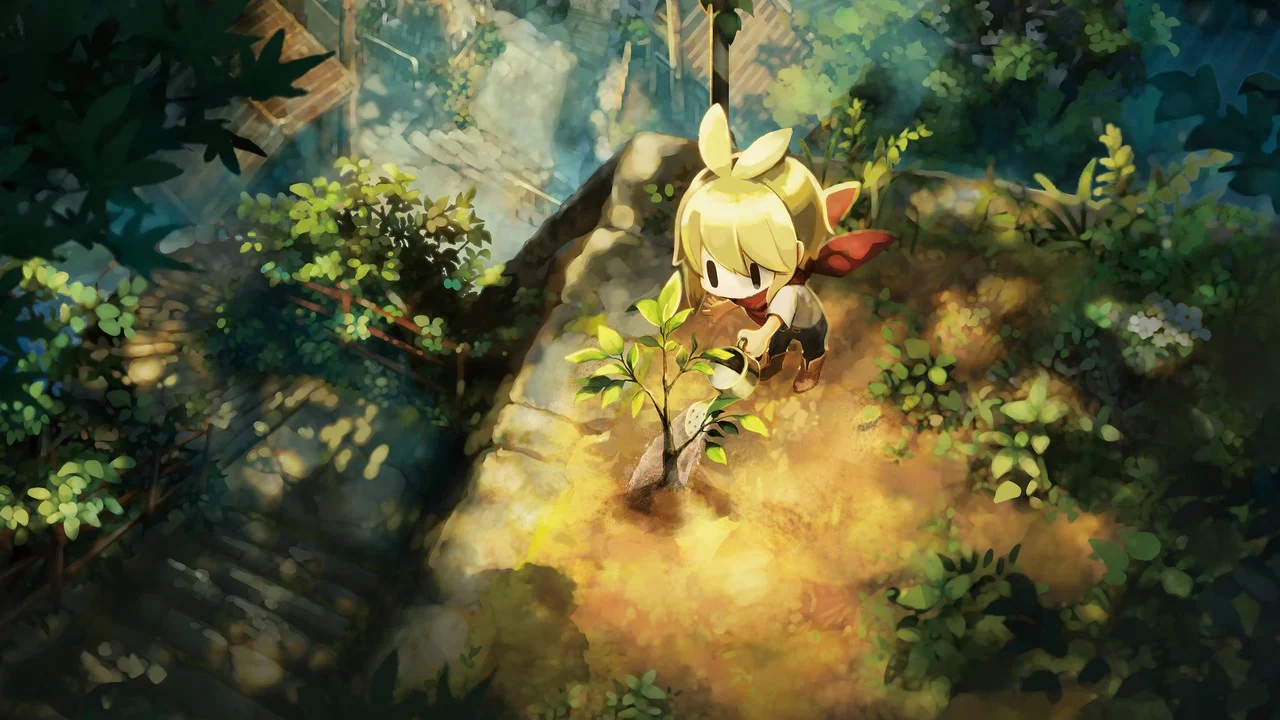

The farming-sim genre needed Village in the Shade. The horror-tinged cosy game plays all the right beats to slot seamlessly into the library of farming adventures that seemingly come out every month. In fact, its visuals, mechanics, soundtrack, and overall feel would make it one of the better cosy titles to come out in the past few years. The real genius of comes in how it turns a mirror onto the player and makes us question why we find this simulated peace so enticing.
My expectations were set expertly by the game’s cold open. I saw my custom main character, who I had just spent a good 10 minutes designing, falling down a well and dying in a pool of blood.
Next thing I know, I’m climbing out of the well, seemingly unharmed and apparently years into the future where rumours of my disappearance have turned into folklore. The people of Kagastu Village, who are absolutely as sweet as they seem and have nothing to hide whatsoever, then welcomed me into their idyllic mountainside community.

Putting the death and the blood to one side for the moment, that’s a pretty standard farming sim opening. Part of the fantasy of the genre comes from leaving an old life behind and starting a far more simple one. Here, that is represented by a literal death, a hint towards the clever ways in which Village in the Shade plays with cosy tropes.
But before it can manipulate them, the game has to make sure it plays the beats of a normal farming sim, and it does so with relative ease. The first hour might be a tough hang for those familiar with the genre, or video games as a whole. It is dialogue heavy and over-tutorialised, meaning I was reading a bunch of functional dialogue, taking two steps by myself, before being forced into another few minutes of functional dialogue.
As frustrating as that first hour is, I’d heavily suggest sticking with it. Once I had my axe, pickaxe, hoe, watering can, and a bunch of seeds, I was having a wonderful time in my new farmer’s life.

It does nothing to reinvent the wheel with any of the farming mechanics, but still manages to make the labour feel fun. So many games have attempted the genre thinking they can throw any kind of busy work at the player and they’ll eat it up. This game ensures that every tree you chop, every plant you water, every vegetable you sell, and every item you find feels satisfying and rewarding.
Village in the Shade is a bit of a slow burn, revealing some of its deeper mechanics way into the game. About five hours in I was introduced to an abandoned quarry where I could run through procedurally generated floors and scavenge for metal ore, similar to Stardew Valley’s mines.
After 10 hours of playing, I unlocked a skill tree-like mechanic that offered rewards and items in exchange for cursed items I found while exploring. This does mean the game has a frustrating tutorial structure where it’s always wanting to teach you things deep into your playtime.

A huge part of the cosy feel comes from the game’s gorgeous art style. On first glance, it seems super simplistic. The characters are chibi sprites and the world around them leans away from being stylised in any significant way, opting for something approaching photorealism. It is reminiscent of certain shots in Masaaki Yuasa’s The Tatami Galaxy where live action photography is implanted on the frame alongside an otherwise cartoony environment.
The semi-photorealism of the art style serves two functions. Firstly, the parallel between something that appears cute and cartoony but has reality seeping through is core to the themes of the game. Also, it allows for the lighting at different times of day to stand out more and offer a deeper immersion.
Another method of immersion is the character designer. In one way, it’s progressive, not boxing the player into a certain gender and allowing you the androgyny to look how you want. Characters refer to you with they/them pronouns. However, there are zero complexion options, which feels ridiculously regressive. Still, I’ve had a lifetime of playing video games to get used to mapping myself on to white characters.

I was initially intimidated by the big chunk of land the game allows you to explore, wondering if I’d ever get used to finding my way around all of its sideroads. But after a couple hours, Kagatsu felt like a second home to me, and that’s the exact kind of thing you want from a cosy game. There were times when I was fishing by the lake during golden hour with music heavily inspired by both Animal Crossing and Joe Hisaishi’s Studio Ghibli scores gently guiding me through the day, and that’s the stuff right there.
Village in the Shade offers you the option to play it as a straight farming sim, and I could have sunk hundreds of hours playing it like that. The game doesn’t rely on a real world clock, instead each in-game minute is a real-life second, meaning you can live in Kagastu for days without a break.
However, I didn’t choose the path of sunshine and roses, I wanted to see the dark side of the village. I often noticed the villagers of Kagatsu come out with some oddly dark and sometimes threatening dialogue, which always stand out from the generic pleasantries they spout most of the time. In my first hour I was lectured on the village rules which include foreboding demands like ‘Do not be outside after 11pm,’ ‘Do not expose other people’s secrets,’ and ‘Do not respond to voices from the mountains.’

I found myself breaking almost every rule, but only when the game allowed. Developer NIS doesn’t offer the freedom of games like Pokopia or Animal Crossing where you can do your own chores and progress the story when you want. Story progression here is forced, which is a bit annoying when I have plans laid out to spend a certain amount of time fishing or to get a certain thing from the shops, instead being trapped into a tutorial on hunting.
When allowed, I discovered the ghosts and ghouls that patrol the streets at night, finding that one of them comes to my door at 2am every night, loudly knocking and tempting me to come outside in exchange for hints about my past. This is the stuff that kept me wanting to come back to Kagatsu. I couldn’t get enough of the village’s increasingly dark lore and I desperately wanted to know the truth behind my character’s resurrection.
Horror needs to have a purpose and the game uses it to make you question your love for the farming sim. We use these games as an escape; Village in the Shade asks us what we’re running from. This is an excellent commentary on the cost of an idyllic-seeming society. What are we sweeping under the rug in order to achieve a world where nothing goes wrong and everybody’s friendly? What demons are coming out at night? Why do we want to start over at a farm in the mountains instead of confronting the life we have in front of us?

Not only is it a critique of the farming sim genre, but the pursuit of polite society in general. Village in the Shade is a sharp, searing take on the bottled up rage that comes with presenting a veneer of politeness.
Conclusion
Village in the Shade pulls off a magic trick, presenting you with a fun, addictive, idyllic farming sim before using your desire for escapism against you, acting as a reminder that you can never truly outrun the darker sides of life.
The true genius of the trick is that this doesn’t stop the game from being entertaining, only pulling you deeper into its satisfying and appropriately complex mechanics as well as the psychological questions it poses.