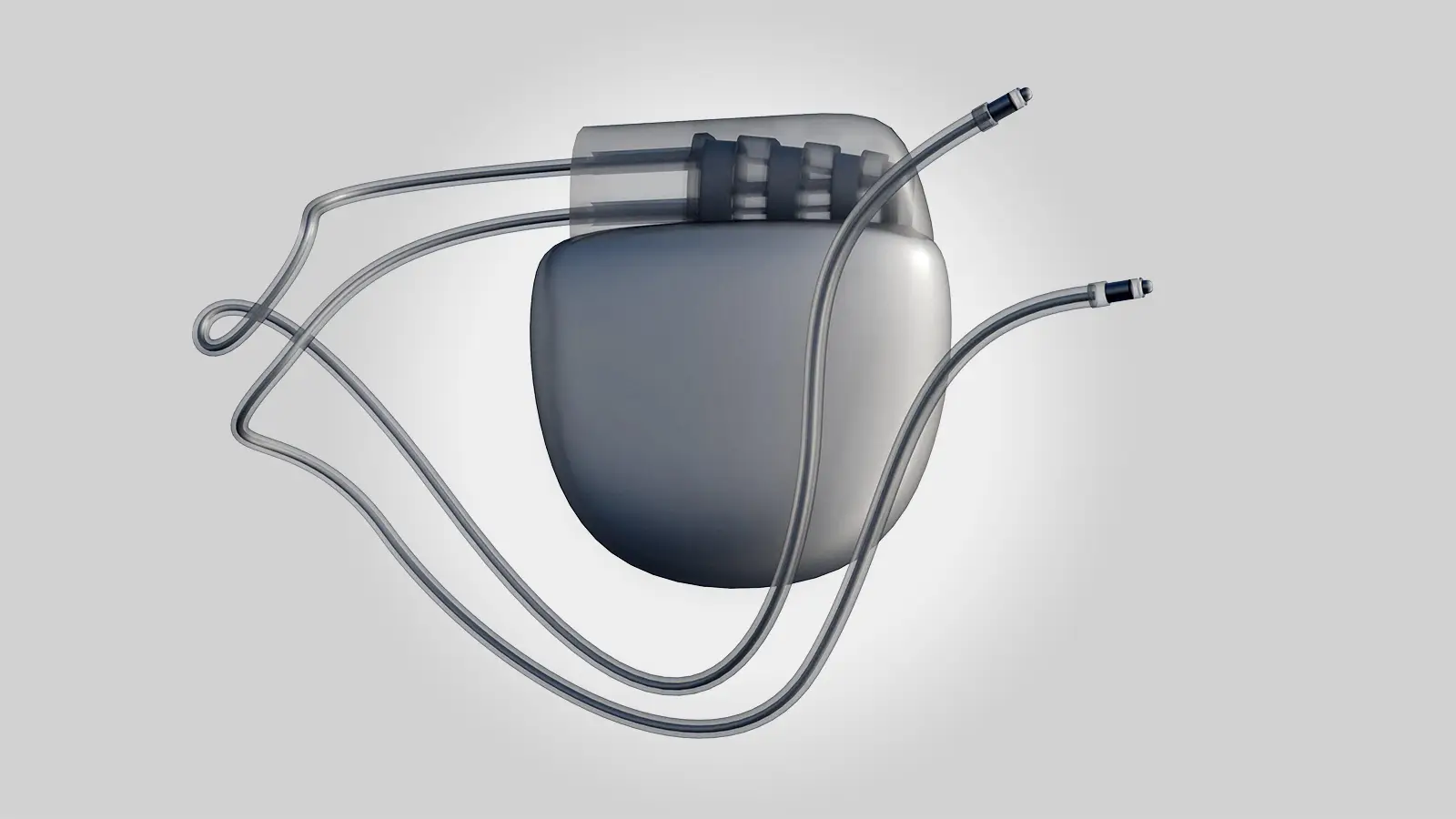
- In a Chinese trial, left bundle branch area pacing (LBBAP) was compared against right ventricular pacing among patients with atrioventricular block and preserved LVEF requiring high-burden ventricular pacing.
- LBBAP met criteria for superiority in reducing the risk of the composite endpoint of all-cause death, HF events, or upgrade to biventricular pacing at 24 months.
- Findings strengthen the evidence for LBBAP as a preferred pacing strategy in this population, in line with guideline recommendations for cardiac physiologic pacing.
For lower-risk patients with atrioventricular block (AVB) requiring substantial ventricular pacing, left bundle branch area pacing (LBBAP) was able to claim superiority in a randomized trial from China.
Among such individuals with preserved left ventricular ejection fraction (LVEF) who were in sinus rhythm, the composite clinical outcome of all-cause death, heart failure (HF) events, and upgrade to biventricular pacing cardiac resynchronization therapy at 24 months significantly favored LBBAP over right ventricular pacing (RVP), the latter largely done septally in this trial (2.4% vs 12.5%, P=0.003).
The 24-month Kaplan-Meier estimated cumulative incidence of the primary endpoint reached 5.0% vs 13.2% and supported LBBAP’s superiority (HR 0.37, 95% CI 0.19-0.73), reported Xiaohan Fan, MD, PhD, of Fuwai Hospital and the Chinese Academy of Medical Sciences and Peking Union Medical College in Beijing, and colleagues. Their LEAP-Block trial manuscript was published in JAMA.
“These findings suggest that for patients with AVB and preserved cardiac function and a high anticipated ventricular pacing burden, LBBAP offers feasibility and safety comparable to those of RVP while reducing adverse clinical outcomes,” study authors concluded.
Of note, Fan’s group showed that the benefit of LBBAP appeared to be driven by a reduction in HF events (3.4% vs 11.3%), with no difference made in all-cause death, biventricular pacing upgrade, device-related complications, or pacing-induced cardiomyopathy.
This drop in HF events likely stems from a decrease in the development of pacing-inducted cardiomyopathy (3.4% with LBBAP vs 7.4% with RVP), suggested Fred Kusumoto, MD, of the Mayo Clinic in Jacksonville, Florida, who was not involved with LEAP-Block.
“LBB pacing has already become very popular and commonly used around the world, and this study confirms guideline recommendations to maintain physiologic ventricular activation when significant ventricular pacing due to AVB is present,” Kusumoto told MedPage Today.
LBBAP is a type of conduction system pacing directly engaging the heart’s intrinsic conduction system to restore or preserve synchrony of ventricular contraction. Growing evidence suggests better clinical outcomes with LBBAP as opposed to RVP in patients with bradycardia and HF. Hence, in 2023, the Heart Rhythm Society released guidelines giving cardiac physiologic pacing a IIb recommendation, deeming it reasonable, for patients with normal LVEF who are anticipated to require substantial ventricular pacing.
Kusumoto commented that LEAP-Block adds more support to the evidence for LBBAP, where prior studies have often compared LBB pacing with RV apical pacing alone. “The authors are to be congratulated that there were no additional complications associated specifically with LBB pacing,” he added, as septal perforation has been a concern based on prior observations.
Fan and colleagues noted that the trial cohort had been relatively low-risk, having preserved LVEF, unlike the high-risk patients (LVEF <50%) for whom guidelines give stronger recommendations for conduction system pacing or biventricular pacing over RVP.
LEAP-Block was a multicenter superiority trial conducted across 14 Chinese hospitals. Participants were adults with indications for ventricular pacing and an anticipated ventricular pacing burden greater than 40%, including third-degree AVB, Mobitz type II second-degree AVB, intermittent advanced AVB, and symptomatic prolonged first-degree AVB. LVEF had to be at least 50%.
Out of 551 patients screened, 499 were randomized to LBBAP or RVP from 2021 to 2023.
All participants received a dual-chamber pacemaker with the atrial lead placed in the right atrial appendage or septum. For LBBAP, a lead was positioned to the LBB area using a C315 His sheath and a 3830 lumenless lead. For RVP, a stylet-driven active-fixation lead was placed at the RV septum or apex under fluoroscopic guidance. Crossovers were allowed if the initially assigned pacing approach failed.
In the end, the modified intention-to-treat primary analysis cohort came out to 482 people (mean age 67 years, 46% women). Mean LVEF was 64%. Complete AVB was present in 54.6% of participants, and 37.0% had a baseline QRS duration exceeding 120 ms, including 10.3% with left bundle branch block and 23.7% with right bundle branch block.
Baseline characteristics were generally balanced between the LBBAP and RVP groups, except for a higher mean age in the latter (65.2 vs 68.0 years).
Fan and colleagues reported that acute procedure success reached 97.9% for LBBAP and 99.6% for RVP (P=0.22). Among the LBBAP procedures, left bundle branch capture was confirmed in 79.7% of cases. Among those with successful RVP implants, 96.7% received RV septal pacing and the remainder RV apical pacing.
The tally of HF events after LBBAP and RVP was based on clinical symptoms, physical findings, laboratory or imaging abnormalities, and HF-directed therapy.
The finding of a between-group difference in these HF events could have been affected by individual clinician behavior, Kusumoto cautioned. “For example, would the treating clinician be more likely to admit for shortness of breath and heart failure when they identified a QRS morphology consistent with RV septal pacing?”
The authors acknowledged that their study’s limited sample size and duration precluded them from showing statistically significant differences in individual components of the composite outcome. Additionally, the trial may not be generalizable to LBBAP using a stylet-driven lead.
LEAP-Block’s findings also cannot be applied to patients who require pacing for sinus node dysfunction and have normal atrioventricular conduction, Kusumoto cautioned.