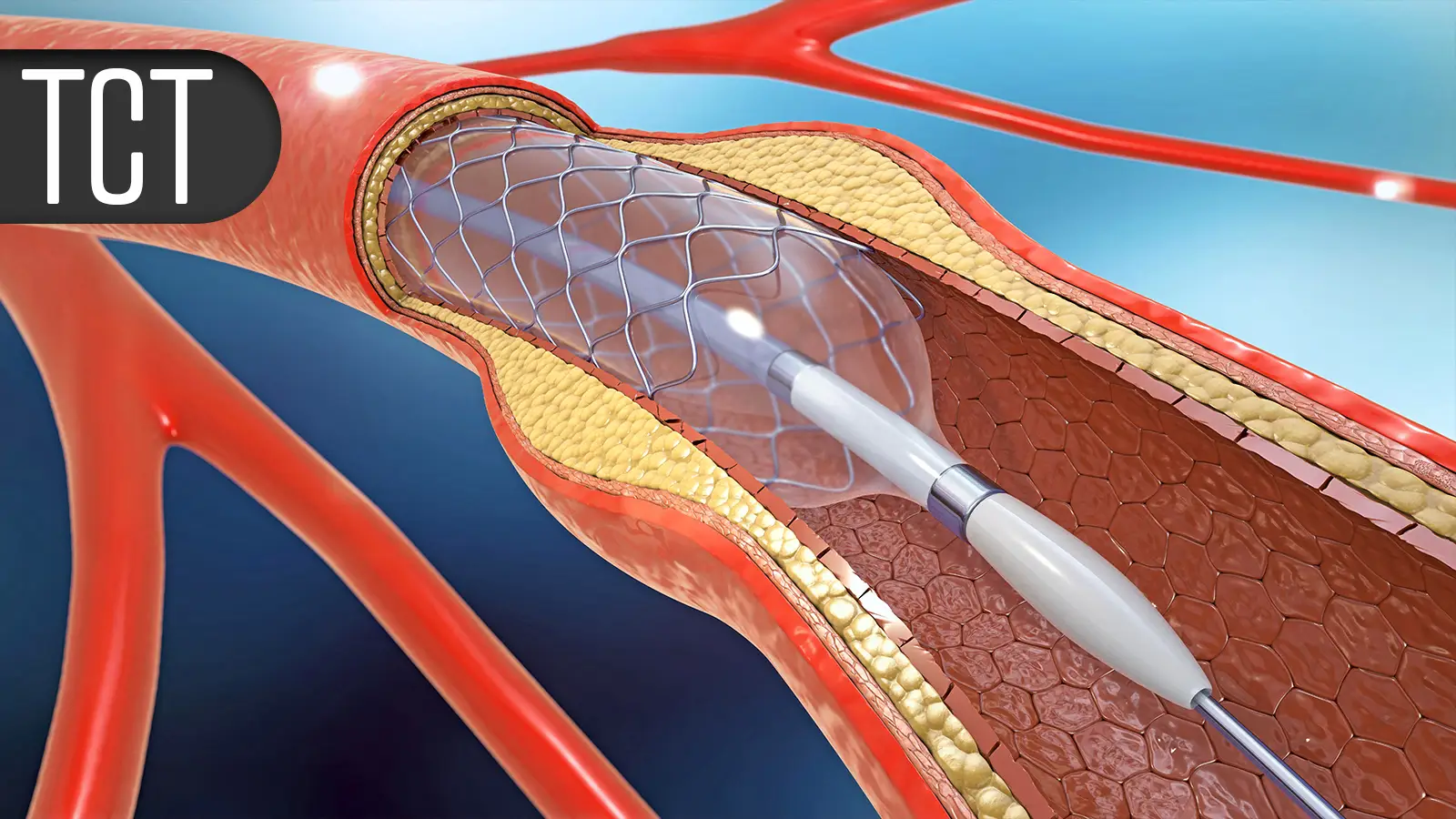
Coronary CT angiography (CCTA) made it feasible and safe to plan percutaneous coronary intervention (PCI) procedures before cardiac catheterization, as shown by the open-label randomized P4 trial.
At 12 months, a CCTA-guided PCI strategy was noninferior to intravascular ultrasound (IVUS)-guided PCI with respect to target vessel failure — a composite of death from cardiac causes, target vessel myocardial infarction (MI), or ischemia-driven target vessel revascularization — occurring in 4.1% versus 4.6% of patients, respectively (P<0.001 for noninferiority), reported Carlos Collet, MD, PhD, of the Cardiovascular Research Foundation in New York City.
Additionally, CT guidance resulted in shorter procedures (46 vs 63 minutes) and reduced contrast utilization (150 vs 170 mL).
“P4 supports a CT-based pathway for PCI planning and guidance in selected patients referred to the cath lab … What we’re proposing is moving the PCI planning, not to do it in the cath lab, but basically shift that upstream to read, think, process, share the decision, and then go in the cath lab and treat,” Collet concluded at the Transcatheter Cardiovascular Therapeutics (TCT) annual conference hosted by the Cardiovascular Research Foundation.
The P4 manuscript was simultaneously published in the New England Journal of Medicine.
Collet noted the current reliance on making PCI decisions in real time — everything related to lesion preparation, stent diameter and length, and more — during the procedure.
“That generates or increases the cognitive load of our brain, when we have to use it to make very complex decisions. So, what if we were to learn from our colleagues in the structural field and start planning PCI interventions? We will be better prepared, perhaps reduce the variability in treatment care, and that will give us an opportunity for shared decision-making with our patients,” he said.
Of note, the comparator in P4, IVUS-guided PCI, is associated with a lower risk of adverse clinical events than angiography-guided PCI, but still only provides information after cardiac catheterization has begun.
TCT session discussant Emmanouil Brilakis, MD, PhD, of the Minneapolis Heart Institute Foundation, called P4 a “landmark” trial.
“The study does provide the clinical evidence we need to move to this new era that Dr. Collet alluded to, which is that of planning the procedures before we come to the cath lab,” he said. “But there are many steps that we need to achieve to be able to get there. Number one is to have a high-quality scan. The scans in the study were screened and they were very high quality.”
“We need to learn how to actually use the CT, how to look at the CT images, and implement them for planning our practices,” Brilakis added.
Collet stressed the point that interventional cardiologists should take it upon themselves to look at the CCTA images, and not rely on the reports of the radiologists. “They [radiologists] don’t know the details of the techniques that we’re using. They don’t know the details on when to modify the calcium, bifurcation treatment, etc. So we need to get used to looking at the pictures.”
During a press conference, Collet alluded to a rising prevalence of patients undergoing CT scans before a PCI. He noted that the practice is now commonplace in the U.K.; in the U.S., it still varies widely with a national site average of about 10%, he estimated.
“Let us not forget that this requires contrast and radiation for the CT scan,” Brilakis cautioned. “Therefore, this needs to be taken into account, and there is also some extra time for the patient to have this procedure.”
P4, or the Precise Procedural and PCI Plan trial, was an open-label noninferiority trial that enrolled at 23 centers.
Participants were patients with a clinical indication for coronary revascularization who had undergone CCTA as part of routine clinical care before enrollment in the trial. Entry criteria included having at least one epicardial lesion with a diameter stenosis >70%, a CCTA-fractional flow reserve of ≤0.80, reference vessel diameter 2.5-4.0 mm, and no more than two target vessels.
There were 1,105 individuals randomized to CCTA or IVUS guidance of PCI. To avoid leaving underexpanded stents, Collet and colleagues mandated that the CT arm utilize stent enhancement tools based on angiography.
Median age was 65 years, and 21.7% of the cohort were women. About one in five had diabetes and fewer than 3% a prior PCI. The vast majority had stable ischemic heart disease (about 98%) as opposed to acute coronary syndrome, and the extent of coronary artery disease was mostly one vessel (64%). Average SYNTAX scores were 8 for the CCTA group and 9 for IVUS.
Study authors noted that the burden of coronary calcification was substantial in this cohort, with mean coronary calcium scores of approximately 500, and over 10% of participants judged to have severe calcification.
Participants who ultimately ended up receiving PCI came out to about 93% in both arms.
The investigators reported that beyond the aforementioned primary analysis, CCTA guidance continued to have favorable results when target vessel failure was broken down to its individual components:
- Death from cardiac causes: 0% vs 0.4%
- Target vessel MI: 2.9% vs 3.5%
- Ischemia-driven target vessel revascularization: 1.4% vs 1.5%
Additionally, a per-protocol analysis was consistent with the intention-to-treat analysis.
The noninferiority margin used for the study was an absolute risk difference of 4.5 percentage points. With that met, the investigators proceeded to test for superiority of CCTA guidance, which did not meet significance.
Safety events in P4 did not raise red flags for CCTA-guided PCI. There was no major excess of all-cause death (0.2% vs 0.5% in the IVUS-guided PCI group), bleeding of Bleeding Academic Research Consortium (BARC) type 2, 3, or 5 (1.4% vs 1.3%), or BARC type 3 or 5 bleeding (0.4% vs 0.7%).
However, the P4 trial had lower than expected event rates and is still pending a final 5-year follow-up, Collet acknowledged.
Moreover, among the trial’s exclusion criteria were ST-segment elevation MI, left main coronary artery disease, previous PCI in a target vessel, previous coronary artery bypass grafting, and a severely low estimated glomerular filtration rate.
Collet reported that CT planning appeared disproportionately beneficial for patients with the most complex coronary disease. As such, a new trial, P5, is now ongoing, testing the strategy specifically in this population.