Even when given the same drug, some patients respond well while others show little or no response. This is particularly true of immunotherapy. A research team at POSTECH (Pohang University of Science and Technology) has developed an artificial intelligence (AI) technology that can predict, in advance, which patients are likely to benefit from treatment.
A research team led by professor Sanguk Kim of the Department of Life Sciences and the Graduate School of Convergence Science and Technology at POSTECH, together with Minsoo Kim, an integrated MS-Ph.D. student at the Graduate School of Artificial Intelligence, has developed a machine-learning method that analyzes genetic information from cancer patients to predict their response to immunotherapy. The study was recently published in npj Digital Medicine.
Obstacles to predicting immunotherapy response
Unlike conventional cancer treatments that directly attack tumor cells, immunotherapy works by helping the patient’s own immune system fight the cancer. While its ability to produce long-lasting responses is a major advantage, a significant number of patients do not respond to immunotherapy. In such cases, patients may not only incur substantial costs for an ineffective treatment but also lose valuable time that could otherwise be spent pursuing alternative therapies. This makes it important to determine in advance whether immunotherapy is likely to work for a particular patient.
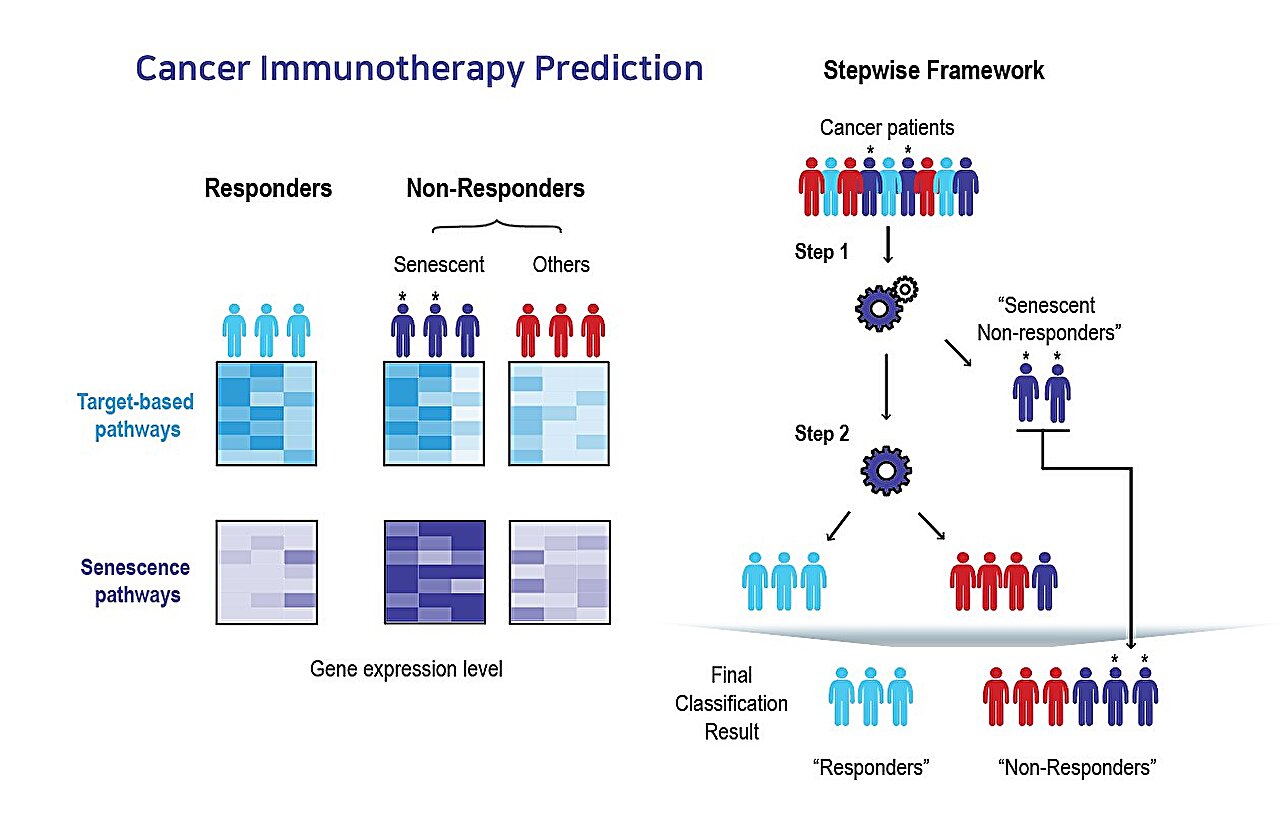
One of the key challenges is that the environment surrounding a tumor varies considerably from patient to patient. Among the various factors involved, senescent cells in the tumor microenvironment can suppress immune-cell activity. They are like troublemakers on a battlefield, subtly hindering the advance of friendly forces. Because it is difficult for clinicians to assess such a complex and highly variable environment on a case-by-case basis, researchers have increasingly turned to AI for help.
AI, however, faces its own challenge: a lack of patient data for training. The problem is particularly pronounced because the number of patients is relatively small, while the amount of genetic information that must be analyzed is enormous. When the amount of information far exceeds the number of patients, AI models can become overly tailored to the training population and perform poorly when presented with new patients. It is much like a student who memorizes practice questions by heart but struggles when faced with an unfamiliar exam.
A stepwise approach improves prediction
The research team took a different approach. Rather than feeding all the information into the AI at once, they first identified tumors with a senescent microenvironment in which immune-cell activity was suppressed. They then progressively stratified patients to determine whether they were likely to respond to treatment. This step-by-step approach allowed the AI to avoid becoming overly biased toward any particular patient group and achieve robust predictive performance across diverse patient populations.
In experiments, the method outperformed biomarkers currently used in clinical practice in predicting treatment response across four cancer types, including skin cancer, and six patient cohorts. Compared with other existing prediction methods, it also demonstrated consistent performance when validated in an independent cohort of skin cancer patients that was not included in the model’s training.
Accounting for senescence in personalized treatment
The significance of this study goes beyond simply improving prediction accuracy. Its key contribution is bringing the previously overlooked factor of a “senescent tumor microenvironment” into the prediction of treatment response. If clinicians can determine in advance whether senescent cells are likely to interfere with the effects of immunotherapy, they may be able to develop treatment strategies tailored to individual patients. In this sense, the study represents another step toward personalized cancer treatment, in which the optimal treatment may differ from patient to patient even for the same type of cancer.
Sanguk Kim, who led the study, said, “By taking cellular senescence into account, this prediction method could help more cancer patients benefit from immunotherapy in the future. Through follow-up studies, we will continue to develop AI-based approaches for predicting treatment response that more precisely reflect the tumor microenvironment.”
Publication details
Minsoo Kim et al., Senescence-aware filtering facilitates robust prediction of cancer immunotherapy outcomes, npj Digital Medicine (2026). DOI: 10.1038/s41746-026-03131-1
Journal information:
npj Digital Medicine
Key medical concepts
Clinical categories


Citation:
AI identifies tumor aging patterns to predict immunotherapy response across multiple cancer types (2026, October 21)
retrieved 22 October 2026
from https://medicalxpress.com/news/2026-10-ai-tumor-aging-patterns-immunotherapy.html
This document is subject to copyright. Apart from any fair dealing for the purpose of private study or research, no
part may be reproduced without the written permission. The content is provided for information purposes only.