

After a person suffers a stroke, the clock starts ticking for doctors. Every minute that blood flow to the brain remains blocked, more brain tissue risks permanent damage or death. One way to restore circulation is through endovascular thrombectomy, a minimally invasive procedure that can physically remove the clot, restore blood flow and significantly reduce the risk of long-term disability or death. Such mechanical thrombectomy procedures are a standard emergency treatment within the first 24 hours of an acute ischemic stroke.
A recent study investigated a question that has long lingered in doctors’ minds: Could thrombectomy still save brain tissue beyond this 24-hour window if scans showed that parts of the brain, although starved of oxygen and blood, had not yet suffered irreversible damage?
The LATE-MT trial identified adult patients across 35 stroke centers in China who had suffered an ischemic stroke caused by a major blocked blood vessel. One group underwent mechanical thrombectomy between 24 and 72 hours after symptoms began alongside medication, while the other only received standard stroke medications.
The researchers found that patients who received thrombectomy had significantly better overall functional recovery. About 49% of treated patients were able to live independently at 90 days, compared with 35% of those who received medication alone. The findings are published in the New England Journal of Medicine.
To do or not to do thrombectomy
In endovascular thrombectomy, doctors guide a thin device through the blood vessels to reach the blocked artery and physically remove the clot. They try to get on with the procedure as soon as possible, preferably within the first 24 hours after the stroke. But there might be situations when patients arrive at the hospital much later.
Earlier clinical trials had firmly established mechanical thrombectomy as an effective treatment within the first 24 hours of a stroke. However, beyond this window, doctors lacked definitive evidence from randomized trials to determine whether removing the clot could still improve patients’ recovery or expose them to greater risks.
The LATE-MT study, a prospective, randomized controlled trial, brought together 336 eligible patients from stroke centers across China and divided them into two equal groups of 168. The control group received oral antiplatelet drugs to prevent clots from growing or reforming, treatment to manage brain swelling and routine hospital support as part of their standard care.
The other group underwent mechanical thrombectomy alongside guideline-based medical care, with doctors aiming to begin the procedure within 60 minutes of randomization. The clot-removal procedure was performed between 24 and 72 hours after the first stroke symptoms appeared.
24 hours not the ultimate deadline
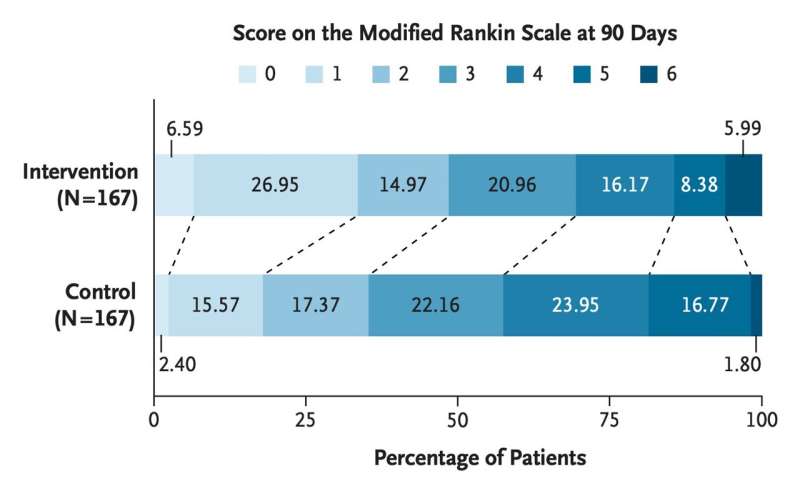
By the 90-day mark, patients who underwent mechanical thrombectomy were showing better recovery outcomes than those who received standard care alone. This was reflected in their modified Rankin Scale scores, which track the extent of disability after a stroke and how well patients regain their ability to function.
Among patients who underwent thrombectomy, 26.9% had no significant disability despite some remaining symptoms, compared with 15.6% in the control group. They also reported better quality of life and greater ability to manage everyday activities.
However, the gains came with some added risks. Symptomatic intracranial hemorrhage, or bleeding in the brain severe enough to cause symptoms, occurred in 4.8% of patients who underwent thrombectomy, while no such cases occurred in the control group. The 90-day death rate was also higher among patients who received the procedure, at 6.0% compared with 1.8%.
The findings suggest that patients arriving more than 24 hours after a stroke should not automatically be ruled out for thrombectomy. Instead, specialists could assess whether selected patients might still benefit from the procedure, while taking into account the amount of salvageable brain tissue post-stroke and potential risks of thrombectomy.
Written for you by our author Sanjukta Mondal, edited by Sadie Harley, and fact-checked and reviewed by Robert Egan—this article is the result of careful human work. We rely on readers like you to keep independent science journalism alive.
If this reporting matters to you, please consider a donation (especially monthly). You’ll get an ad-free account as a thank-you.
Publication details
Pengfei Yang et al., Mechanical Thrombectomy 24 to 72 Hours after Large-Vessel Ischemic Stroke, New England Journal of Medicine (2026). DOI: 10.1056/nejmoa2609362
Journal information:
New England Journal of Medicine
Clinical categories



© 2026 Science X Network
Citation:
Clot removal days after a stroke could help more patients recover, but the procedure is not without risks (2026, November 1)
retrieved 1 November 2026
from https://medicalxpress.com/news/2026-10-clot-days-patients-recover-procedure.html
This document is subject to copyright. Apart from any fair dealing for the purpose of private study or research, no
part may be reproduced without the written permission. The content is provided for information purposes only.