When people are collaborating on a common task, they often need to decide the extent to which they trust and rely on each other. While many past psychology and neuroscience studies have explored the neural underpinnings of human cooperation, much about what happens across the brains of people as they work toward a common goal remains unclear.
Researchers at Beijing Normal University and other institutions set out to further investigate what happens in the brains of pairs of cooperating individuals. The results of their study, published in Nature Neuroscience, suggest that cooperation is associated with similar patterns of activity in the amygdala, a brain structure known to support the processing of emotions and some socially relevant information.
“When we recall past events, neural activities resemble those observed during the original experience,” Jun Ni, first author of the paper, told Medical Xpress.
“Within a single brain, the neural patterns are reinstated across different stages during a successful memory recall. Inspired by this phenomenon, we asked whether neural patterns across two brains might also resemble or align with each other, particularly when people coordinate their actions and work toward a shared goal.”
Recording brain activity during a social decision game
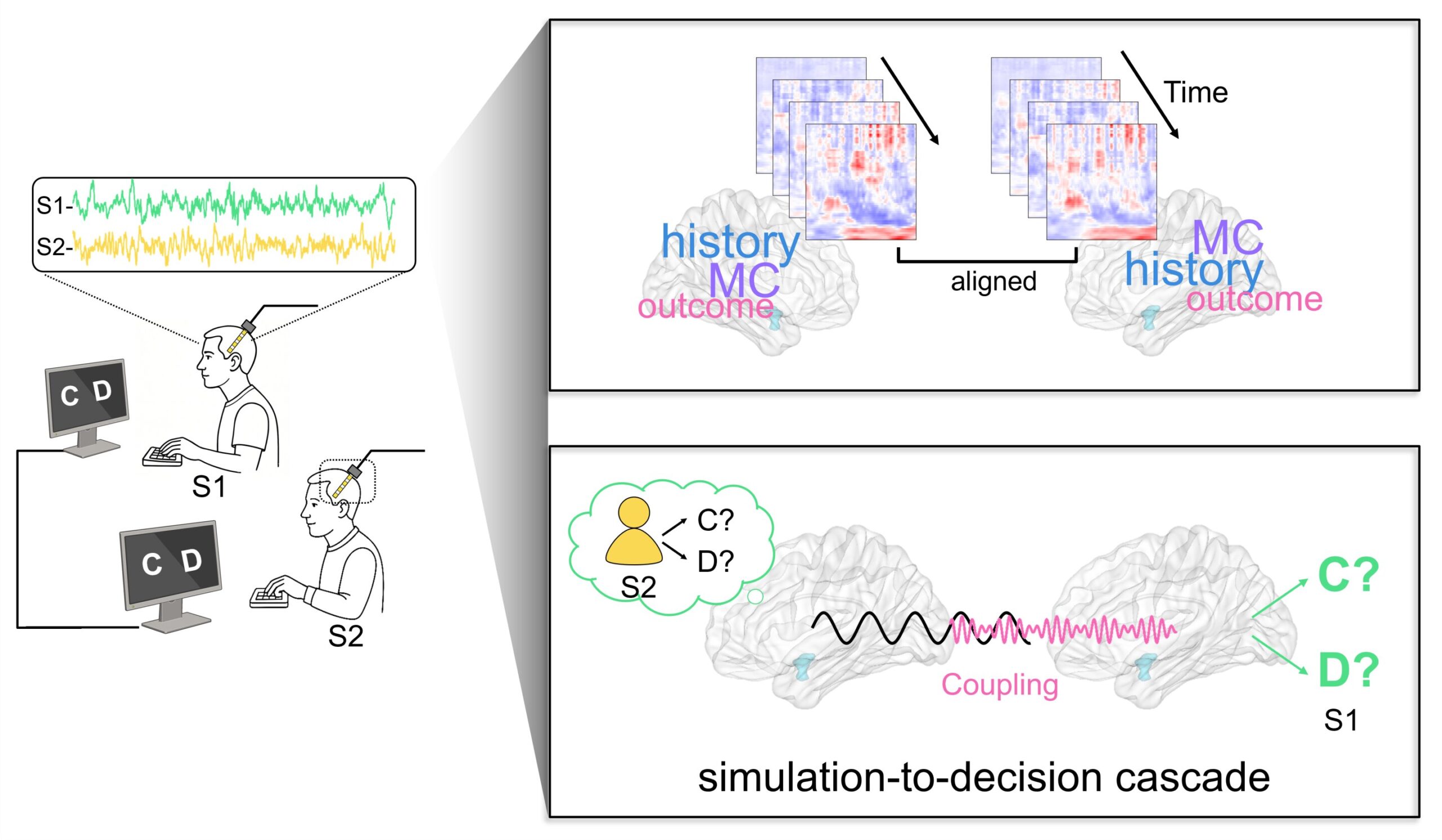
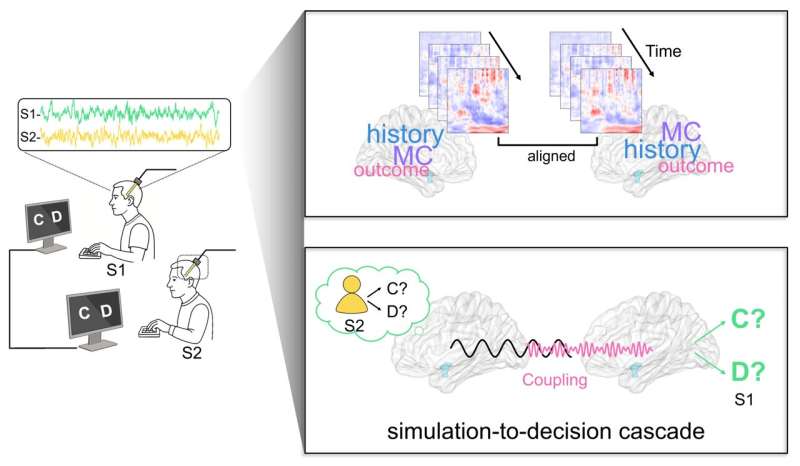
The main goal of this study was to explore the possibility that neural activity aligns in the brains of cooperating individuals. To do this, the researchers recruited 58 patients with medication-resistant epilepsy who had intracranial electrodes implanted in their brains as part of clinical practices aimed at identifying the source of their seizures.
“These electrodes allowed us to record electrical activity directly from specific brain regions with millisecond temporal resolution,” explained Ni.
The study participants were divided into pairs and played consecutive rounds of a social decision game called “Prisoner’s Dilemma.” This game requires players to independently decide whether to cooperate or act selfishly.
If both participants choose to cooperate, they both benefit. If one decides to act selfishly and the other cooperates, the selfish one receives an even greater reward. Finally, if both act selfishly, the two players receive a lesser reward than if they had both cooperated.
Ni and the other researchers in Dr. Yina Ma’s lab at Beijing Normal University analyzed neural activity recordings collected simultaneously from participants while they took part in this game. Specifically, they compared patterns of activity in the amygdala during different rounds when both partners cooperated, i.e., mutual cooperation (MC), and rounds when at least one acted selfishly.
Deepening the understanding of human cooperation
The researchers found that when both players in a pair decided to cooperate, they exhibited similar patterns of activity in the amygdala. While earlier studies had also observed similarities in brain activity during social interactions, how these similarities arise remains unclear.
“Previous work has merely treated it as a correlation between neural signals,” said Ni. “We advance our understanding of inter-brain similarity, from viewing it as signal-based similarity to content-based similarity: similar neural patterns emerge across brains when players represent shared cognitive contents at the same time, such as information about interaction history and simulations of their partner’s future behavior.
“This provides a possible explanation for how inter-brain similarity arises and offers a new perspective for studying how inter-brain dynamics support other forms of social interaction.”
The recent work by Ni and his colleagues offers new insight into how brain activity may align in the brains of cooperating individuals. Future research could try to determine whether similar brain activity patterns also emerge during cooperation in everyday scenarios.
“A key question for further research is when two independent brains align their neural activities,” added Ni. “Beyond shared external stimulus, we want to know whether any endogenous neural oscillations could predict or pinpoint the precise onset for inter-brain alignment.”
Written for you by our author Ingrid Fadelli, edited by Sadie Harley, and fact-checked and reviewed by Robert Egan—this article is the result of careful human work. We rely on readers like you to keep independent science journalism alive.
If this reporting matters to you, please consider a donation (especially monthly). You’ll get an ad-free account as a thank-you.
Publication details
Jun Ni et al., An amygdala-mediated simulation-to-decision cascade aligns interbrain dynamics to solve social dilemmas, Nature Neuroscience (2026). DOI: 10.1038/s41593-026-02473-z.
Journal information:
Nature Neuroscience
Key medical concepts
Clinical categories



© 2026 Science X Network
Citation:
Cooperating partners show similar brain activity patterns in region involved in processing emotions (2026, October 27)
retrieved 27 October 2026
from https://medicalxpress.com/news/2026-10-cooperating-partners-similar-brain-patterns.html
This document is subject to copyright. Apart from any fair dealing for the purpose of private study or research, no
part may be reproduced without the written permission. The content is provided for information purposes only.